31 Key Terms You Need to Know for AI SEO in 2026
Search has split into two parallel systems, and most marketing teams are still only fluent in one of them. Traditional SEO rankings, backlinks, click-through rate still matters, but a growing share of buyer research now happens entirely inside ChatGPT, Claude, Perplexity, and Google's AI Overviews, where the currency isn't a ranking position at all. It's a citation. Getting mentioned by name inside an AI-generated answer requires a genuinely different vocabulary than classic SEO ever did, and that vocabulary is exactly what this guide covers.
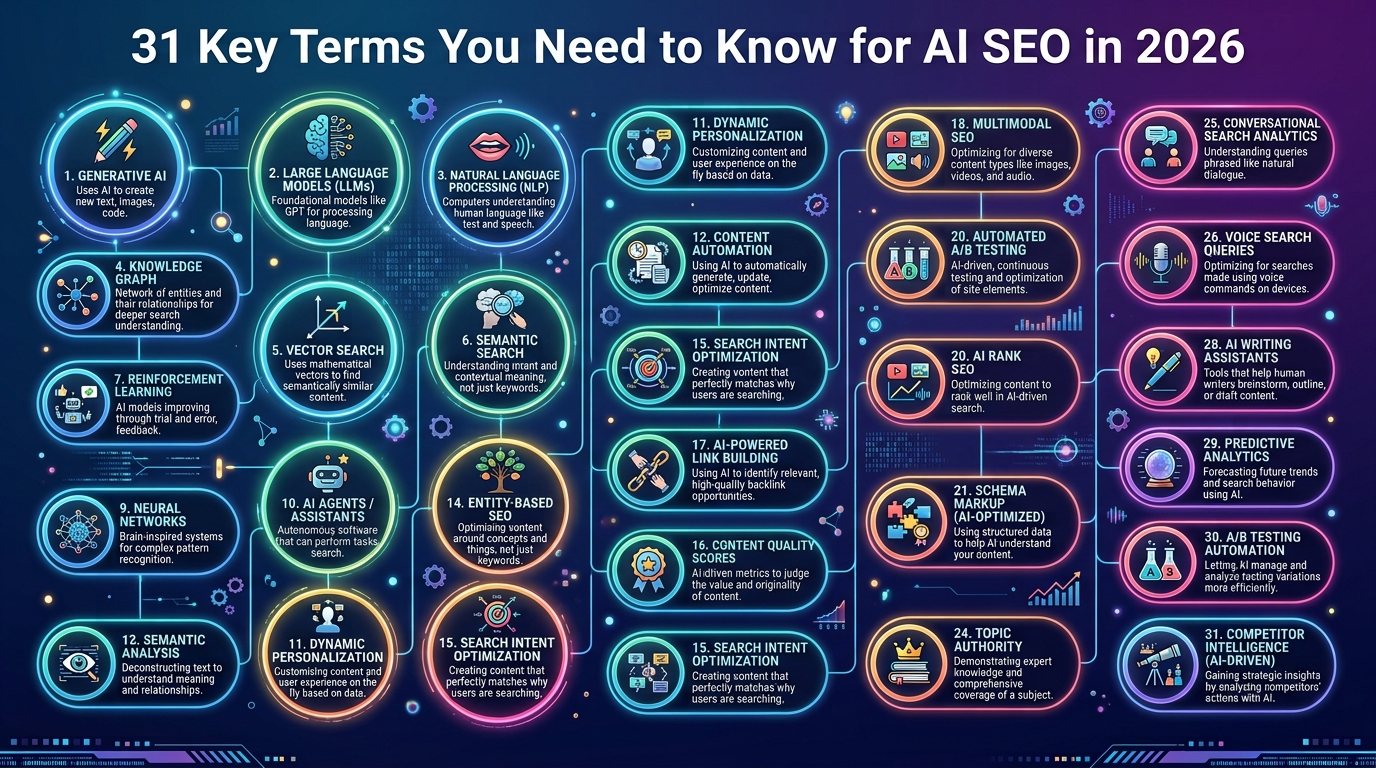
Below are 31 terms worth knowing cold if you're responsible for how your brand shows up in AI search in 2026 grouped by category so the glossary reads as a coherent map of the discipline, not just an alphabetical list.
Foundational AI Concepts
Large Language Model (LLM): A neural network trained on enormous volumes of text to generate human-like responses, predicting the most probable next word or token based on everything it's already produced. GPT, Claude, and Gemini are all LLMs at their core, even though the products built on top of them look and behave differently from each other.
LLM vs. Generative AI: These terms get used interchangeably in casual conversation, but they aren't the same thing. Generative AI is the broader umbrella any AI system that produces original output, whether that's text, images, audio, or video. An LLM is specifically the text-focused subset of that category. Every LLM is a form of generative AI; not every generative AI system is an LLM, which matters once you're evaluating tools that generate images or video rather than text.
Answer Engine: Any AI-driven product that returns a synthesized answer directly, rather than a ranked list of links to click through. ChatGPT, Claude, Perplexity, and Google's AI Mode all function as answer engines, which is the core reason optimizing for them requires a different mental model than optimizing for a traditional search results page.
Generative Engine: A broader term than answer engine, covering any AI system producing original content text, recommendations, or synthesized answers in response to a query. Generative Engine Optimization draws its name directly from this category.
Multimodal Models and Image Generation: Beyond pure text, a growing share of LLM-adjacent tools now generate images, video, or audio from the same underlying transformer architecture. When evaluating the best LLM for image generation specifically, the more accurate framing is usually best multimodal or diffusion-based model, since pure text-focused LLMs and dedicated image-generation systems are architecturally different tools that increasingly get bundled into the same product suite.
The New Search Disciplines
AI SEO: The umbrella discipline covering everything involved in getting a brand's content, structured data, and third-party citations reliably surfaced and recommended by AI search systems. AI SEO isn't a replacement for traditional SEO it sits alongside it, sharing some tactics while requiring genuinely new ones.
Answer Engine Optimization (AEO): The sub-discipline of AI SEO focused specifically on winning citations inside AI-generated answers. AEO structures content around clear, self-contained passages a direct question followed by a concise, quotable answer designed to be extracted cleanly even when pulled out of the surrounding page context. Most brands that implement AEO fundamentals see measurable citation lift within four to six weeks.
Generative Engine Optimization (GEO): Closely related to AEO but emphasizing a slightly different mechanism how generative engines synthesize information across multiple sources rather than pulling from a single citation. GEO leans heavily on the concept of information gain: providing genuinely unique data or perspective an AI system can't find anywhere else, which is what makes a source worth citing over dozens of others covering the same topic.
Search Everywhere Optimization: A newer reframing some practitioners have adopted in 2026 to describe visibility across the full landscape a buyer might search from Google, AI answer engines, and social search platforms all at once, rather than treating each as a separate discipline with separate tactics.
Search Experience Optimization (SXO): The combination of SEO and genuine user experience. A technically flawless answer served on a slow, cluttered page still underperforms, because both traditional search algorithms and AI systems increasingly weigh full-page engagement, not just the underlying text content.
Technical Infrastructure for AI Visibility
llms.txt: A proposed markdown file, served at yourdomain.com/llms.txt, that gives AI systems a curated summary of a site's most important pages essentially a map telling an AI crawler where to find the content that best represents your brand, written in a format optimized for fast machine parsing rather than human browsing. Think of it as an AI passport for your domain, sitting alongside your existing robots.txt file rather than replacing it.
How llms.txt Differs From robots.txt: Where robots.txt is a restrictive, decades-old convention telling crawlers what they're not allowed to fetch, an llms.txt file is a positive signal it tells an AI system what's actually worth fetching, pre-summarized so a model doesn't have to parse an entire messy HTML page just to understand what it's about. The standard is still emerging in 2026, but several major AI labs have signaled support, and the cost of implementing one is genuinely low relative to the potential upside.
Building an llms.txt File: You don't need custom development work to create one. A handful of dedicated tools now function as a llms.txt generator, taking your sitemap or a list of URLs and producing a properly formatted file automatically Firecrawl's llms.txt generator is one of the more widely used free options, scraping a site's structure and converting it directly into a compliant llm.txt file without manual formatting. For teams that want more control, a simple txt file maker or general-purpose text file generator works too, as long as the resulting llms txt file follows the standard's markdown structure a clear title, a short summary, and organized links to your most important pages. Whichever txt file creator you use, the goal is the same: generate llms.txt output that's genuinely useful for llm.txt for seo purposes, not just a technically valid file nobody would find helpful.
AI-Ready Data: A broader concept than the llms.txt file alone the general practice of structuring a site's or organization's information so AI systems can reliably access, parse, and cite it. What is AI-ready data, concretely? Content with clear entity definitions, consistent structured data, minimal reliance on JavaScript rendering to display core information, and a logical information hierarchy an LLM can traverse without ambiguity.
LLM-Ready Data Platform: A step beyond a single website's optimization a broader infrastructure layer, often used by larger organizations or data vendors, purpose-built to prepare and serve structured, current data specifically for consumption by AI systems and agents, rather than for human browsing. This category has grown quickly in 2026 as more businesses need to feed AI systems (both public search engines and internal AI tools) with genuinely reliable, current information rather than stale or poorly structured exports.
How LLMs Parse Web Pages: Contrary to a common assumption, most LLMs don't see a webpage the way a human browser renders it. They typically work from extracted text, often converted through an HTML-to-markdown process that strips out navigation clutter, ads, and decorative markup to isolate the actual content. Pages that rely heavily on JavaScript to render their core text, or that bury key information inside complex nested HTML without clear structural tags, are frequently parsed poorly or missed entirely one of the most common, and most fixable, technical reasons a genuinely good page fails to get cited.
HTML to LLM Conversion: The specific technical process referenced above transforming raw, cluttered HTML into clean, structured text or markdown that an LLM can process efficiently. Tools built for this exact purpose (including the same category of tool that powers many llms.txt generators) strip formatting noise and preserve the actual informational content, which is increasingly treated as foundational infrastructure work rather than an optional technical nicety.
AI-Ready CRM Data Model: Applying the same structure it for machine consumption principle to internal business data rather than public web content. As more companies connect AI agents directly to their CRM through protocols like MCP, having a clean, consistently structured, well-labeled data model rather than years of inconsistent manual entry determines whether an AI assistant querying that CRM returns genuinely useful answers or confidently wrong ones.
Schema Markup: Machine-readable labels embedded directly in a page's HTML (typically via JSON-LD) that tell both search engines and AI systems exactly what a given piece of content represents an FAQ entry, a product listing, a review, an author bio, a step in a how-to guide. Schema markup significantly improves an AI system's ability to extract accurate, citable information, and FAQ schema specifically remains one of the highest-impact single technical changes available for AEO.
AI Crawlers: The specific bots GPTBot, Google-Extended, ClaudeBot, and others that AI companies use to gather training and retrieval data from the open web. Monitoring server logs for this traffic has become a standard technical SEO practice in 2026, since it's the clearest direct evidence of whether AI systems are actually accessing your content at all.
Content and Authority Signals
E-E-A-T: Google's quality framework Experience, Expertise, Authoritativeness, Trustworthiness extended in 2022 to add first-hand Experience as a distinct pillar. All four signals now inform both traditional ranking algorithms and how AI systems evaluate whether a source is credible enough to cite, with genuine first-hand experience becoming especially valuable as LLMs get better at distinguishing direct knowledge from secondhand reporting.
Topical Authority: Building comprehensive coverage of every reasonable question connected to a core subject, rather than a handful of scattered posts loosely related to it. Genuine topical authority signals to an AI system that your domain is the primary, trustworthy source for a given niche, which measurably increases citation likelihood across every related query, not just the specific page that ranks.
Information Gain: The specific, unique value a piece of content adds that genuinely can't be found anywhere else original data, a first-hand case study, a contrarian finding backed by real evidence. This has become one of the central concepts in GEO specifically, since AI systems synthesizing an answer from multiple sources have a structural incentive to cite whichever source actually adds something the others don't.
Entity: A specific, well-defined thing a person, brand, product, or concept that search engines and AI systems can recognize and connect across multiple sources. Strong entity definition (consistent naming, structured data, and cross-referenced mentions) is what allows an AI system to confidently associate scattered information across the web with a single, coherent brand identity rather than treating each mention in isolation.
Citation: The moment an AI system directly references your content, brand, or data as the source behind part of its answer. Citation is the core currency of AEO and GEO the AI-search equivalent of a backlink, and increasingly a stronger correlate of AI visibility than traditional backlinks are on their own.
Grounding: The technical process by which an AI system anchors its generated response to specific, verifiable external sources rather than relying purely on patterns learned during training. Grounded answers are what make citations possible in the first place an AI system that isn't grounding its response to real sources has nothing concrete to cite.
Measurement and Tools
Share of Voice (AI): A metric tracking how often, and how prominently, your brand appears across AI-generated answers relative to competitors for a defined set of buyer-intent queries. A proper audit typically samples hundreds to thousands of realistic prompts, runs them across multiple AI systems in parallel, and aggregates the results into a comparable score.
LLM Rank Tracking: The AI-search equivalent of traditional keyword rank tracking monitoring where and how often your brand's content gets surfaced or cited across AI answer engines for a defined query set, tracked over time to measure whether your GEO and AEO efforts are actually moving the needle.
LLM SEO Trackers: The dedicated software category built specifically to run this kind of monitoring at scale platforms that query multiple AI systems automatically, log citation presence and prominence, and report brand mentions and sentiment across ChatGPT, Claude, Perplexity, and Gemini. This category has grown rapidly through 2026 as more marketing teams need concrete, repeatable measurement rather than anecdotal checks of what ChatGPT happens to say on a given day.
AI Visibility Audit: A structured, one-time or recurring assessment of exactly how a brand currently appears (or fails to appear) across AI search systems typically combining LLM rank tracking data with a manual review of specific high-value queries to understand not just whether you're cited, but how accurately and favorably.
LLM Prompt Generator: A tool that helps construct well-structured prompts for testing how a brand, product, or topic gets represented across different AI systems useful both for AI visibility auditing and for the more general task of getting more reliable, consistent output from an LLM for any content or research task.
Applying These Terms to Content Production
LLM for Product Content Generation: One of the most common practical applications of this entire glossary using an LLM to draft product descriptions, specification summaries, and comparison content at scale, ideally from structured product data rather than a blank prompt each time. Done well, this produces genuinely consistent, accurate copy across a large catalog; done poorly, it produces generic descriptions that fail every information-gain and E-E-A-T signal covered above. The difference almost always comes down to whether the underlying product data feeding the model is itself clean and AI-ready, tying this term directly back to the data-structuring concepts earlier in this glossary.
Where to Start If This Is All New
Thirty-one terms is a lot to absorb at once, so it's worth closing with a practical starting order rather than leaving every concept feeling equally urgent. Begin with the infrastructure layer, since it's the fastest to implement and creates no downside: add schema markup to your key pages, confirm your site renders its core content without requiring JavaScript to display, and generate an llms.txt file pointing to your most important pages with clear, honest summaries. None of this requires new content it's making existing content easier for AI systems to find and trust.
From there, move to measurement before you invest heavily in new content production. Run an AI visibility audit, even an informal one using a handful of realistic buyer-intent prompts across ChatGPT, Claude, and Perplexity, to understand your actual starting point. Only after that baseline exists does it make sense to prioritize new content investment and when you do, weight it toward genuine information gain (original data, first-hand experience, a perspective competitors haven't already published) rather than another well-structured but generic explainer covering ground a dozen other sites already cover just as thoroughly.
Final Thoughts
Most of these 31 terms describe the same underlying shift from a few different angles: AI systems reward content that's genuinely useful, clearly structured, and easy for a machine to parse and trust which, encouragingly, is close to the same standard good SEO has always aimed for. The vocabulary is new, and the technical infrastructure (llms.txt files, schema, AI-ready data models) is worth implementing properly. But the underlying discipline is the same one it's always been: build something genuinely worth citing, then make sure the systems doing the citing can actually find and understand it.
Frequently Asked Questions
Is llms.txt actually required, or is it optional in 2026?
It's still an emerging, voluntary standard rather than a hard requirement no major AI system currently mandates it. That said, several major AI labs have signaled support, implementation cost is low, and it provides a genuine, low-effort signal about which pages best represent your brand.
What's the difference between AEO and GEO in practice?
AEO focuses on winning a single, direct citation slot inside an AI-generated answer. GEO focuses more broadly on how generative engines synthesize multiple sources together, emphasizing unique information gain across your whole content library rather than one optimized page.
Do I need a dedicated LLM SEO tracker, or can I just check ChatGPT manually?
Manual spot-checks give you a snapshot, but they're not repeatable or comparable over time. A dedicated tracker running consistent queries across multiple AI systems gives you the kind of measurable, trackable data needed to actually evaluate whether your AEO and GEO efforts are working.
Does having clean, AI-ready data actually improve my AI search visibility?
Yes, meaningfully content an AI system can parse cleanly and confidently attribute to a well-defined entity is far more likely to get cited than the same information buried in cluttered, JavaScript-heavy HTML with no structured data behind it.
Is AI SEO replacing traditional SEO entirely?
No. Traditional ranking factors, technical SEO, and backlinks remain foundational and continue to inform how AI systems evaluate source credibility. AI SEO adds a new layer of discipline on top of that foundation rather than replacing it.
Read more: 9 Best Business Process Automation Solutions 2026 Ranked
Written by

Alex
Creative blogger sharing insights, stories, and fresh ideas.