BDSM Test: What It Is, How It Works, and What the Research Says

A BDSM test is a free online questionnaire that scores your kink interests and power dynamic preferences, such as dominant, submissive or switch. It takes about 15 to 30 minutes. It is a self reflection tool and not a clinical diagnosis. I found research that analyzed its data, but no peer reviewed validation of the public test itself.
I'll be straight with you. Most people take a BDSM test out of curiosity, then stare at their percentages wondering what they mean.
I've dug through the research so you don't have to. Below you'll find the steps, the science, a comparison table and an FAQ.
What Is a BDSM Test, Exactly?
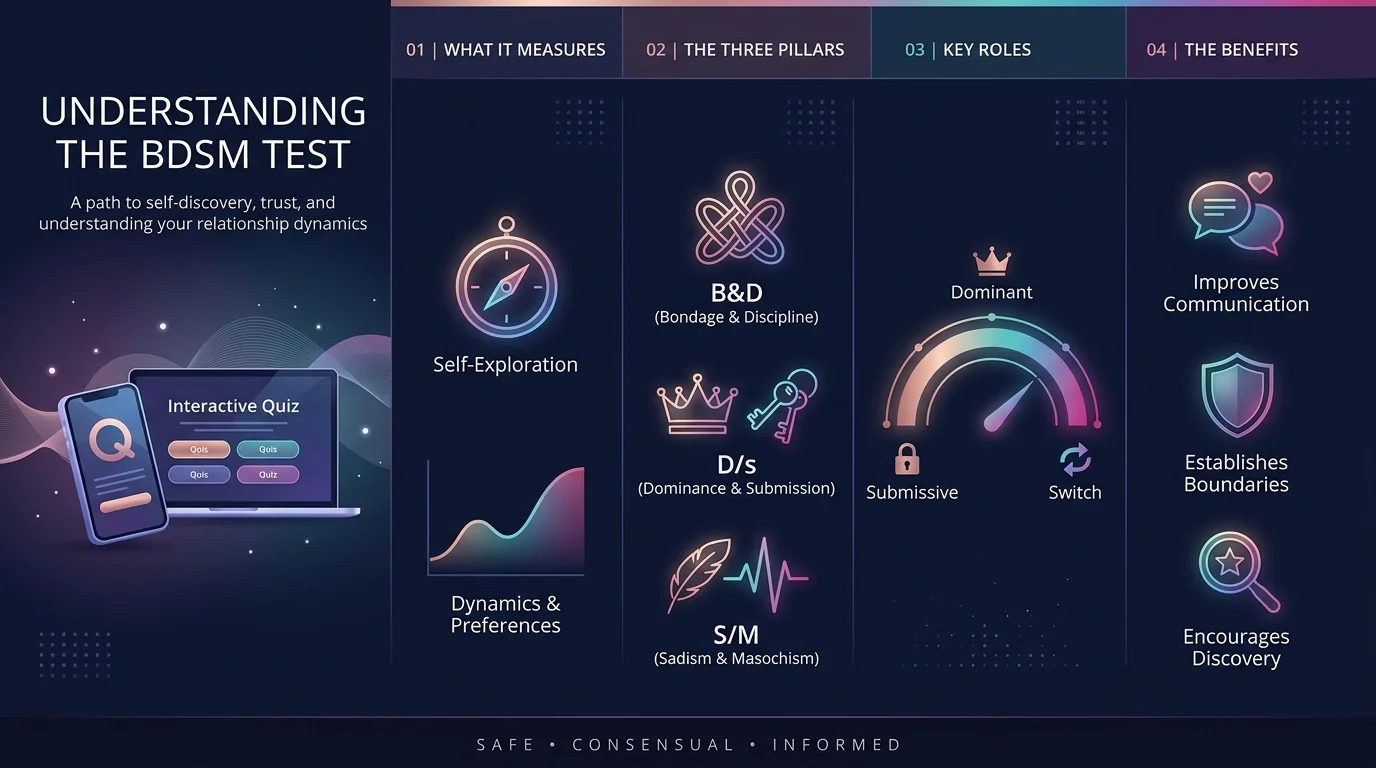
A BDSM test gives you vocabulary. It helps you describe your sexual preferences and power dynamics to yourself and to a partner. Think of it as a mirror, not a medical chart. Here's the background you need before you click anything.
The best known version, The BDSM Test, launched in 2014. It asks how much you agree with statements about your sexual appetite. Sexologists and sex educators sometimes use it with clients.
It scores you across 25 archetypes. You can score high in several at once.
Dominant, Submissive, or Switch?
Before you read your results, you need the BDSM roles straight. They get mixed up constantly, so here's a quick refresher.
A dominant takes psychological control. A submissive hands it over. A switch enjoys both sides.
Top and bottom are different again. Many people treat them as physical roles, while dominant and submissive describe psychological authority. A sadist enjoys giving sensation and a masochist enjoys receiving it. None of these automatically implies the others.
How to Take the BDSM Test: Step by Step
The test takes about 15 to 30 minutes. How you take it changes what you get, so here's my process. Follow it and your results will be more useful.
Pick a private moment. Choose a quiet time with no one reading over your shoulder.
Answer honestly. Don't pick what sounds cool or what a partner wants.
Start with the full version. The Daily Dot recommends it for the most accurate picture.
Skim the definitions page. Terms like "brat tamer" aren't obvious.
Save your results. You'll want them later for comparison.
Protect your privacy. If you used a shared device, clear your browser cookies when you finish.
My tip: don't overthink any single question. Your gut answer is usually the real one.
How to Read Your BDSM Test Results
Your results page shows percentages, not labels. That trips people up. A surprising 90% can feel weird, so relax. Here's how to make sense of it without judging yourself.
Look at your top three scores first. Then look at the pattern. A high dominant score plus a high sadist score tells a different story than dominant plus vanilla.
Remember that tastes shift. The Daily Dot author found her answers changed significantly between two tests a year apart. Treat your results as a snapshot and not a verdict.
BDSM Test vs. Other Kink Assessments
Not every tool does the same job. Some are fun and popular, and others are built for research. Here's a side by side so you can pick the right one. This matters if you plan to cite results in your own writing.
Tool | Best for | Format | Evidence status |
|---|---|---|---|
The BDSM Test | Self discovery, conversation starter | 25 archetypes, percentage scores | 236,353 results analyzed; I found no formal validation |
Kink Orientation Scale | Research on kink identity and practice | 18 items, 5 factors | Validated with 200 students and 1,025 kink participants (2024) |
IFAKBDSM | Kink fantasies and activities in Portuguese adults | 4 factors | Factor analyses with 260 and 515 adults (2025) |
KinkMe quiz | Quick D/s role check | 15 questions | Informal, entertainment level |
Yes/No/Maybe list | Negotiating with a partner | Checklist, not a test | Recommended by therapists |
Does the Science Back the BDSM Test Up?
Kind of, but not the way the hype suggests. This section gets nerdy, but it'll keep you from believing shaky claims. I've read the papers, and the picture is more interesting than the marketing.
What 236,353 Test Results Revealed
One cluster analysis examined 236,353 anonymous results from The BDSM Test. The authors concluded that no single line from dominant to submissive captures how people vary. They proposed a two dimensional typology.
You're not "either or," and that's useful to know.
The catch is that the authors state they have no affiliation with the test's site. Analyzing its data isn't the same as validating the test as a clinical instrument.
What Research Says About People Into Kink
The stigma doesn't hold up. Here are the key numbers:
A 2013 study compared 902 practitioners with 434 controls. Practitioners were less neurotic and reported higher well being.
A Spanish replication with 1,884 adults supported those findings.
In another study of 279 practitioners, about 25% were dominant, 38% submissive and 37% switch.
A systematic review cited a Belgian sample of 1,027. In it, 46.8% had tried BDSM themed activities, but only 7.6% self identified as practitioners.
In a Finnish sample of 8,137, adults aged 18 to 28 showed almost three times the interest of older adults.
Using Your BDSM Test Results Safely
A score means nothing without consent, communication and boundaries. Read this section twice before acting on anything. I mean it.
Talk First, Play Later
Your result starts a conversation and doesn't grant permission. Try this:
Share your top scores with your partner.
Compare them without judgment.
Build a yes/no/maybe list to find hard and soft limits.
Agree on a safe word.
Check in during and after.
If the first talk feels awkward, warm up with a game of this or that questions. Light, low pressure questions make the heavier ones easier to ask.
Know Your Consent Frameworks
SSC means Safe, Sane, Consensual. RACK means Risk Aware Consensual Kink. RACK exists because no sexual activity is ever 100% safe. For more terms, grab the NCSF glossary.
Frequently Asked Questions
These are the questions I get most often. Each answer stands on its own, so you can skip straight to the one you need.
What is a BDSM test?
A BDSM test is an online questionnaire that estimates your interest in kink roles such as dominant, submissive, switch, sadist and masochist. It usually takes 15 to 30 minutes and returns percentage scores. It's meant for self reflection and conversation, not for diagnosis.
How accurate is a BDSM test?
It's accurate enough to start a conversation, but it isn't a clinical tool. I found research analyzing its data, but no peer reviewed validation of the public test itself. Your answers also change over time, so treat the result as a snapshot of where you are now.
How long does the BDSM test take?
Plan on 15 to 30 minutes for the full version. Shorter quizzes exist, such as a 15 question option, but they give you less detail. If you want a result you can really use, set aside the extra time.
Can my BDSM test results change?
Yes, and they often do. Experience, trust, stress and your relationship context can all shift your answers. One writer's results changed significantly across two tests a year apart. Retake the test every so often.
Is being into BDSM a sign of mental health problems?
No. The research points the other way. A large 2013 comparison found favorable psychological profiles among practitioners, and a Spanish replication agreed. Both are cross sectional, so they can't prove cause and effect.
Take the Test and Start the Conversation
So, should you take a BDSM test? Yes. It's free, quick and surprisingly eye opening. You'll finish with better words for what you want and an easier way to talk about it.
Here's my challenge. Set aside half an hour tonight. Take the full test, save your results, then pick one score and talk it through with someone you trust.
Don't wait for the "right time." Your self discovery starts with one honest answer. Take it now, and come back here whenever you need help reading your results.
Written by
Alex
Creative blogger sharing insights, stories, and fresh ideas.