Generative Engine Optimization Services: What You Get, What It Costs, and How to Choose (2026)

Quick answer: Generative engine optimization (GEO) services help your brand get named and cited inside AI answers from ChatGPT, Perplexity, Gemini, Copilot and Google AI Overviews. A real GEO service tracks the prompts your buyers ask, makes your site easy for AI crawlers to read, rewrites key pages so they are easy to quote, and builds mentions of your brand on trusted third-party sites. Most small and mid-sized businesses pay $2,000 to $8,000 a month, and the first movement usually shows up within 60 to 90 days.
A SaaS founder asked us a question on a call that we now hear all the time.
"When I ask ChatGPT for the best tool in my category, it names three competitors. It never names us. So what exactly am I paying a GEO agency to fix?"
Fair question.
Search for generative engine optimization services and you get page after page of agencies promising to make you "the brand AI recommends." Very few tell you what the work actually is, what it costs, or how you will know it is working.
So we did it properly. We audited the agency pages that rank at the top for this keyword, compared published 2026 pricing, and went back to the research paper that started GEO in the first place.
Here is everything we found. What GEO services include, what they cost, how long they take, the red flags to avoid, and a simple test you can run yourself before you pay anyone a cent.
What Are Generative Engine Optimization Services?
Let us keep this plain.
Generative engine optimization services are the work of making your brand easy for AI tools to find, trust and quote. The goal is not a blue link on page one. The goal is to be named inside the answer itself.
That is it.
Think of it like asking a well-read friend for a recommendation. They do not hand you a list of ten shops and wish you luck. They say "go to this one, and here is why." GEO is the work of becoming the shop that friend remembers.
The term is not a marketing invention. It comes from a research paper by a team from Princeton and IIT Delhi that was presented at KDD 2024, one of the top data science conferences. You can read the original GEO research paper yourself. The researchers tested content changes across 10,000 search queries and found that the right changes could boost a source's visibility in AI answers by up to 40%.
That is the number every agency quotes. Almost none of them link to where it came from.
GEO vs SEO vs AEO: What Is the Difference?
These three terms get mixed up all the time, so here is the short version.
SEO | AEO | GEO | |
|---|---|---|---|
Main goal | Rank pages in search results | Be the direct answer to a question | Be named and cited inside AI answers |
Where you show up | Google and Bing blue links | Featured snippets, voice search, AI Overviews | ChatGPT, Perplexity, Gemini, Copilot, Google AI Mode |
What gets measured | Rankings, clicks, organic traffic | Snippet wins, answer coverage | Brand mentions, citations, share of voice |
Content style | Keyword-focused pages | Short question and answer blocks | Fact-rich, quotable passages with sources |
Off-site work | Backlinks | Reviews and listings | Brand mentions, digital PR, links on trusted sites |
The important part: GEO does not replace SEO. It sits on top of it.
AI engines that search the web in real time still pull from pages they can crawl and trust. If your SEO base is weak, your GEO results will be weak too. Any agency that tells you to stop SEO and "switch to GEO" is selling you a story.
How AI Engines Decide Which Brands to Cite
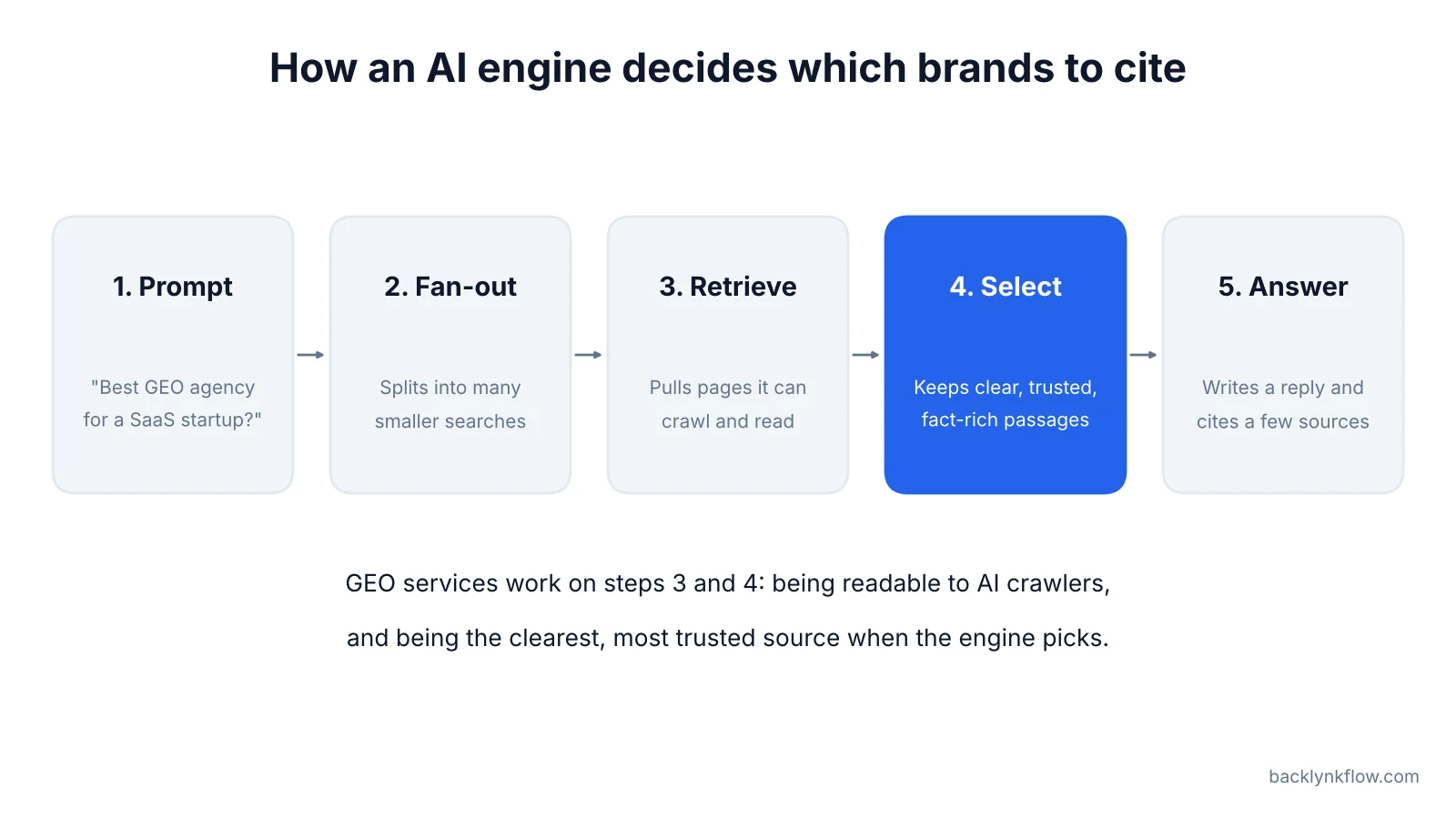
When someone types a question into ChatGPT search, Perplexity or Google AI Mode, a few things happen in a few seconds.
The prompt comes in. For example, "best GEO agency for a SaaS startup."
The engine fans out. It splits that one prompt into many smaller searches. This is called query fan-out.
It retrieves pages. It pulls pages its crawlers can reach and read, such as OAI-SearchBot for ChatGPT and PerplexityBot for Perplexity.
It selects passages. It keeps the clearest, most trusted, most fact-rich passages.
It writes the answer. It names a few brands and cites a few sources.
GEO services work on steps 3 and 4. Can the engine read your pages? And when it compares you against everyone else, are you the clearest and most trusted source? Step 2 also shapes which pages get pulled in, and we explain it in our guide to query fan-out.
The original research gives us useful clues about step 4:
Adding statistics, quotations and cited sources gave the biggest visibility gains of all the methods tested.
Keyword stuffing did not help. The old SEO trick of repeating a phrase over and over was one of the weakest methods.
Smaller sites gained the most. Pages that ranked lower in normal search saw much bigger lifts than pages already at the top.
It worked on a live engine too. On Perplexity, the same methods improved visibility by up to 37%.
That last point about smaller sites matters. You do not need to be the biggest brand to get cited. You need to be the clearest source.
What a Real GEO Service Includes
Most agency pages list a dozen buzzwords. Strip those away and a real generative engine optimization service comes down to seven pieces of work.
1. A prompt set and a baseline. The agency builds a fixed list of real prompts your buyers ask, runs them across the main AI engines, and records who gets named today. Without this baseline, nobody can prove anything changed later.
2. AI crawler access and technical fixes. This means checking that your robots.txt does not block the AI search crawlers, that your key content loads without heavy JavaScript, that pages are fast, and that schema markup is in place. An llms.txt file can be added too, but treat it as an optional extra, not a magic switch. We cover this in our guide on whether you need an llms.txt file.
3. Entity clarity. AI engines need to understand exactly who you are. That means one consistent company name and description across your site, your About page, Organization schema, and profiles on sites like LinkedIn, Crunchbase and G2.
4. Content built for extraction. Key pages get rewritten so the answer comes first, headings match real questions, paragraphs are short, and claims are backed by numbers and sources. Comparison tables and clear definitions get quoted far more often than long walls of text. Our breakdown of how LLMs parse web pages shows why.
5. Original data. Surveys, benchmarks and audits give AI engines (and journalists) something new to cite. This is one of the few assets competitors cannot copy.
6. Off-site authority. AI answers lean heavily on third-party sources: review sites, industry roundups, news coverage, Reddit threads and YouTube videos. A real GEO service works on getting your brand mentioned in the places the engines already trust.
7. Honest reporting. You should see share of voice across your prompt set, citation counts, whether AI describes you correctly, and AI referral traffic in Google Analytics 4. Not just a folder of screenshots.
If a proposal is missing two or more of these, you are probably buying an SEO retainer with a new label.
We Audited the Top-Ranking GEO Agency Pages. Here Is What We Found
We wanted to know how well the agencies selling GEO actually explain it.
So on November 11, 2026, we searched "generative engine optimization services" and reviewed the nine agency service pages that came up at the top. We checked each page against the questions a real buyer would ask before signing anything.
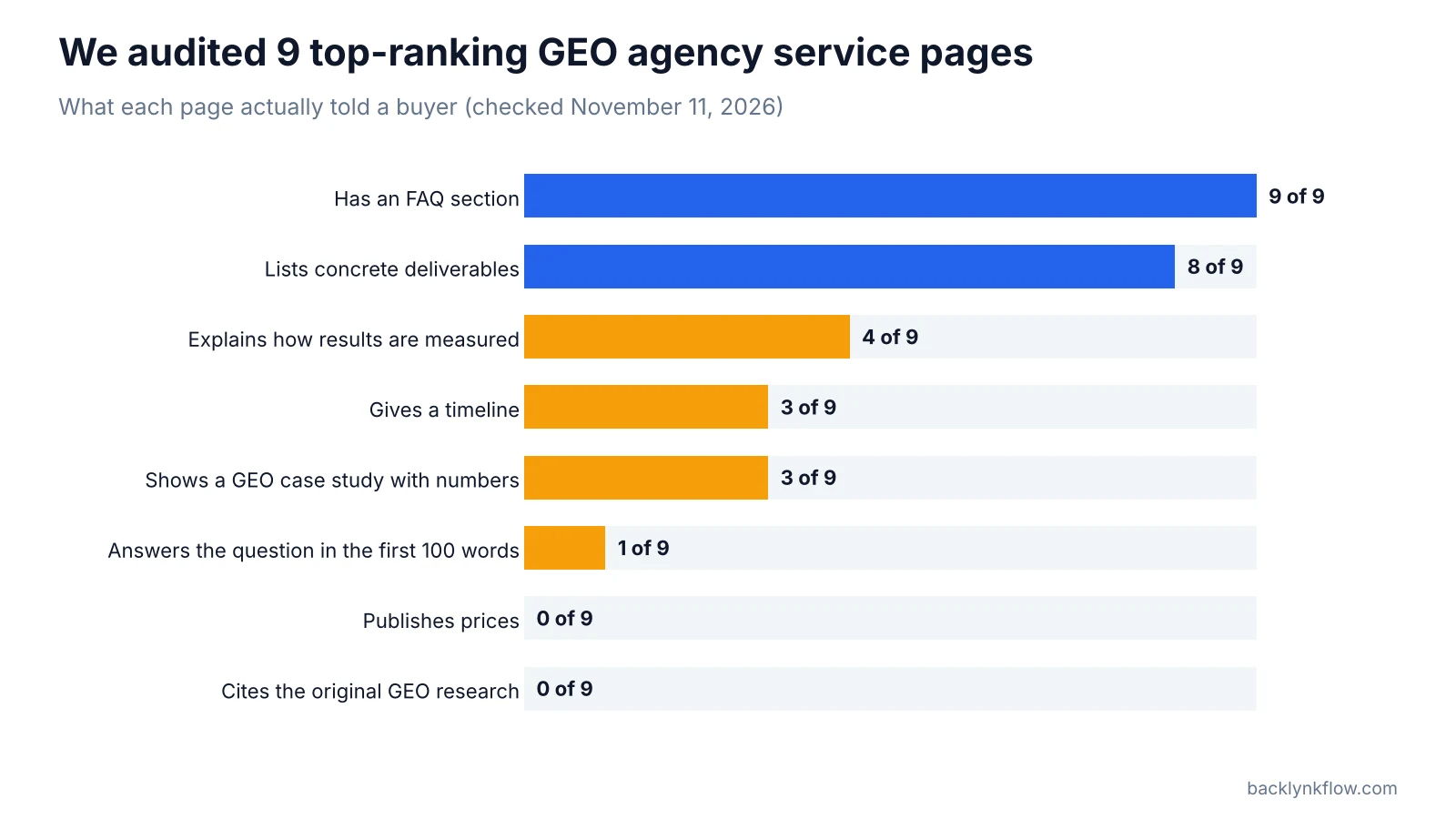
What we checked | Pages that did it |
|---|---|
Has an FAQ section | 9 of 9 |
Lists concrete deliverables | 8 of 9 |
Explains how results are measured | 4 of 9 |
Gives a timeline for results | 3 of 9 |
Shows a GEO case study with real numbers | 3 of 9 |
Answers "what is GEO" in the first 100 words | 1 of 9 |
Publishes prices | 0 of 9 |
Cites the original GEO research | 0 of 9 |
A few things stood out.
Not one page published a price. Every single one sent us to a contact form or a "custom quote."
Only one page answered the question up front. This one made us smile. Putting the answer first is one of the first things a GEO agency should fix on your site. Eight of the nine had not done it on their own page.
Not one cited the research GEO comes from. Several quoted big percentage gains. None linked to where the idea started.
Most case studies were SEO results. Only three pages showed GEO-specific numbers. The rest showed organic traffic wins, which is a different thing.
The good news: most were honest about guarantees. Five of the nine said plainly that no agency can guarantee an AI citation. Two used wording that came close to a promise, such as saying their service "ensures" you appear in AI answers. Be careful with that.
What this means for you is simple. The sales page will not tell you enough. You have to ask. That is why we put a full list of questions further down.
How Much Do Generative Engine Optimization Services Cost in 2026?
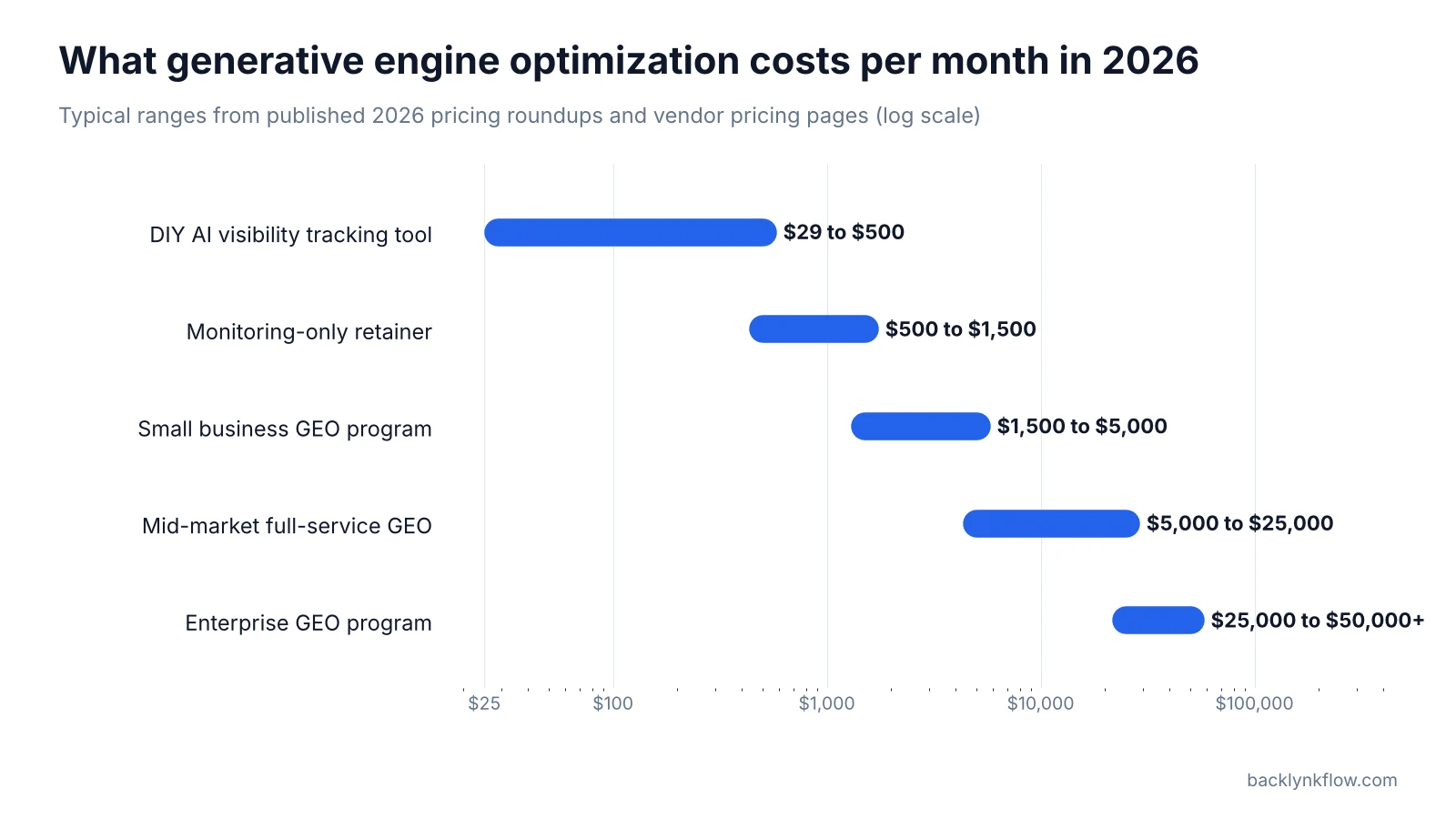
Since none of the agencies we audited publish prices, we pulled together published 2026 pricing roundups and vendor pricing pages. Here is what the market looks like.
Option | Typical monthly cost | What you usually get |
|---|---|---|
DIY AI visibility tool | $29 to $500 | Prompt tracking only. You do all the work yourself. |
Monitoring-only retainer | $500 to $1,500 | Tracking, monthly reports and advice. Little or no execution. |
Small business GEO program | $1,500 to $5,000 | Audit, technical fixes, a few content updates each month. |
Mid-market full-service GEO | $5,000 to $25,000 | Content production, digital PR, multi-engine tracking. |
Enterprise GEO program | $25,000 to $50,000+ | Multiple markets, heavy PR, custom data and reporting. |
For most small and mid-sized businesses, a realistic budget for real work is $2,000 to $8,000 a month.
Our honest take: under about $1,500 a month you are buying monitoring and advice, not execution. That can be perfectly fine if you have a strong writer in-house. Just know what you are paying for.
Also watch the tool pricing. Tracking tools usually charge by the number of prompts. One popular tool starts at $29 a month for 15 prompts, which is enough to test the water but not enough to measure a whole category.
How Long Does GEO Take to Work?
GEO is faster than traditional SEO in some places and slower in others. Here is a realistic timeline.
Timeframe | What should happen |
|---|---|
Weeks 1 to 2 | Prompt set built, baseline measured, technical audit done |
Weeks 2 to 6 | Crawler access fixed, key pages rewritten, schema added |
Days 30 to 90 | First citation movement in engines that search the web live, such as Perplexity, ChatGPT search and AI Overviews |
Months 3 to 6 | Gains from off-site mentions, digital PR and original data |
The reason for the split is simple. Engines that search the web in real time can pick up a better page within weeks. Brand reputation built through third-party mentions takes longer to earn and longer for the engines to notice.
If an agency promises results in two weeks, ask them exactly which part of this timeline they are skipping.
Run This 20-Prompt Test Before You Hire Anyone
This is the part most guides skip. Before you pay a GEO agency, spend one afternoon measuring where you stand. It costs nothing and it makes every sales call more honest.
Step 1: Write 20 prompts. Split them like this:
5 category prompts, such as "best [your category] for [your customer]"
5 comparison prompts, such as "[your brand] vs [competitor]"
5 problem prompts, such as "how do I fix [problem your product solves]"
5 brand prompts, such as "is [your brand] worth it" or "[your brand] pricing"
Step 2: Run them in four engines. Use ChatGPT with search on, Perplexity, Gemini and Google AI Mode. Use a private browser window so your history does not skew the answers. AI answers change from run to run, so run each prompt twice.
Step 3: Fill in a simple scorecard.
Prompt | Engine | Were we named? | Were we cited with a link? | Competitors named | Sources cited | Anything wrong about us? |
|---|---|---|---|---|---|---|
best [category] for [customer] | ChatGPT | No | No | Brand A, Brand B | G2, a Reddit thread | n/a |
Step 4: Work out your share of voice. Divide the number of answers that named you by the total number of answers. If you were named in 12 out of 160 answers, your share of voice is 7.5%.
Step 5: Study the sources column. This is the gold. The sites the engines cite for your category are exactly where you need to be mentioned. That list becomes your off-site plan.
Now take that scorecard into every sales call. Ask each agency how they would move those numbers and by how much. The good ones will get specific fast. The weak ones will change the subject.
7 Red Flags When Hiring a GEO Agency
They guarantee placement in ChatGPT. Nobody controls what an AI model says. Most of the agencies we audited admit this themselves.
Reporting is just screenshots. Screenshots are easy to cherry-pick. Ask for a fixed prompt set measured the same way every month.
A secret "AI visibility score." If you cannot see how the score is calculated, you cannot trust it.
No talk of off-site sources. If the plan only touches your own website, it is missing the part AI engines lean on most.
Vague scope. "Ongoing GEO optimization" is not a deliverable. Every month should have named outputs.
A 12-month lock-in before any baseline. A fair agency proves value in the first 90 days.
Mass AI-written content as the main tactic. Publishing hundreds of thin pages can break Google's spam policies and hurt the SEO base your GEO depends on.
Questions to Ask Before You Sign
Copy these into your next sales call.
Which prompts will you track, and can I see and edit the list?
Which AI engines will you measure, and how often?
What exactly will you deliver each month?
How will you measure share of voice and citations?
Can you show me a GEO case study, not an SEO one, with before and after numbers?
What off-site work is included, and where will those mentions come from?
What will you change on my site in the first 30 days?
What happens if nothing moves after 90 days?
Agency, Consultant or In-House: Who Each One Wins For
There is no single best option. It depends on your budget, your team and how crowded your category is.
Option | Typical cost | Best for | Watch out for |
|---|---|---|---|
DIY with a tracking tool | $29 to $500 a month | Early-stage brands with a strong in-house writer | It takes real time, and you have no PR reach |
Independent consultant | A few thousand a month | Teams that can execute but need a strategy | Limited capacity for content and outreach |
Specialist GEO agency | $2,000 to $25,000 a month | Competitive categories that need hands-on execution | Ask for GEO proof, not just SEO wins |
Full-service SEO and GEO agency | $5,000 a month and up | Brands that want one partner for search and AI | GEO can be a thin add-on to an SEO retainer |
Where LLMProGen Fits in GEO
Here is something most agency pages skip.
Before an AI engine can quote you, it has to read you. And many websites are much harder for AI to read than their owners think. Menus, pop-ups, cookie banners and heavy scripts all sit between the engine and your actual content.
That is the problem we built LLMProGen to solve. LLMProGen turns any website into clean, structured text, the plain kind of content AI tools work with. Run your key pages through it and you see exactly what is left once the noise is gone. If your main answer is buried or missing, an AI engine will struggle to find it too.
It does not replace the off-site work. Mentions on trusted third-party sites still carry a lot of weight. But it gives you a fast, honest check on step 3 of the process: can AI actually read your pages?
Our Verdict
The best generative engine optimization service is not the one with the boldest promise. It is the one that measures honestly, tells you exactly what it will deliver, and builds trust for your brand both on your site and off it.
Start with the 20-prompt test. Know your share of voice before anyone sells you anything. Then hire the partner who can explain, in plain words, how they will move that number.
That is a real answer.
Frequently Asked Questions
What do generative engine optimization services include?
A real GEO service includes a tracked prompt set and baseline, technical fixes for AI crawler access, entity and schema work, content rewritten so AI can quote it easily, original data, off-site brand mentions, and monthly reporting on share of voice and citations.
How much do GEO services cost?
Most small and mid-sized businesses pay $2,000 to $8,000 a month for real GEO work. Monitoring-only retainers start around $500 a month, DIY tracking tools start around $29 a month, and enterprise programs can pass $50,000 a month.
How long does GEO take to show results?
Technical and content fixes can start moving citations within 30 to 90 days in engines that search the web live, such as Perplexity and ChatGPT search. Gains from off-site mentions and digital PR usually take three to six months.
Does GEO replace SEO?
No. GEO builds on top of SEO. AI engines that search the web still rely on pages they can crawl and trust, so a strong SEO base makes GEO work better.
Can a GEO agency guarantee my brand will appear in ChatGPT?
No. No agency controls what an AI model says. A good agency will promise clear work and honest measurement, not a guaranteed placement.
Do I need an llms.txt file for GEO?
It does no harm, but it is not a must. Clear content, open crawler access, good schema and strong third-party mentions matter far more than an llms.txt file.
How do I measure GEO results?
Track a fixed set of buyer prompts across ChatGPT, Perplexity, Gemini and Google AI Mode every month. Measure how often you are named (share of voice), how often you are cited with a link, whether the facts about you are correct, and how much AI referral traffic shows up in Google Analytics 4.
Written by