How to Clean a Whiteboard: 4 Methods That Actually Work


To clean a whiteboard, erase it dry first, mist it lightly with water or a dedicated whiteboard cleaner, wipe it with a microfiber cloth, then buff dry with a second cloth. For ghosting, colour over the marks with a fresh dry erase marker and wipe, or use 70% isopropyl alcohol on a microfiber cloth. Never use abrasives, bleach, or paper towels on any board surface.
Key Takeaways
Surface type decides everything — melamine, porcelain and tempered glass tolerate completely different cleaners
Isopropyl alcohol (70% or higher) fixes most ghosting; apply it to the cloth, not the board
A dirty eraser causes more ghosting than the marker does — clean it weekly
Erase within 24–48 hours; ink that sits is ink that stains
Microfiber only — paper towels micro-scratch soft surfaces and shed lint that clogs marker tips
Let me guess. You walked into the room, uncapped a marker, and found last month's meeting still faintly staring back at you.
How to clean a whiteboard properly isn't complicated, but a lot of what circulates online is half right — and the half that's wrong will quietly destroy your board. So here's the thing: this guide covers the chemistry, the surface types, the exact steps, and the "hacks" you should run away from. No fluff. Just what actually works on a dry erase board.
Why Your Whiteboard Stops Erasing (The Chemistry Nobody Explains)
Chemistry sounds like the boring part. But this single concept explains every tip below — whiteboard ghosting, the famous Sharpie trick, and why paper towels are secretly ruining your board. Get this, and you'll never guess at a cleaning method again.
Dry erase marker ink has three working parts:
Pigment — the colour you see
Solvent — usually alcohol, which evaporates in roughly 2–3 seconds
Release agent — an oily silicone polymer, and this is the hero
Here's the magic. Permanent markers use an acrylic polymer — a glue, basically — that bonds pigment to whatever it touches. Dry erase markers swap in a slippery silicone polymer that sits between the pigment and your board like a microscopic non-stick pan.
So when you erase, you're not scrubbing ink off.
You're sliding a film off.
The ink never bonded in the first place.
USPTO Patent 6,040,359 puts hard numbers on it: these release agents — siloxanes, mostly polydimethylsiloxanes — make up about 5% to 15% of the ink by weight. Below roughly 1% it won't erase. Push it too high and the ink gets too viscous to flow through the nib.
Now here's why your board fails. That clean release only works on a non-porous surface. The moment the surface develops pores, micro-scratches, or a layer of dry erase ink residue, pigment starts getting trapped.
Trapped pigment is what you call ghosting.
First, Identify Your Whiteboard Surface Type
This is the step everyone skips, and it's why so many boards get wrecked by well-meaning owners. Acetone on the wrong board is permanent. A magic eraser on the wrong board is permanent. Take ten seconds to identify what you own.
Melamine Whiteboards (The Fragile One)
The budget board from the office supply aisle. It's a melamine resin coating over fiberboard — more porous and more abrasion-prone than anything else here.
It ghosts easily. It hates harsh chemicals. And in a busy classroom, melamine typically lasts two to three years before replacement.
Gentle and frequent is your entire strategy.
Porcelain Enamel-on-Steel Boards (The Workhorse)
Baked-on ceramic over steel backing. Usually magnetic. Usually what your school or office bought. Ink can't soak in, so it resists staining far better and tolerates a much wider range of cleaners.
Tempered Glass Boards (The Easy One)
The premium option and the lowest-maintenance by a mile. Glass is completely non-porous, so ghosting is barely a thing — many glass boards ship with 20-year warranties. What you do get is surface residue: smudged pigment dust, skin oils, coffee splatter. All of which wipe straight off.
Not sure which to buy next time? Our glass vs melamine whiteboard comparison breaks down the cost-per-year maths.
Surface Comparison Table
Surface | Typical lifespan | Ghosting risk | Isopropyl alcohol | Glass cleaner | Acetone | Abrasives |
|---|---|---|---|---|---|---|
Melamine | 2–3 years (heavy use) | High | Sparingly, 70% | Avoid | Never | Never |
Porcelain enamel | 10+ years | Low | Yes, up to 99% | Occasionally | Test first | Non-abrasive only |
Tempered glass | Often 20-yr warranty | Very low | Yes | Yes | Test first | Damp, gentle |
The Daily Whiteboard Cleaning Routine (2 Minutes)
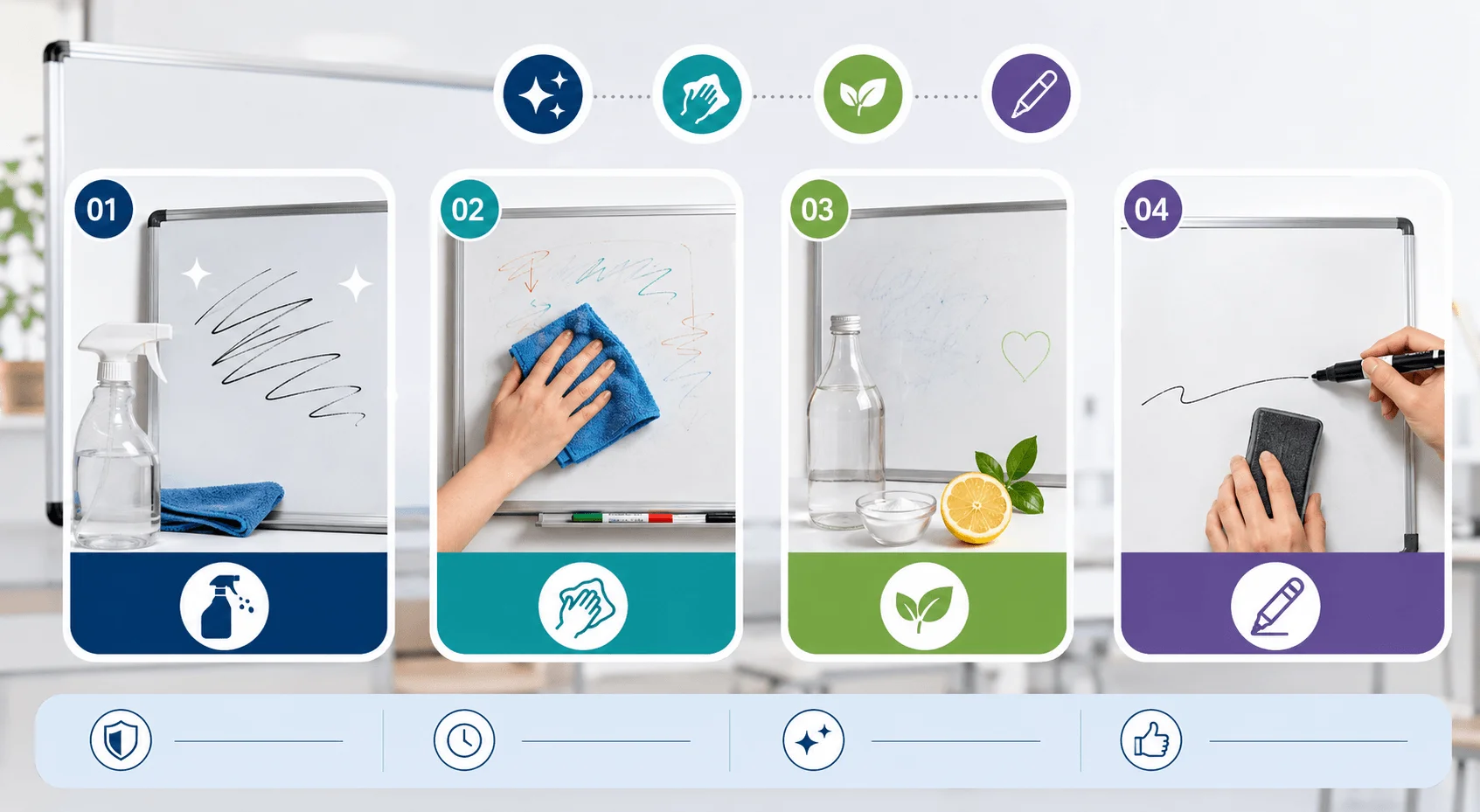
This routine prevents about nine out of ten of the problems people run into. Do it at the end of the day, not the start — that timing detail matters more than you'd think.
What you'll need: two microfiber cloths, a spray bottle of water or whiteboard cleaning spray, and a felt eraser. Time: 2 minutes.
Step 1 — Erase everything, dry, first. EXPO is emphatic about this: get as much ink off as possible before any liquid touches the board. Wet cleaner plus loose ink dust equals smeared paste.
One caveat — if there's anything on the board you'll need later, capture it before you wipe. A phone photo works, but if you want something searchable and shareable, here's how to scan a document properly.
Step 2 — Mist lightly. Water or a dedicated cleaner. On melamine, spray the cloth, not the board. Let it sit about 5 seconds so it loosens the ink instead of pushing it around.
Step 3 — Wipe with microfiber. Broad, overlapping strokes. Paper towels and cotton cloths leave lint and micro-scratch softer surfaces over time. Use a 300 GSM or higher cloth if you're buying new. If you remember one thing from this article, make it microfiber.
Step 4 — Buff dry with the second cloth. Leave zero moisture. Leftover solution mixing with fresh ink is how you create a stain.
And don't leave writing up overnight. Ink that sits is ink that soaks.
How to Remove Whiteboard Ghosting (Step-by-Step)
Ghosting is the faint grey shadow that refuses to leave. Most people write the board off as worn out. Usually it isn't. Here's the mechanism: ink particles lodge in surface pores, and writing or erasing under pressure drives them deeper. Every dry wipe grinds residue further in — which means the fix has to dissolve, not scrub.
Work through these in order. Stop as soon as it's clean.
Method 1: The Fresh Marker Trick (Free)
Sounds backwards. Works beautifully.
Colour completely over the ghosted area with a fresh dry erase marker
Block out every trace of the old marks
Let it dry — about 10–15 seconds
Wipe with a dry eraser
The new ink binds with the old and loosens it off the surface. Repeat until the shadow's gone. Zero cost, zero risk. Worth noting: this works best with fresh markers, so check our guide to the best dry erase markers if yours are drying out.
Method 2: Isopropyl Alcohol (Under $5 a Bottle)
The reliable workhorse. There's genuine disagreement on concentration, and I'd rather tell you than pretend consensus:
EVERWhite, a US board manufacturer since 1992, recommends 90–99% IPA with firm circular pressure
Plenty of other sources say 70% rubbing alcohol is plenty
Start at 70% on melamine; go higher only on porcelain and glass. Apply it to the cloth rather than the board, and note that repeated alcohol use degrades melamine coatings over time.
Let it dwell 30 seconds on stubborn spots. Wipe. Buff dry.
Method 3: A Dedicated Cleaner-Conditioner
For boards that are genuinely far gone. Quartet's Cleaner/Conditioner is formulated for melamine and porcelain enamel-on-steel to remove shadowing and restore the original write-on/wipe-off performance. It isn't just cleaning — it's re-laying the slick layer the release agent needs. Typically an 8 fl oz bottle.
Method 4: Non-Abrasive Ceramic Cleaner (Porcelain Only)
Last resort, porcelain steel only. For heavy ghosting it can restore the surface significantly — but severely degraded melamine may be past saving.
At that point, replacement is the honest answer.
Cleaning Solution Comparison
Solution | Best for | Safe on | Avoid on | Rough cost |
|---|---|---|---|---|
Fresh dry erase marker | Ghosting, permanent marker | All surfaces | — | Free |
70% isopropyl alcohol | Ghosting, residue | All (sparingly on melamine) | Daily melamine use | ~$3–6 |
90–99% isopropyl alcohol | Heavy buildup | Porcelain, glass | Melamine | ~$5–8 |
Vinegar + water (1 tsp/cup) | Haze, water spots | All, best on glass | — | Pennies |
Mild dish soap + warm water | Light ghosting, oils | All | — | Pennies |
Branded whiteboard cleaner | Weekly maintenance | Per label | Glass (use glass-specific) | ~$6–12 |
Cleaner-conditioner | Restoring old boards | Melamine, porcelain | Glass | ~$8–15 |
Glass cleaner | Streak-free glass | Glass | Melamine | ~$4–8 |
How to Remove Permanent Marker from a Whiteboard
Someone grabbed a Sharpie. It happens in every office on earth, and the panic is unnecessary. This is the easiest problem in the article, and the fix comes straight from the manufacturer.
Let the permanent ink dry completely
Scribble directly over it with a dry erase marker, in a colour at least as dark
Cover every bit of it
Wipe immediately with an eraser or cloth
EXPO — the company that makes the markers — confirms this works and explains why: dry erase ink contains a non-polar solvent (meaning it dissolves oils and resins rather than water-based substances) that's excellent at lifting pigment. It reactivates the permanent marker's binding polymer and both come away together.
Faint residue left? One alcohol pass finishes it. On tempered glass it comes off completely, every time. Same principle applies elsewhere too — see removing permanent marker from other surfaces.
How to Clean a Whiteboard Eraser
Here's the one nobody thinks about. A saturated felt eraser doesn't remove ink — it redistributes it, which means you're painting a thin grey film back onto the board every single wipe. Then you blame the markers.
The tell is simple: if your eraser leaves grey smears, it needs cleaning.
Quick fix: tap it firmly against a hard surface over a bin to shed loose pigment dust
Weekly: wipe the felt with a damp cloth, then let it dry completely before the next use
Heavier build-up: a few drops of mild dish soap in a cup of warm water, gently work the felt, rinse, air dry fully
Replace it when the felt is matted flat and no longer springs back
Caring for Dry-Erase Paint and Whiteboard Walls
Dry erase paint and applied whiteboard film behave differently from a framed board, and the manufacturer's instructions genuinely override anything here — coatings vary a lot between brands.
General rules that hold across most of them:
Let the coating fully cure before first use, typically several days after application
Treat them like melamine, not glass: gentle, frequent, no abrasives
Never spray liquid directly onto a wall coating — spray the cloth
Ghosting shows faster than on porcelain because the coating layer is thin
For interactive whiteboards, be extra careful. SMART warns that abrasive products like Mr. Clean Magic Eraser may damage the display surface, and says never to spray cleaner directly onto the screen — mist a soft cloth instead, and keep liquid out of the pen tray.
What NOT to Use on a Whiteboard
A lot of popular "hacks" rank well on Google and are, frankly, terrible advice. They work once. Then the board never quite erases cleanly again. Most of this damage is permanent.
Never, on any surface:
Abrasive cleaners and scrubbing pads — they damage the surface and make every future cleaning harder
Bleach
Paper towels — mildly abrasive, and the lint clogs marker tips
Toothpaste, baking soda, Comet, Bengay — all abrasive, despite circulating endlessly as hacks
Wax-based or polishing products — they leave a film that ruins ink release
Surface-specific traps:
Acetone / nail polish remover — it can strip the coating on melamine and some porcelain, making ghosting worse rather than better
Glass cleaner on melamine — fine on glass; on melamine and porcelain, repeated use strips the conditioning layer that lets ink release
General household cleaners — Quartet advises against them outright, since board surfaces carry protective coatings
Two "Hacks" That Need Serious Nuance
Magic Eraser. It's melamine foam, and its countless tiny sharp edges act like extremely fine sandpaper, physically abrading whatever you rub. Used dry it's far more abrasive still — roughly the equivalent of very fine sandpaper. Verdict: damp, sparing, porcelain or glass only.
WD-40. The oil does loosen bonded ink and temporarily revive a dull finish — but you must wash it off with soapy water or alcohol afterward, or the film attracts dust and makes the next marker smear. A rescue that becomes a bigger mess.
Prevention: Habits That Keep Your Board Like New
Cleaning is remediation. Prevention is cheaper and faster — and it's the difference between a board that lasts three years and one that lasts fifteen.
Clean weekly. EXPO recommends exactly that, because cleaning removes the chemical build-up from repeated marker use.
Erase within 24–48 hours. The single biggest lever against ghosting.
Clean your eraser (see the section above).
Keep hands off the writing surface — skin oils build up and degrade performance.
Let ink dry before erasing, and don't slide magnets across the board. Both cause staining and micro-scratches.
Store markers horizontally, capped. EXPO says that gets you roughly 2–3 years of life; a dried marker can often be revived by capping it tightly and standing it tip-down for 24 hours.
If your board sits behind you on video calls, clean it weekly without fail — ghosting reads far worse on camera than in person. Or just blur your Zoom background until you've had a chance to deep clean.
Running a shared space? Fold these into your office deep-clean checklist so it actually happens.
Frequently Asked Questions
Can you use Windex on a whiteboard?
On tempered glass, yes. On melamine, no — the ingredients can degrade the coating with repeated use. On porcelain, occasionally is fine; daily is not.
How often should I clean my whiteboard?
Erase daily, wipe weekly, deep clean monthly. Heavy-use boards need a wet clean every day.
Why does my whiteboard smear instead of erase?
Three usual suspects: ghosting build-up, a saturated eraser, or an oily residue left behind by something like WD-40 or a wax-based cleaner.
Can a badly ghosted whiteboard be restored?
Often yes — isopropyl alcohol plus repeated deep cleaning, or a cleaner-conditioner. But if it's old melamine and the ghosting survives all that, the coating is gone. Replace it.
Is vinegar safe on a whiteboard?
Yes, diluted. Roughly one teaspoon of white vinegar per cup of water handles light haze and water spots, and it's the gentlest option for glass.
Does the dry erase marker trick really work on permanent marker?
Yes, consistently on non-porous surfaces like porcelain and glass. It's confirmed by EXPO, the manufacturer of the markers themselves.
How to Clean a Whiteboard: The Short Version
Here's what it all comes down to. Your board works because ink sits on a slick, non-porous surface instead of soaking into it. Every good habit protects that slickness — and every bad one sands it away.
So: microfiber, not paper towels. Alcohol, not abrasives. Weekly, not annually.
Learn how to clean a whiteboard this way and you'll get years out of a board most people throw away after two.
Written by
Alex
Creative blogger sharing insights, stories, and fresh ideas.