LLM-ready data Solutions for Generative AI | Complete Guide 2026

In the world of generative AI, data is no longer just storage. It is fuel, structure, and intelligence combined. Organizations that succeed with large language models (LLMs) are not simply “using AI tools.” They are building LLM-ready data ecosystems that allow models to learn, retrieve, and reason with accuracy.
As businesses adopt AI at scale, the demand for AI-ready content platforms and knowledge base management systems continues to grow. Organizations are now focusing on semantic data processing to extract meaning from raw data and convert it into structured knowledge that supports better decision-making and automation. At the same time, LLM training datasets are becoming more refined, ensuring that models learn from high-quality, domain-specific information.
Understanding LLM-Ready Data in Generative AI
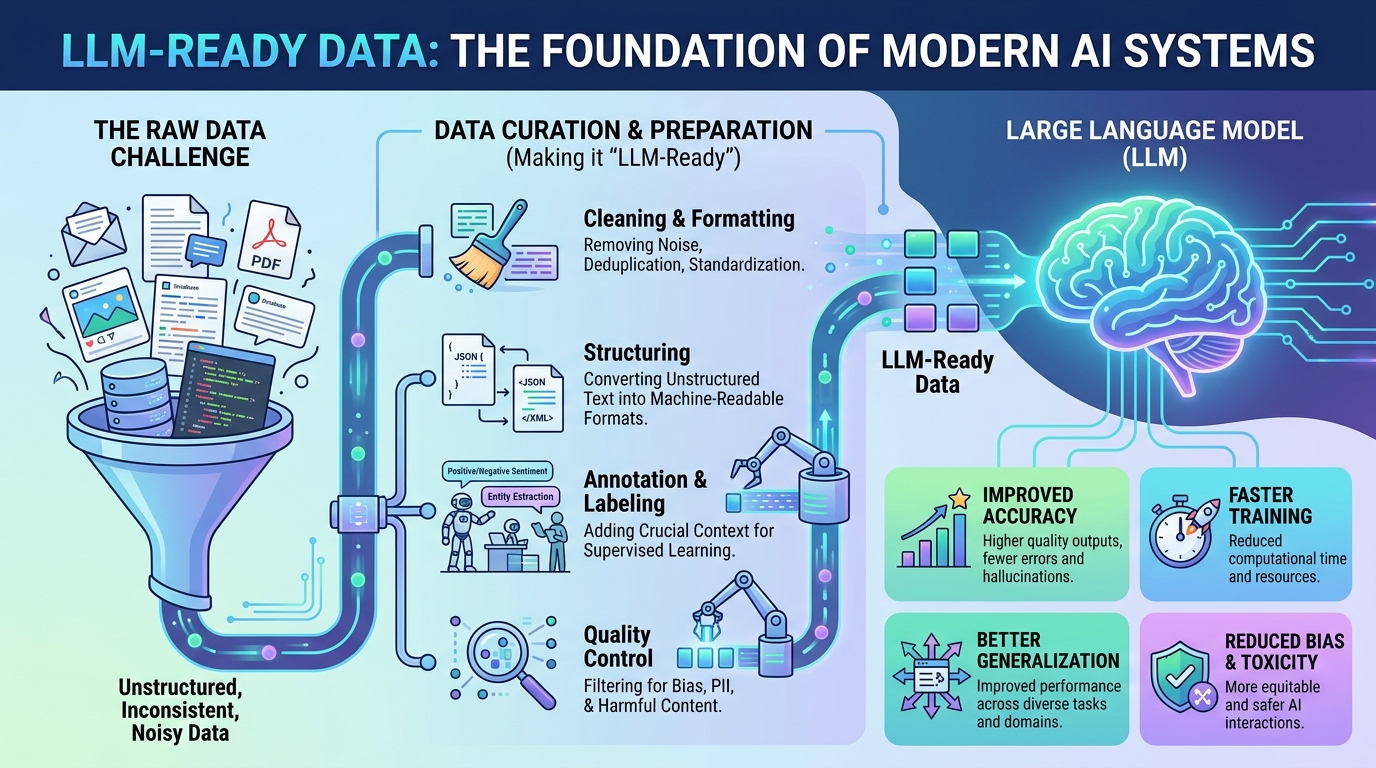
LLM-ready data refers to structured, cleaned, enriched, and semantically organized information that can be directly consumed by large language models or AI systems without additional heavy preprocessing.
Unlike traditional data pipelines, LLM-ready data is designed for:
Semantic understanding rather than just storage
Contextual retrieval instead of raw querying
Continuous learning and updating
Integration with AI reasoning systems
Why LLM-Ready Data Matters for Modern AI Systems
Generative AI models like GPT-based systems perform best when they are supported by high-quality, structured knowledge sources. Without this, they hallucinate or generate incomplete answers.
LLM-ready data ensures:
Higher response accuracy
Reduced hallucination rates
Faster inference and retrieval
Better domain adaptation
Strong enterprise compliance and governance
Organizations using poorly structured data often struggle with inconsistent outputs and unreliable AI performance.
AI Data Infrastructure: The Foundation Layer
Every LLM system starts with a strong AI data infrastructure. This includes the physical and logical systems responsible for collecting, storing, and processing data.
Core components include:
Data lakes and warehouses
Cloud storage systems
Real-time data streaming platforms
ETL/ELT pipelines
Metadata management systems
A modern AI data infrastructure must be scalable, distributed, and capable of handling both structured and unstructured data sources.
Without this foundation, advanced AI systems cannot operate efficiently.
Enterprise Data Platform for AI Systems
An enterprise data platform is the central hub where all organizational data is unified, cleaned, and prepared for AI use cases.
Key characteristics include:
Unified data access layer
Multi-source integration (CRM, ERP, web data, IoT, documents)
Data governance and compliance controls
Role-based access control
AI-ready transformation layers
In LLM systems, enterprise data platforms act as the bridge between raw business data and AI intelligence systems.
They ensure data consistency, traceability, and security.
LLM Data Pipeline: From Raw Data to AI Intelligence
An LLM data pipeline is a structured flow that converts raw data into model-ready formats.
Typical stages include:
1. Data Ingestion
Data is collected from multiple sources:
Websites
APIs
Internal databases
Documents and PDFs
Customer interactions
2. Data Cleaning
Noise is removed:
Duplicate records
Irrelevant content
Formatting issues
3. Data Enrichment
Context is added:
Metadata tagging
Entity recognition
Language normalization
4. Chunking and Structuring
Large documents are split into smaller semantic chunks for better processing.
5. Embedding Generation
Text is converted into vector embeddings for semantic search.
6. Storage in Vector Database
Processed embeddings are stored for retrieval.
This pipeline is the backbone of any production-grade LLM system.
Knowledge Base Management in AI Systems
A knowledge base management system is responsible for organizing enterprise knowledge in a way that AI systems can easily access and interpret.
It includes:
Internal documentation
FAQs and support articles
Product manuals
Policy documents
Historical records
Best practices include:
Continuous updates to avoid outdated knowledge
Version control for data accuracy
Tagging and classification systems
Semantic linking between documents
When properly managed, a knowledge base becomes a powerful AI training and retrieval asset.
Vector Database Integration: The Core of Semantic AI
One of the most important components in modern AI systems is the vector database.
Unlike traditional databases that rely on keyword matching, vector databases store data as numerical embeddings that represent meaning.
Popular use cases:
Semantic search
Recommendation systems
Chatbot memory systems
RAG-based AI applications
Why vector databases matter:
They allow AI systems to understand meaning, not just keywords.
For example:
A query like “best SEO strategies for small business” will retrieve relevant content even if exact words do not match.
This is essential for Retrieval-Augmented Generation (RAG) systems.
AI-Ready Content Platform: Preparing Data for LLMs
An AI-ready content platform ensures that content is structured in a way that LLMs can easily process.
It focuses on:
Clean HTML or markdown structure
Proper heading hierarchy (H1, H2, H3)
Semantic tagging
Internal linking
Context-rich content blocks
Key benefits:
Improved indexing by AI models
Faster retrieval during inference
Better content summarization
Enhanced multi-turn conversation accuracy
Content platforms are no longer just for SEO. They are now critical for AI visibility.
Semantic Data Processing: Making Data Understand Meaning
Semantic data processing transforms raw text into meaning-aware structured data.
This includes:
Named entity recognition (NER)
Sentiment analysis
Intent classification
Topic clustering
Relationship mapping
Instead of treating data as isolated text, semantic processing builds a knowledge graph of meaning.
This helps LLMs connect concepts rather than just retrieve text.
Retrieval-Augmented Generation (RAG): The Game Changer
One of the most powerful techniques in modern AI systems is Retrieval-Augmented Generation (RAG).
RAG combines two systems:
Information retrieval system (vector database)
Language generation model (LLM)
How it works:
User asks a question
System retrieves relevant documents
LLM uses retrieved context to generate an answer
Benefits of RAG:
Reduces hallucinations
Improves factual accuracy
Keeps models up to date without retraining
Enhances domain-specific intelligence
RAG is now a standard architecture for enterprise AI systems.
LLM Training Datasets: Building High-Quality AI Intelligence
Training datasets are critical for building powerful language models.
Characteristics of high-quality LLM datasets:
Clean and structured data
Balanced domain coverage
Multilingual support
Bias reduction techniques
Proper labeling and annotation
Common dataset sources:
Public datasets (Wikipedia, books, research papers)
Enterprise internal data
Customer interaction logs
Synthetic data generation
Poor-quality datasets lead to biased and unreliable models, making dataset engineering one of the most important parts of AI development.
AI Knowledge Management: Long-Term Intelligence Layer
AI knowledge management ensures that organizational intelligence is continuously updated and optimized for AI use.
Core components:
Knowledge lifecycle management
Automated content updates
AI-driven tagging systems
Feedback loops from user interactions
This layer ensures that AI systems do not become outdated over time.
It also helps organizations maintain a competitive advantage by continuously improving AI responses.
Building an End-to-End LLM Data Architecture
A complete LLM-ready system combines all the above components into a unified architecture:
1. Data Sources
Enterprise systems, APIs, documents, user interactions
2. AI Data Infrastructure
Storage, pipelines, cloud systems
3. LLM Data Pipeline
Cleaning, enrichment, embedding generation
4. Vector Database Layer
Semantic storage and retrieval
5. RAG Engine
Combines retrieval and generation
6. Knowledge Base System
Organized enterprise intelligence
7. AI Application Layer
Chatbots, copilots, analytics tools
This layered approach ensures scalability and performance.
Challenges in Implementing LLM-Ready Data Systems
Despite its advantages, organizations face several challenges:
1. Data Quality Issues
Incomplete or inconsistent data reduces AI accuracy.
2. Scalability Problems
Large datasets require high-performance infrastructure.
3. Security and Compliance
Sensitive data must be protected.
4. Integration Complexity
Multiple systems need to work together seamlessly.
5. Cost of Infrastructure
Vector databases and cloud compute can be expensive.
Best Practices for Enterprise Implementation
To successfully implement LLM-ready systems:
Start with a clear data strategy
Invest in scalable AI infrastructure
Use modular pipeline architecture
Implement strong data governance
Continuously monitor AI performance
Prioritize semantic structuring of data
These practices ensure long-term sustainability and performance.
Future of LLM-Ready Data Systems
The future of AI data systems is moving toward:
Fully automated data pipelines
Real-time semantic indexing
Self-updating knowledge bases
Multimodal AI data integration (text, image, video)
AI-native enterprise platforms
Soon, organizations will not just store data, they will train live intelligence systems continuously.
Final Thoughts
LLM-ready data solutions are the backbone of modern generative AI systems. Without structured, semantic, and well-managed data, even the most advanced language models cannot perform effectively.
From AI data infrastructure to vector database integration, every layer plays a critical role in building intelligent, scalable, and reliable AI systems.
Frequently Asked Questions
1. What is LLM-ready data in generative AI?
LLM-ready data is structured and cleaned information prepared specifically for large language models so they can understand, retrieve, and generate accurate responses without additional heavy processing.
2. Why is AI data infrastructure important for LLM systems?
AI data infrastructure provides the foundation for storing, processing, and managing large-scale datasets. It ensures that LLM systems run efficiently, securely, and at scale.
3. What is an LLM data pipeline?
An LLM data pipeline is a step-by-step system that collects raw data, cleans it, enriches it, converts it into embeddings, and stores it for AI model usage.
4. How does a vector database improve AI performance?
A vector database stores data as embeddings instead of keywords, allowing AI systems to understand meaning and perform semantic search with higher accuracy.
5. What is retrieval-augmented generation (RAG)?
RAG is an AI architecture that combines information retrieval systems with language models to improve accuracy by pulling real-time or relevant context before generating responses.
6. What role does knowledge base management play in AI?
Knowledge base management organizes enterprise information so AI systems can easily access, update, and use it for generating accurate and relevant responses.
7. What is semantic data processing?
Semantic data processing involves analyzing data based on meaning, relationships, and intent rather than just keywords, helping AI understand context more effectively.
8. Why are LLM training datasets important?
LLM training datasets determine how well an AI model learns. High-quality datasets improve accuracy, reduce bias, and enhance overall model performance.
9. What is an AI-ready content platform?
An AI-ready content platform structures digital content in a way that makes it easy for AI systems to read, process, and retrieve information efficiently.
10. How do enterprises benefit from AI knowledge management systems?
Enterprises benefit by improving decision-making, automating workflows, enhancing customer support, and maintaining consistent, updated knowledge across AI systems.
Written by
Alex
Creative blogger sharing insights, stories, and fresh ideas.