Voiceprint Payment: 5 Real-World Projects and How to Launch One


Voiceprint payment approves a transaction by matching your voice to a stored voice biometrics template. Banks use it today in telephone banking, and wearables are testing it. It works best when you pair it with liveness detection and a second factor, because voice cloning can fool a voiceprint on its own.
Key Takeaways
HSBC UK, Bank of Ireland and Santander run voiceprints at scale in call centers.
SayPay and Alipay+ GlassPay show where voice payments are heading.
AWS ended Amazon Connect Voice ID support on May 20, 2026, so vendor risk is real.
Voice alone is no longer enough. Layer it.
You can pilot a safe flow in one quarter.
What Is Voiceprint Payment?
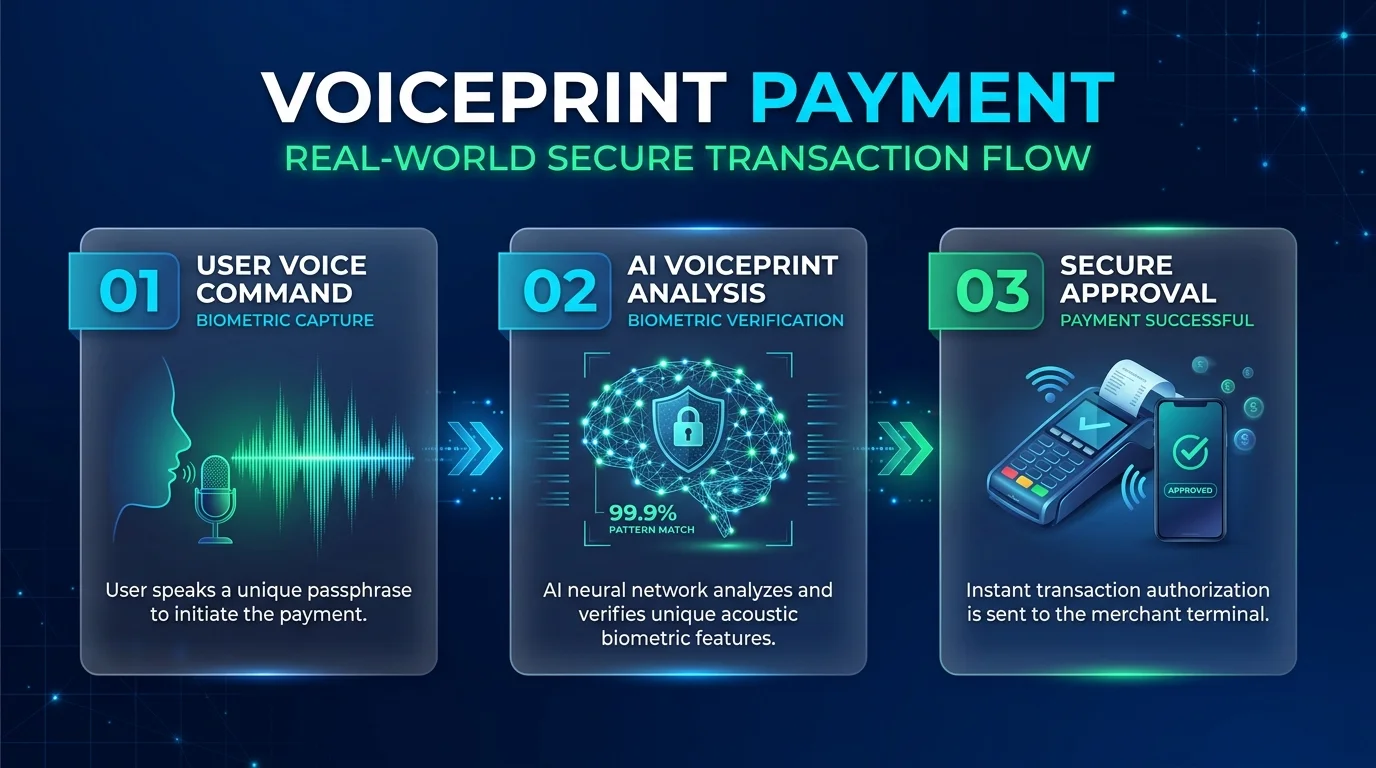
Let me start with the basics, because most articles skip them. Voiceprint payment lets you authorize a purchase, a bill or a transfer by speaking. The system doesn't care much about your words. It cares about how your voice sounds. That's why people call it a "fingerprint made of sound." Once you understand that, every example below makes more sense.
How Voice Biometrics Works
Here's the deal. During enrollment, you repeat a passphrase a few times. HSBC Hong Kong, for example, has you repeat a sample passphrase three times to build your voiceprint. The system mixes physical traits, like your vocal tract, with behavioral ones, like your speed and accent.
Next time you call, it compares the new sample against the stored template. That's speaker verification, not speech recognition.
Two flavors exist:
Text dependent: you say a fixed or random phrase or digits.
Text independent: the system recognizes you in free speech.
Real World Voiceprint Payment Projects at a Glance
Theory is cheap, so I pulled together documented deployments. Some are payments in the strict sense. Others are banking authentication that sits right beside payments. I've dated every claim so you can judge how current it is.
Project | Channel | Method | Reported result | Date |
|---|---|---|---|---|
HSBC UK Voice ID | Telephone banking | Passive voiceprint plus fraudster voice library | 2.8M+ active customers; about £249M of fraud stopped in a year | Launched 2016; stat as reported by HSBC UK (verify the date) |
Contact centers | Voice biometrics | €34M investment; 11,000+ calls daily | May 2024 | |
SayPay | Mobile bill pay, e-commerce | Spoken one time code plus voice match | Used by Varam Capital, which serves 60,000 beneficiaries | 2015 to 2016 |
Alipay+ GlassPay | Smart glasses | Voiceprint plus QR payment | Hands free voice activated payment | Current docs |
Mastercard pilot | Mobile e-commerce | Voice plus face | 98% verification, 14,000+ transactions | 2014 |
HSBC UK Voice ID
This is the heavyweight case study. It matters because it shows fraud prevention at national scale, not a lab demo. HSBC reported that Voice ID had more than 2.8 million active customers and stopped nearly £249 million of customer money from reaching phone fraudsters in a year.
The bank also checks incoming calls against a library of known fraudster voiceprints. So the system defends and hunts at the same time. Before you quote the figure, confirm its date with HSBC.
Bank of Ireland's €34 Million Bet
Big institutions don't spend this kind of money on gimmicks. Bank of Ireland announced more than €34 million to overhaul its telephony and CRM systems, with voice biometrics improving customer authentication and cutting wait times.
It handles over 11,000 calls a day, so even small efficiency gains add up fast. Smaller banks, take note: you can copy the logic at a smaller scale.
SayPay's One Time Voice Code
This one is clever. SayPay has you speak a cryptographically generated one time code while it authenticates your voice. Because the code changes every time, a replayed recording fails.
That's why I like it as a model. It blends multi-factor authentication (your phone, the code and your voice) into one natural action. Plus, it works on any basic phone.
Alipay+ GlassPay
Now let's look ahead. Alipay+ GlassPay is a hands free payment application for smart glasses. You bind your payment method, the system records your voiceprint, and later it runs a voiceprint verification before approving a payment.
I find this exciting, but I'd still pair it with extra checks for large amounts. Wearables are new territory.
Mastercard's Voice and Face Pilot
This is the historical proof of concept. In 2014, Mastercard tested a mobile app on over 14,000 transactions and reported a 98% verification rate mixing voice and facial recognition. But it was an employee only trial, and reports noted the 98% wasn't a pure measure of biometric accuracy. Treat it as a milestone, not a benchmark.
Vendors Are Retiring Voice Products: What Changed in 2026
Here's a gap most competitors miss. The vendor landscape shifted, and you need to know it before you sign anything. This section is short, but it could save you a painful migration, because voice authentication tools you rely on can disappear with limited notice.
AWS announced that Amazon Connect Voice ID would stop accepting new customers on May 20, 2025 and end support on May 20, 2026. Biometric Update also reported that Microsoft retired Azure Speaker Recognition, and ValidSoft noted earlier end of life news for Nuance Gatekeeper. So ask every vendor about its roadmap and data export options.
The Biggest Risk: Voice Cloning and Deepfakes
I'd be doing you a disservice if I only sold the upside. Voice cloning is built on generative models, and if you want a plain English primer on how that technology differs from agent style AI, read this breakdown of agentic AI vs generative AI.
At a Federal Reserve conference in July 2025, OpenAI's Sam Altman warned that some institutions still accept voiceprints and that AI has defeated that approach.
An academic survey of threats against voice authentication shows how widely banks like JPMorgan, Wells Fargo and TD have adopted it, and researchers have also shown that replay attacks can fool unprotected systems.
There's a contrarian view too. One fintech design guide argues you should never treat the user's voice as an authentication factor for agent driven payments.
So what do I recommend? Don't abandon voice. Layer it with anti-spoofing, liveness detection and deepfake detection. Santander, for example, said its system could detect a recording played over the phone. The ASVspoof challenges are the standard benchmark for spoof detection, though vendor rankings are marketing claims, so run your own tests.
Step by Step: How to Launch a Voiceprint Payment Flow
Ready to build? This plan works because it starts small and adds protection in the right order. Follow the steps in sequence, because skipping the liveness layer is the most common mistake I see. Teams rush to launch and bolt on security later. Don't.
Pick one low risk use case. Start with telephone banking or payment confirmations under a set limit.
Vet the vendor. Ask about roadmap, data export and spoof detection test results.
Use a dynamic challenge. Prefer random digits or a one time code, as SayPay does.
Add liveness and deepfake checks. Make them mandatory.
Layer a second factor. Use device ID, an OTP or a callback for high risk actions. If you bind approvals to a phone, it helps to understand how Android and iOS security differ.
Get explicit consent. Let customers opt in and delete their voiceprint anytime.
Monitor weekly. Track false accepts, false rejects and spoof scores, then retune.
Why You Should Invest in Voiceprint Payment Now
Let me make the case plainly. First, customer experience. A study of telephone banking found high usability and customer acceptance for voiceprint authentication. Second, fraud reduction, as HSBC's results suggest. Third, reach: voice works on any phone, even an old handset.
And the market is still moving. Fraudsters aren't waiting, so you shouldn't either. Pick a platform that bundles voice biometrics, liveness detection and deepfake detection. Run a 90 day pilot. Measure it. Then scale. That's how you buy with confidence.
Frequently Asked Questions
What is voiceprint payment?
It's a payment authorization method that confirms your identity by matching your voice to a stored template. You speak, the system verifies you, and the payment proceeds.
Is voiceprint payment safe?
It's safe enough when layered. On its own, a voiceprint is vulnerable to voice cloning and replay attacks. Add anti-spoofing, liveness detection and a second factor for strong protection.
What's the difference between text dependent and text independent voice verification?
Text dependent systems ask you to say a specific phrase or digits. Text independent systems recognize you in free speech. Text dependent is simpler to secure for payments, especially with random prompts.
Does voice authentication work if I have a cold?
Vendors claim it usually does, according to coverage of HSBC's Malaysia launch. Test it with your own users before relying on it.
Where is voiceprint payment used today?
Mostly in call centers, banking apps and emerging wearables. WeChat offers voiceprint login in some regions, though not in the US, UK or EU.
How should I get started?
Shortlist two vendors, request spoof detection test results from each, and book a pilot. Begin with a low risk use case.
Ready to Launch?
You've seen what works, what broke and how to protect yourself. Now move. Shortlist your vendors this week, ask the hard questions about deepfake detection, and start your pilot. Your customers will thank you, and your fraud team will too.
Written by
Alex
Creative blogger sharing insights, stories, and fresh ideas.