What Is an LLM Generator? The Complete Guide for 2026

If you've spent any time in AI communities, developer forums, or machine learning circles lately, you've almost certainly come across the term LLM generator. It's used in documentation, job descriptions, startup pitches, and GitHub READMEs often without a proper explanation of what it actually means or what problem it solves.
This guide fixes that. By the end of this article, you'll have a crystal-clear understanding of:
What an LLM generator is (and what it isn't)
How LLM generators work under the hood
Why they matter for AI development in 2026
The different types of LLM generators and their use cases
How to choose the right LLM generator for your project
Why LLMProGen is the go-to free LLM generator for web content extraction
Whether you're a seasoned ML engineer or someone just getting started with AI, this is your definitive reference.
What Is an LLM Generator? A Clear Definition
An LLM generator is a tool, system, or pipeline that either:
Generates text using a Large Language Model (LLM) producing human-like content from prompts, or
Generates LLM-ready data files from raw sources like websites, documents, or databases preparing content for model training, fine-tuning, or retrieval-augmented generation (RAG)
Both definitions are valid and in widespread use. The context usually makes clear which meaning is intended but the second type (data generation for LLMs) is increasingly the more specific and technically important usage, especially in 2026 as the demand for high-quality AI training data has skyrocketed.
This guide covers both definitions, but spends significant time on the second because it's where the most practical, underexplored value lives for developers and researchers today.
Type 1: LLM Generators That Produce Text (Generative AI)
When most non-technical users say "LLM generator," they mean a tool that takes a prompt as input and returns generated text as output. Think ChatGPT, Claude, Gemini, Llama these are all LLMs, and any interface that lets you interact with them is, in essence, an LLM text generator.
How Text-Generating LLMs Work
At a high level, large language models are neural networks trained on massive text corpora. They learn statistical relationships between tokens (chunks of text) and become extraordinarily good at predicting what comes next in a sequence.
When you give an LLM a prompt say, "Write a product description for a wireless keyboard" the model processes your input through billions of parameters and generates a probability distribution over possible next tokens. It samples from that distribution iteratively, producing one token at a time until it reaches a stopping condition.
The result is text that is statistically coherent, contextually appropriate, and in the best cases genuinely useful.
Key Characteristics of LLM Text Generators
Probabilistic output the same prompt can produce different outputs across runs
Context window each model has a limit on how much text it can process at once (measured in tokens)
Temperature control a parameter that controls creativity vs. determinism in outputs
Instruction following modern LLMs are trained with RLHF (Reinforcement Learning from Human Feedback) to follow instructions, not just predict text
Multimodality increasingly, LLM generators handle images, audio, and code alongside text
Popular LLM text generators include GPT-4o (OpenAI), Claude 3.5 (Anthropic), Gemini 1.5 Pro (Google), Llama 3 (Meta), and Mistral each with distinct strengths, pricing, and context window limits.
Type 2: LLM Generators That Produce Training Data
This is where things get more technical and more interesting for AI practitioners.
An LLM data generator (sometimes called an LLM file generator or LLM-ready content generator) is a tool that takes raw, unstructured content from websites, PDFs, databases, or other sources and transforms it into clean, structured files optimized for language model consumption.
Think of it this way: before any LLM can be trained or fine-tuned on web content, that content needs to be extracted, cleaned, structured, and formatted. A raw HTML page is full of navigation menus, ad scripts, cookie banners, and tracking pixels. None of that is useful training data. An LLM generator strips all of that away and delivers the semantic content in a format the model can actually learn from.
This is exactly what LLMProGen does and why it's become an essential tool in the AI development stack.
Deep Dive: How LLMProGen Works as an LLM Generator
LLMProGen is purpose-built as an LLM data generator. It solves one of the most time-consuming problems in AI development: getting clean, structured training data from the open web.
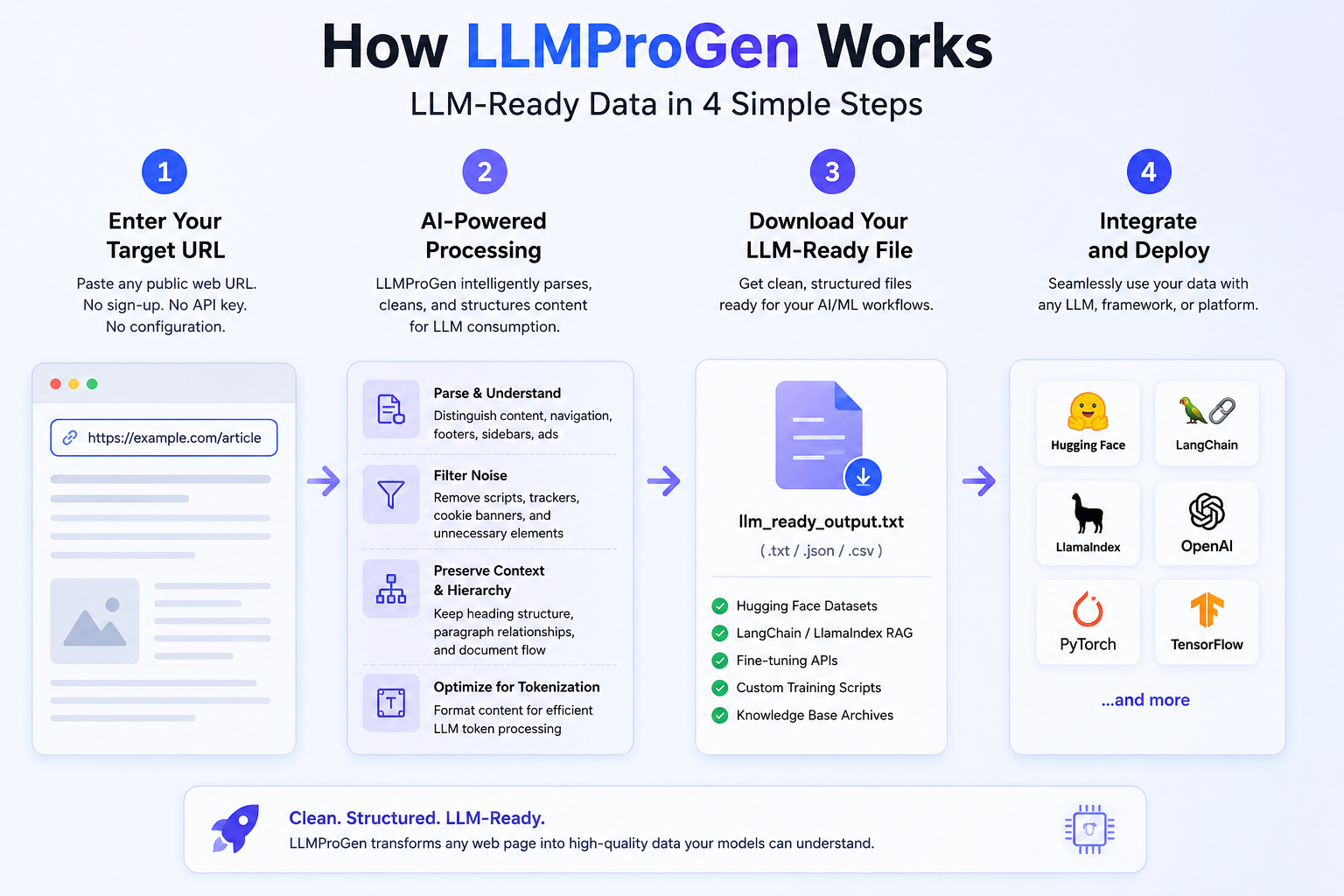
Here's how it works, step by step:
Step 1 — Enter Your Target URL
You paste any public web URL into LLMProGen's interface. No registration, no API key, no configuration required. The tool accepts any valid URL from simple blog posts to complex documentation portals.
Step 2 — AI-Powered Processing
This is where LLMProGen differentiates itself from generic web scrapers. Instead of dumping the raw page content, LLMProGen's algorithms:
Parse and understand page structure distinguishing between primary content, navigation, footers, sidebars, and ads
Filter noise removing scripts, tracking pixels, cookie banners, and layout elements that have no semantic value
Preserve context and hierarchy maintaining heading structures, paragraph relationships, and document flow
Optimize for tokenization formatting the output in a way that aligns with how language model tokenizers process text
The result is not just cleaner content it's content that has been specifically prepared for LLM consumption, not just human reading.
Step 3 — Download Your LLM-Ready File
LLMProGen delivers a clean .txt file (or .json / .csv on the Pro plan) that you can immediately:
Drop into a Hugging Face dataset
Load into a LangChain or LlamaIndex RAG pipeline
Upload to a fine-tuning API
Feed into a custom training script
Archive as a structured knowledge base entry
Step 4 — Integrate and Deploy
The generated files work seamlessly with every major ML framework and LLM platform. No post-processing. No reformatting. No headaches.
Why LLM Generators Matter More Than Ever in 2026
The AI landscape in 2026 is defined by one central tension: the gap between foundation model capability and training data quality.
Foundation models have become commoditized. GPT-4-class performance is now achievable with open-source models running on consumer hardware. The competitive moat has shifted. What separates good AI products from great ones is no longer which model you're using it's what data you trained or fine-tuned it on.
This shift has driven explosive demand for LLM generators particularly tools like LLMProGen that make high-quality data preparation fast, accessible, and scalable.
The RAG Revolution
Retrieval-Augmented Generation has gone from a research curiosity to a production staple. Instead of relying on a model's parametric knowledge (what it learned during training), RAG systems pull relevant documents from a knowledge base at query time and inject them into the prompt context.
Building a RAG knowledge base requires exactly what LLMProGen produces: clean, structured text files that can be chunked, embedded, and indexed efficiently. Poorly formatted input data leads to poor retrieval quality which leads to poor answers. Garbage in, garbage out.
Fine-Tuning at Scale
Organizations across every industry are fine-tuning base models on proprietary data customer support transcripts, legal documents, technical documentation, product manuals. The workflow almost always starts with data preparation: extracting content from websites and documents into clean, structured formats.
LLM generators like LLMProGen compress what used to be hours of manual work into seconds.
The Knowledge Base Economy
Beyond model training, knowledge bases have become a foundational piece of enterprise AI infrastructure. Product teams build them to power intelligent search. Support teams build them to automate ticket resolution. Research teams build them to synthesize literature at scale.
Every knowledge base starts with content ingestion and content ingestion requires a reliable LLM generator.
LLM Generator Use Cases: Who Needs One and Why
Understanding what an LLM generator does is one thing. Understanding who needs one and why makes the value concrete.
AI/ML Engineers
Engineers training or fine-tuning custom models spend enormous amounts of time on data preparation. An LLM generator like LLMProGen automates the most tedious part extracting clean text from web sources so engineers can focus on model architecture and training strategies.
Example: An engineer fine-tuning a customer support model needs to extract content from 200 product documentation pages. With LLMProGen Pro's multi-page extraction and unlimited generations, this becomes a matter of minutes, not days.
Data Scientists
Data scientists building NLP datasets need consistent, clean input. Web content is the most abundant training data source available but raw HTML is almost unusable without significant preprocessing. LLM generators bridge that gap.
Researchers
Academic researchers often need to build structured corpora from online sources news archives, scientific repositories, government databases. An LLM generator provides a reproducible, efficient extraction pipeline.
Product Teams
Product managers and competitive intelligence teams use LLM generators to systematically harvest and structure competitor content, industry reports, and market data. The structured output feeds directly into analytical workflows.
Developers Building RAG Applications
Any developer building a RAG-powered chatbot, intelligent search engine, or document Q&A system needs a reliable way to populate their vector database. LLMProGen's output is ready to chunk, embed, and index.
Content Strategists
SEO and content professionals use LLM generators to audit large volumes of web content, analyze competitor structures, and build content databases for AI-assisted writing workflows.
LLM Generator vs. Web Scraper: What's the Difference?
This is one of the most common questions from developers new to AI data preparation. They're related but fundamentally different tools.
Feature | Web Scraper | LLM Generator (e.g., LLMProGen) |
Primary output | Raw HTML or raw text | Clean, structured LLM-ready files |
Noise removal | Minimal or manual | Automated, AI-powered |
Semantic understanding | None | Preserves document hierarchy and context |
Tokenization optimization | None | Built-in |
Target user | Developers (coding required) | Anyone (no code needed) |
ML framework compatibility | Requires post-processing | Plug-and-play |
Use case | Data extraction for any purpose | Specifically for AI/LLM workflows |
Web scrapers extract. LLM generators transform. Both have their place but if your end goal is feeding content into a language model, an LLM generator like LLMProGen will save you hours of post-processing work.
How to Choose the Right LLM Generator for Your Project
Not all LLM generators are equal. Here's what to evaluate before committing to a tool:
1. Output Quality
The most important factor. Does the output actually look like clean training data or does it still contain navigation clutter, ad text, and script fragments? Test with a complex page (one with sidebars, footers, dynamic content) and evaluate the output carefully.
LLMProGen's AI-powered extraction consistently produces cleaner output than generic scrapers on complex, real-world pages.
2. Ease of Use
If a tool requires you to write a custom scraping script for every new domain, it's a scraper not an LLM generator. The best tools work on any URL with zero configuration.
3. Output Format Flexibility
Your ML framework may require .txt, .json, or .csv. Make sure your LLM generator supports the formats you need. LLMProGen's free tier offers .txt; the Pro plan adds .json and .csv.
4. Scale
For small projects, 5 free generations per day (LLMProGen's free tier) is plenty. For production workloads processing hundreds of pages, you need unlimited generations LLMProGen Pro at $29/month.
5. Privacy
If you're processing sensitive URLs or proprietary content, you need a tool that doesn't log your activity. LLMProGen explicitly does not store generated content or track processed URLs.
6. Dynamic Content Handling
Many modern websites render content via JavaScript. A basic scraper can't see this content. LLMProGen Pro includes JavaScript rendering for dynamic sites.
LLMProGen Pricing: Free to Enterprise
One of LLMProGen's greatest strengths is its accessibility. You don't need a credit card, an account, or a technical background to start generating LLM-ready files today.
Plan | Price | Best For | Key Features |
Free | $0/forever | Individuals, prototyping | 5 generations/day, single-page, .txt output |
Pro | $29/month | Developers, researchers | Unlimited generations, multi-page, .txt + JSON + CSV, API access (10K req/mo), JS rendering |
Enterprise | Custom | Teams, organizations | Unlimited everything, site-wide extraction, custom pipelines, 99.99% SLA, on-premise option |
The free tier is genuinely capable not a crippled demo. For most solo developers and researchers, it's all you'll ever need. The Pro plan unlocks the features required for production-scale AI data pipelines.
Frequently Asked Questions About LLM Generators
What types of websites can an LLM generator process?
LLMProGen works with any publicly accessible URL blogs, documentation sites, news articles, academic pages, product pages, and more. Password-protected or authentication-required pages need the Enterprise tier.
Is an LLM generator the same as ChatGPT?
No. ChatGPT is an LLM that generates text in response to prompts. An LLM generator like LLMProGen generates LLM-ready data files from web content. They solve entirely different problems.
Can I use LLM generator output for commercial AI products?
Generally yes the generated files contain text extracted from the source page. Always verify that the source website's terms of service permit content extraction for your use case.
How does an LLM generator differ from copy-paste?
Dramatically. Manual copy-paste preserves formatting artifacts, navigation text, and layout noise. An LLM generator intelligently identifies and extracts only the semantic content, formats it for tokenization, and delivers a file ready for ML pipelines at scale, in seconds.
Do I need coding skills to use LLMProGen?
No. LLMProGen was designed for anyone from senior ML engineers to non-technical researchers. Paste a URL, click generate, download your file. The Pro API is available for developers who want to automate at scale.
How often is the output quality checked?
LLMProGen's extraction algorithms are continuously improved based on real-world usage. The platform's "intelligent content extraction" layer understands page structure across thousands of website architectures, not just simple blogs.
Conclusion: LLM Generators Are the Foundation of Modern AI Pipelines
Whether you're building a text-generating chatbot or a RAG-powered knowledge base, LLM generators are foundational infrastructure. They're the bridge between the raw, noisy web and the clean, structured data that language models need to perform at their best.
Understanding what an LLM generator is and knowing which one to use gives you a significant edge in AI development. You spend less time on data wrangling and more time on the work that actually differentiates your product.
For web content extraction specifically, LLMProGen is the cleanest, fastest, most accessible LLM generator available in 2026. It's free to start, requires zero setup, and produces output that's immediately compatible with every major ML framework and LLM platform.
If you're working with LLMs in any capacity start here.
Written by
Alex
Creative blogger sharing insights, stories, and fresh ideas.