SEO Ranking API: Best Tools & Pricing Compared (2026)


An SEO ranking API is a tool that automatically queries search engines and returns structured data — your keyword's position, the URL ranking, and any SERP features triggered — all in clean, machine-readable JSON. Instead of manually refreshing Google fifty times a day, you get real-time, accurate rank tracking data delivered straight into your dashboard or workflow.
I'll be honest with you — when I first started digging into this topic, I thought it was going to be a boring, technical rabbit hole. Turns out? It's one of the most underrated levers in modern SEO.
If you've ever refreshed Google trying to check where your blog post ranks, you already know the pain I'm talking about. It's slow. It's inaccurate (thanks, personalization). And honestly, it's a waste of your time.
So today, I'm going to walk you through exactly what a SEO ranking API is, why it matters more in 2026 than ever, and how you can use one to build a smarter, faster rank tracking workflow. If you're also working on your broader strategy, check out our guide to competitive intelligence for SEO for related reading.
Let's get into it.
What Is an SEO Ranking API, Really?
Here's the simple version.
An SEO ranking API fires off automated search queries and hands you back structured data — think position tracking, title, URL, snippet, and SERP features — all wrapped up in clean, machine-readable JSON.
No manual checking. No guessing. No incognito tabs.
You just query it, and it tells you exactly where you (or your competitor) stand in the search engine results page.
Sounds simple, right? But here's the thing — what comes back isn't just a number.
It's a full snapshot of the SERP: who's ranking, what content they're using, and which SERP real estate they own. That context is what turns raw data into an actual strategy.
Why This Matters More Than You Think
Search rankings aren't static anymore. They shift constantly — algorithm updates, competitor moves, seasonal spikes, you name it.
And if you're still relying on monthly spreadsheet exports? You're already behind.
That's exactly why teams are shifting toward rank tracking APIs that deliver real-time, structured data straight into their dashboards.
The Big Players in the SEO Ranking API Space (Compared)
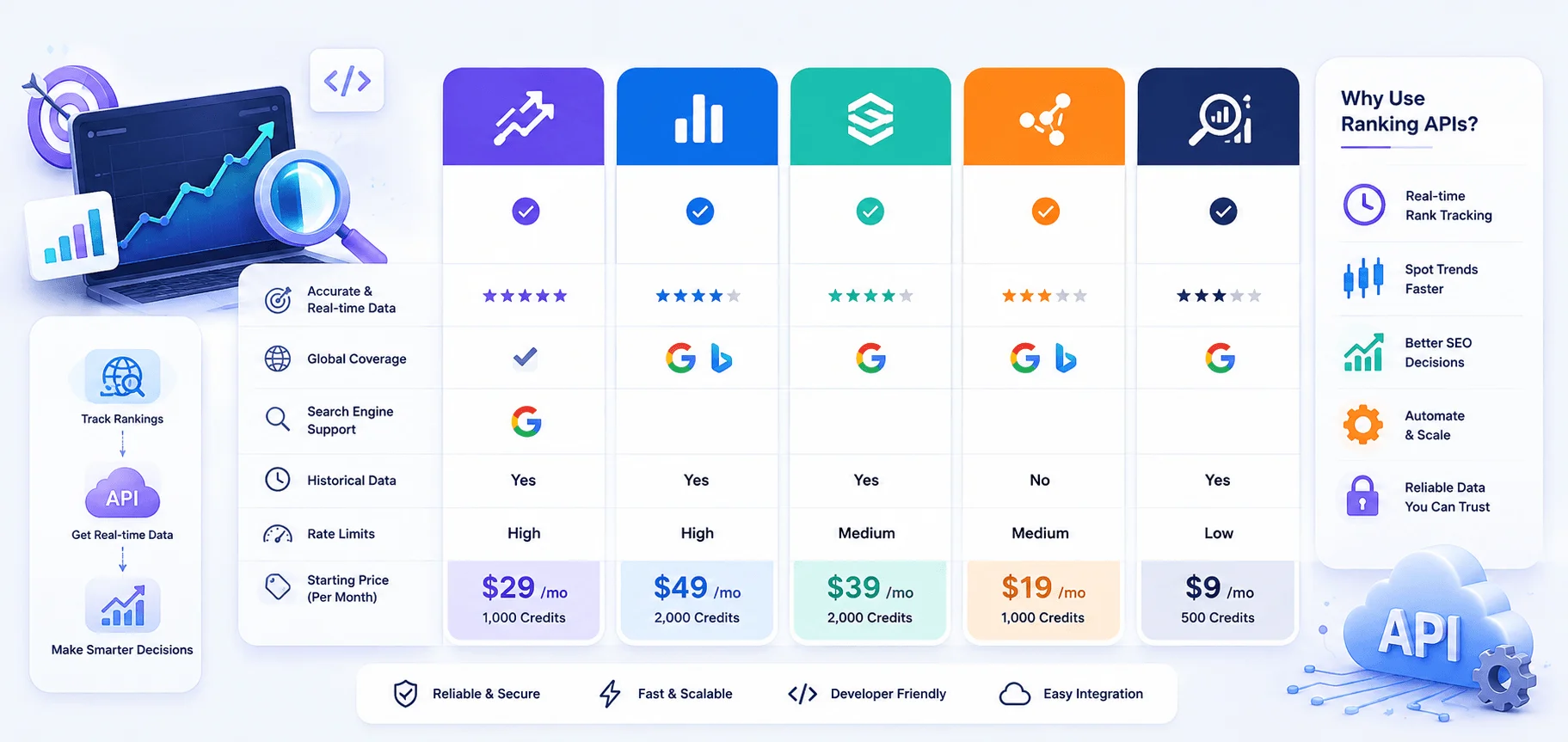
I'm not going to bore you with an exhaustive list of every provider under the sun. Instead, let's look at the three that actually matter, side by side.
Provider | Best For | Pricing Model | Notable Feature |
|---|---|---|---|
DataForSEO | Developers wanting raw, unified data | Pay-per-task, from ~$0.0006/request | Covers SERP, keyword, backlink, and on-page data in one API |
SerpApi | Rich SERP context & local tracking | Monthly tiers: Free (250 searches), $25/mo (1,000), $75/mo (5,000), $150/mo (15,000), $275/mo (30,000) | Full browser rendering; Shopping, Maps, Knowledge Graph data |
SE Ranking API | Teams wanting API + usable dashboard | Pay-as-you-go or bundled subscription | Domain audits, AI-engine visibility tracking, white-label reports |
(Pricing figures reflect published 2026 rate cards as of this writing — always confirm current pricing on the provider's site before budgeting.)
DataForSEO
Think of this as the Swiss Army knife of programmatic SEO data. It covers SERP data, keyword research, backlinks, and on-page metrics through one unified API, running on a pay-per-task model so you only pay for what you query.
The catch? It's pure infrastructure. No fancy dashboard, minimal hand-holding. You'll need some technical chops to make it sing.
SerpApi
This one's a favorite among developers who want the entire SERP picture, not just a position number. Each request runs through a real browser to mimic actual human search behavior, returning structured results for Shopping, Maps, Knowledge Graphs, featured snippets, and more.
It's also genuinely useful for hyper-local rank data — want to know how you rank in Austin versus Miami? SerpApi handles that beautifully.
SE Ranking API
SE Ranking takes a hybrid approach — you get both raw API access and a working product on top of it. That means domain audits, backlink data, and keyword tracking, wrapped in a usable interface for people who'd rather not write code from scratch.
Honorable Mentions
You've also got ScrapingBee, Bright Data, Scrapingdog, and Serpent API floating around the space, each with slightly different strengths in pricing and proxy reliability.
My honest take? Don't get paralysis by analysis. Pick one, test it on a small batch of keywords, and see how the data holds up against what you're actually seeing in Search Console.
The Google num=100 Change (And Why It Broke Everyone's Pricing)
Quick history lesson — but stick with me, because this is actually important.
In September 2025, Google removed the num=100 parameter from search queries. Before that change, a single API request could pull all 100 organic results in one go.
Not anymore.
This change rippled across the entire industry, driving up the cost of deep-rank tracking for basically every provider. If you're budgeting for an API in 2026, this is a detail you cannot skip.
Some providers, like Serpent API, responded with flat top-100 pricing to sidestep the multiplier effect. Others quietly raised their per-request costs. So when comparing providers, don't just look at the sticker price — ask specifically how they handle deep pagination now.
AI Overview and AI Mode Tracking: The New Frontier
Here's a subtopic that's exploding in relevance right now, and most guides on this topic barely touch it.
Ranking APIs aren't just tracking the traditional ten blue links anymore — they're increasingly built to track your visibility inside AI Overviews and AI Mode results.
Platforms like Semrush now let you filter your Position Tracking reports by SERP feature type, including a dedicated filter for keywords that trigger Google's AI Overview. You can even compare your AI Overview presence directly against a competitor's by adjusting the domain parameters in the same query.
Why does this matter to you? Because share of voice inside AI-generated answers is quickly becoming as important as classic organic position — sometimes more so, since an AI Overview can push your normal listing below the fold even when you technically "rank #1."
If your ranking API doesn't track AI Overview and AI Mode appearances yet, that's a real gap worth asking your provider about. For a full breakdown of optimizing for this shift, check out our Google AI Overviews SEO playbook.
How to Choose the Right SEO Ranking API for You
Ask yourself these questions first:
Do you have developer resources? If not, lean toward a hybrid platform like SE Ranking rather than raw infrastructure like DataForSEO.
Do you need hyper-local data? SerpApi shines here.
Are you tracking thousands of keywords daily? Cost-per-call matters more than feature breadth. Look closely at batch keyword tracking pricing.
Do you care about AI Overviews and SERP features? Not every provider tracks these consistently — confirm before you commit.
Step-by-Step: Setting Up Your First Rank Tracking Workflow
Step 1: Get your API key. Sign up, verify your account, and grab your API key authentication credentials from the dashboard.
Step 2: Define your keyword list. Start small. Pick 20–30 target keywords tied to actual search intent, not just vanity terms.
Step 3: Set your location and device parameters. This is where a lot of people mess up. If you don't configure geo-targeting and device-specific settings (mobile vs desktop), your data will be noisy and unreliable. For a deeper look at how location affects your rankings, see our guide on geo-location rank tracking.
Step 4: Run your first query. Send the request, and check the JSON response. You're looking for position, URL, and any SERP features triggered.
Step 5: Automate it. Once you trust the data, set up a scheduled job (daily or weekly) so you're not manually pulling reports every time.
Step 6: Pipe it into a dashboard. Whether that's Google Sheets, Looker Studio, or a custom-built tool, get the data somewhere you'll actually look at it regularly.
Search Intent: The Piece Everyone Forgets
Here's something I need you to really absorb, because it trips up so many people.
You can have the most accurate rank tracking API in the world, and it still won't save you if your content doesn't match search intent.
Ranking data tells you where you stand. It doesn't tell you why you're not converting.
Before you obsess over position #3 vs #1, ask yourself: does this page actually answer what the searcher wants? Are they looking to buy, learn, compare, or just browse? Your content needs to mirror that intent.
This is honestly the difference between "ranking" and "ranking and getting traffic that converts."
On-Page SEO Basics You Still Need (Even With the Best API)
I know, I know — this feels basic. But you'd be shocked how many people skip it.
Your main keyword needs to show up in a few non-negotiable places:
In your URL — keep it short and clean
In your title tag — ideally near the front
Within the first 100 words of your page — this signals relevance immediately
In your H1 tag — there should only be one per page
In at least one H2 tag — this reinforces topical relevance for search engines
No API in the world fixes a page that's missing these fundamentals. Get the on-page basics right first, then let your ranking API tell you how well it's working.
Tracking SERP Features (Because Position #1 Isn't Everything Anymore)
Here's a truth bomb: ranking #1 doesn't mean what it used to.
SERP features like featured snippets, People Also Ask boxes, and AI Overviews often steal clicks away from the standard organic listings — even from the top spot.
A good SEO ranking API needs to track more than just position. It should tell you:
Which SERP features are present for your target keywords
Whether you already rank in the standard results but haven't captured the feature
How your competitors are performing across those same features
If you're already ranking on page one for a keyword and it has a featured snippet you don't own? That's low-hanging fruit. Go get it.
Common Mistakes People Make With Ranking APIs
Mistake #1: Ignoring location settings. Rankings vary wildly by city, region, and even device. If you're not specifying this, your data means almost nothing.
Mistake #2: Tracking too many keywords too soon. Start small. Validate the data. Then scale.
Mistake #3: Treating position as the only metric that matters. Combine your ranking data with click-through rate and actual traffic numbers from Search Console. Position alone doesn't pay the bills.
Mistake #4: Forgetting about cost scaling. Remember that num=100 change we talked about? Deep-rank pulls can get expensive fast if you're not paying attention to pricing tiers.
Frequently Asked Questions
What is an SEO ranking API used for?
It's used to automatically check and monitor keyword positions in search results, track SERP features like featured snippets, and monitor competitor rankings — all without manual searching.
What's the cheapest SEO ranking API?
DataForSEO tends to be the cheapest per request (around $0.0006/request as of 2026), though SerpApi's free tier (250 searches/month) works fine for small-scale testing.
Do ranking APIs track AI Overviews?
Some do. Semrush's API, for example, lets you filter Position Tracking reports specifically for AI Overview appearances. Not every provider supports this yet, so confirm before choosing one.
Is a rank tracking API better than manual checking?
Yes, mainly because manual checks are skewed by Google's personalization and location settings. An API gives you consistent, location-controlled, repeatable data.
How often should I run rank tracking queries?
Daily is standard for competitive keywords; weekly is fine for lower-priority terms, mainly to control API costs.
Wrapping This Up
So, where does that leave you?
SEO ranking APIs aren't just a "nice to have" anymore — they're becoming core infrastructure for anyone serious about search visibility monitoring at scale.
Whether you go with DataForSEO for raw power, SerpApi for rich SERP context, or SE Ranking for an all-in-one platform, the real win comes from combining that data with solid on-page SEO, genuine search intent alignment, and consistent tracking over time.
Start small. Test the data against what you already know. And build from there.
You've got this.
Written by
Alex
Creative blogger sharing insights, stories, and fresh ideas.