Customer Relationship Management (CRM) systems are no longer just databases for storing customer information. In 2026, businesses are shifting toward AI-powered CRM systems that can think, predict, and act in real time. Traditional CRM tools focused on storing contact details, purchase history, and basic interactions. But modern businesses need more. They need systems that understand behavior, predict intent, and automatically deliver personalized experiences.
An AI-ready CRM is not just software. It is a structured customer data architecture designed to feed machine learning models with clean, structured, and enriched data. It allows businesses to build smarter systems for forecasting, segmentation, and automation.
What is an AI-Ready CRM Data Model?
An ai-ready crm data model is a structured framework that organizes customer data in a way that artificial intelligence systems can easily process, analyze, and learn from.
Instead of storing raw, messy data, an AI-ready model ensures:
Data is structured
Data is connected
Data is enriched
Data is real-time ready
Data is machine-readable
This model forms the foundation of modern intelligent customer management systems.
Simple Definition
An AI-ready CRM data model is a structured system that transforms raw customer data into actionable intelligence using AI and automation.
Why Traditional CRM Systems Are No Longer Enough
Legacy CRM systems were built for storage, not intelligence. They can answer questions like:
Who is the customer?
What did they buy?
When did they last interact?
But they cannot answer:
What will the customer buy next?
Which customers are about to churn?
What offer will increase conversion?
Which leads are high-value?
Modern businesses require AI customer insights to stay competitive.
This is why companies are shifting toward AI-powered CRM platforms that combine data modeling, automation, and machine learning.
Core Components of AI-Ready CRM Data Architecture
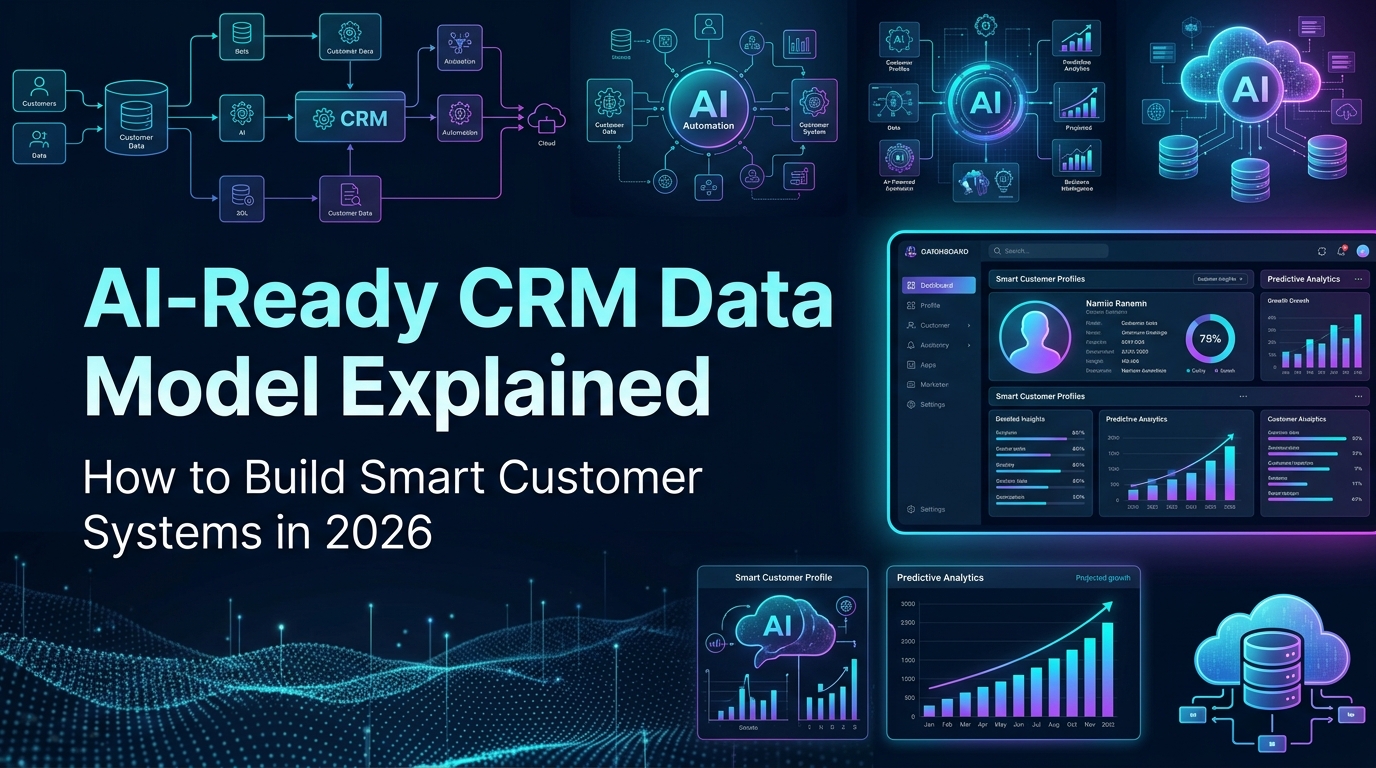
A strong customer data architecture is the backbone of an AI-ready CRM system. It includes several layers that work together.
1. Data Collection Layer
This layer gathers raw customer data from multiple sources:
Website interactions
Mobile apps
Email campaigns
Social media
Customer support chats
Sales interactions
2. Data Processing Layer
Here, raw data is cleaned and structured into a usable format.
Duplicate removal
Standardization
Error correction
Formatting consistency
3. Data Enrichment Layer
This layer enhances customer data using external and internal sources.
CRM data enrichment includes:
Demographic data
Behavioral signals
Purchase intent signals
Third-party data integration
4. AI Processing Layer
This is where machine learning models operate.
It enables:
Predictive customer analytics
Behavioral clustering
Churn prediction
Lead scoring
5. Activation Layer
This layer uses insights to trigger actions:
Automated emails
Personalized offers
Sales alerts
Customer journey optimization
CRM Data Structure: The Foundation of Intelligence
A well-designed CRM data structure is critical for AI success.
Instead of flat tables, modern CRMs use relational and event-driven models.
Key Data Entities
Customers
Leads
Transactions
Interactions
Products
Support tickets
Event-Based Tracking
Every customer action becomes an event:
Page view
Click
Purchase
Subscription
Complaint
This event-based structure is what enables real-time customer intelligence platforms.
AI-Powered CRM: How It Works
An AI-powered CRM goes beyond storing data. It actively learns from customer behavior.
Key Capabilities
Predictive lead scoring
Automated follow-ups
Smart recommendations
Dynamic segmentation
Sentiment analysis
For example:
If a customer repeatedly visits a pricing page but does not purchase, the AI system can automatically trigger:
A discount email
A sales call alert
A personalized offer
This is the power of automation combined with intelligence.
Customer Intelligence Platform Explained
A customer intelligence platform collects and analyzes customer data from multiple touchpoints to generate actionable insights.
It helps businesses answer:
Who are the most valuable customers?
What drives customer retention?
Which campaigns perform best?
Where are conversion gaps?
Benefits
Better decision-making
Higher customer retention
Improved marketing ROI
Personalized customer journeys
Predictive Customer Analytics in CRM Systems
One of the most powerful features of modern CRM systems is predictive customer analytics.
This involves using machine learning models to forecast future customer behavior.
Examples
Predicting churn probability
Forecasting lifetime value
Anticipating next purchase
Identifying upsell opportunities
With predictive analytics, businesses move from reactive to proactive strategies.
Instead of responding to customer behavior, they anticipate it.
CRM Automation: The Engine of Efficiency
CRM automation reduces manual tasks and improves efficiency.
Automated Workflows
Lead assignment
Email sequences
Follow-up reminders
Ticket routing
Customer onboarding
Automation ensures that no lead or customer falls through the cracks.
AI + Automation
When combined with AI, automation becomes intelligent:
Emails adapt based on behavior
Offers change based on user intent
Sales alerts trigger based on scoring
Customer Segmentation Data for Smarter Targeting
Customer segmentation data allows businesses to divide users into meaningful groups.
Types of Segmentation
Demographic segmentation
Behavioral segmentation
Geographic segmentation
Psychographic segmentation
Purchase history segmentation
AI enhances segmentation by dynamically updating groups based on real-time behavior.
For example:
A customer can move from "cold lead" to "hot prospect" instantly based on engagement signals.
AI Customer Insights: Turning Data into Action
AI customer insights transform raw CRM data into meaningful business intelligence.
Examples of Insights
Best-performing marketing channels
High-value customer profiles
Drop-off points in sales funnel
Product affinity patterns
These insights help businesses make faster and smarter decisions.
CRM Data Enrichment: Why It Matters
Without enrichment, CRM data is incomplete and less useful.
CRM data enrichment improves data quality by adding missing information.
Sources of Enrichment
Third-party databases
Social media profiles
Behavioral tracking
External APIs
Enriched data leads to better AI predictions and more accurate segmentation.
Building an Intelligent Customer Management System
An intelligent customer management system combines all the above elements:
Clean data structure
AI models
Automation workflows
Real-time analytics
Enriched customer profiles
Result
A system that:
Understands customers deeply
Predicts behavior
Automates engagement
Improves revenue outcomes
The Role of Data Files in AI CRM Systems
Modern AI systems often require structured data files for training and configuration.
This is where tools like:
txt file creator
text file generator
llms.txt file generator
generate llms.txt
llms txt file
firecrawl llms.txt
become useful.
What is llms.txt?
An llms.txt file is a structured text format used to guide AI systems or large language models on how to interpret or use specific data sources.
It is often used for:
Website data structuring
AI training instructions
Content indexing
Knowledge base formatting
Why CRM Systems Use Text File Generators
A text file generator or txt file creator helps convert CRM data into structured formats for:
AI training models
Data ingestion pipelines
Knowledge base preparation
Firecrawl llms.txt Use Case
Tools like firecrawl llms.txt help extract and structure website data into AI-readable formats, making it easier to integrate CRM data into AI systems.
Future of AI-Ready CRM Data Models
The future of CRM is fully AI-driven.
Trends in 2026 and beyond:
Fully autonomous CRM systems
Real-time predictive engines
Voice-driven CRM interfaces
Hyper-personalized customer journeys
Self-learning data models
Businesses that adopt AI-ready CRM systems early will gain a major competitive advantage.
Conclusion
The shift toward ai-ready crm data model systems is transforming how businesses manage customer relationships. Traditional CRM tools are no longer enough in a world driven by data, automation, and intelligence. Modern organizations need structured customer data architecture, strong CRM data structure, and advanced AI-powered CRM systems that enable predictive insights, automation, and real-time decision-making.
By leveraging customer intelligence platforms, predictive customer analytics, CRM automation, and CRM data enrichment, businesses can build truly intelligent customer ecosystems. At the same time, tools like txt file creator, llms.txt file generator, and structured data formats like llms txt file are becoming important for AI integration and data processing.
Frequently Asked Questions
1. What is an AI-ready CRM data model?
An AI-ready CRM data model is a structured system that organizes customer data in a way that allows AI systems to analyze, predict, and automate customer interactions effectively.
2. Why is customer data architecture important in CRM systems?
Customer data architecture ensures that data is clean, structured, and connected, which helps AI models generate accurate insights and improve decision-making.
3. How is AI-powered CRM different from traditional CRM?
AI-powered CRM uses machine learning to predict customer behavior, automate workflows, and provide intelligent recommendations, while traditional CRM mainly stores customer information.
4. What is CRM data structure?
CRM data structure refers to how customer information, interactions, transactions, and events are organized within a CRM system for efficient processing and analysis.
5. What are customer intelligence platforms?
Customer intelligence platforms collect and analyze data from multiple sources to provide actionable insights about customer behavior, preferences, and value.
6. How does predictive customer analytics work in CRM?
Predictive customer analytics uses AI and machine learning to forecast customer actions such as purchases, churn risk, and lifetime value based on historical data.
7. What is CRM automation?
CRM automation is the use of technology to automatically perform repetitive tasks such as email follow-ups, lead scoring, customer segmentation, and workflow management.
8. Why is CRM data enrichment important?
CRM data enrichment improves customer profiles by adding missing or external data, making AI predictions and segmentation more accurate.
9. What is customer segmentation data used for?
Customer segmentation data is used to group customers based on behavior, demographics, or interests to deliver more personalized marketing and communication.
10. What is llms.txt and why is it used?
llms.txt is a structured text file format used to guide AI systems in understanding and processing website or CRM data for indexing, training, or automation purposes.
Written by