Is ChatGPT an LLM or Generative AI? Full 2026 Guide

Artificial intelligence is changing the way people work, communicate, learn, and create content online. From AI chatbots to image generators and smart assistants, AI tools are now part of daily life for businesses, students, marketers, and developers.
One question that continues to appear frequently is:
Is ChatGPT an LLM or generative AI?
The answer is simple but important:
ChatGPT is both a Large Language Model (LLM)-powered system and a generative AI application.
However, many people confuse these two terms because they are closely connected. Understanding the difference can help you better understand how AI works, how businesses use it, and why tools like ChatGPT are becoming so powerful in 2026.
In this detailed guide, we will explain:
What ChatGPT is
What an LLM means
What generative AI means
The differences between LLMs and generative AI
How ChatGPT works
Real-world applications
Benefits and limitations
Future trends in AI technology
Whether you are a student, content creator, marketer, developer, or business owner, this guide will help you clearly understand modern AI technology.
What Is ChatGPT?
ChatGPT is an AI-powered conversational chatbot developed by OpenAI. It is designed to understand human language and generate intelligent, human-like responses.
Users can interact with ChatGPT by typing prompts or questions in natural language. The AI then responds conversationally within seconds.
ChatGPT can perform a wide range of tasks, including:
Writing blog posts
Generating emails
Creating marketing copy
Coding assistance
Answering questions
Summarizing documents
Translating languages
Brainstorming ideas
Tutoring students
Conducting research assistance
The reason ChatGPT feels natural is because it is powered by advanced language models trained on massive datasets.
What Does LLM Mean?
LLM stands for Large Language Model.
An LLM is a type of artificial intelligence model specifically trained to understand and generate human language.
These models are trained using enormous amounts of text data collected from:
Books
Websites
Articles
Academic papers
Conversations
Public datasets
The model learns:
Grammar
Context
Sentence structure
Language patterns
Word relationships
Human communication styles
The main goal of an LLM is to predict what word or sentence should come next based on the input it receives.
Simple Explanation of an LLM
Imagine reading millions of books and conversations over many years. Eventually, you become very good at predicting how people speak and write.
That is essentially how an LLM works.
It does not “think” like a human. Instead, it recognizes patterns in language and predicts responses based on training data.
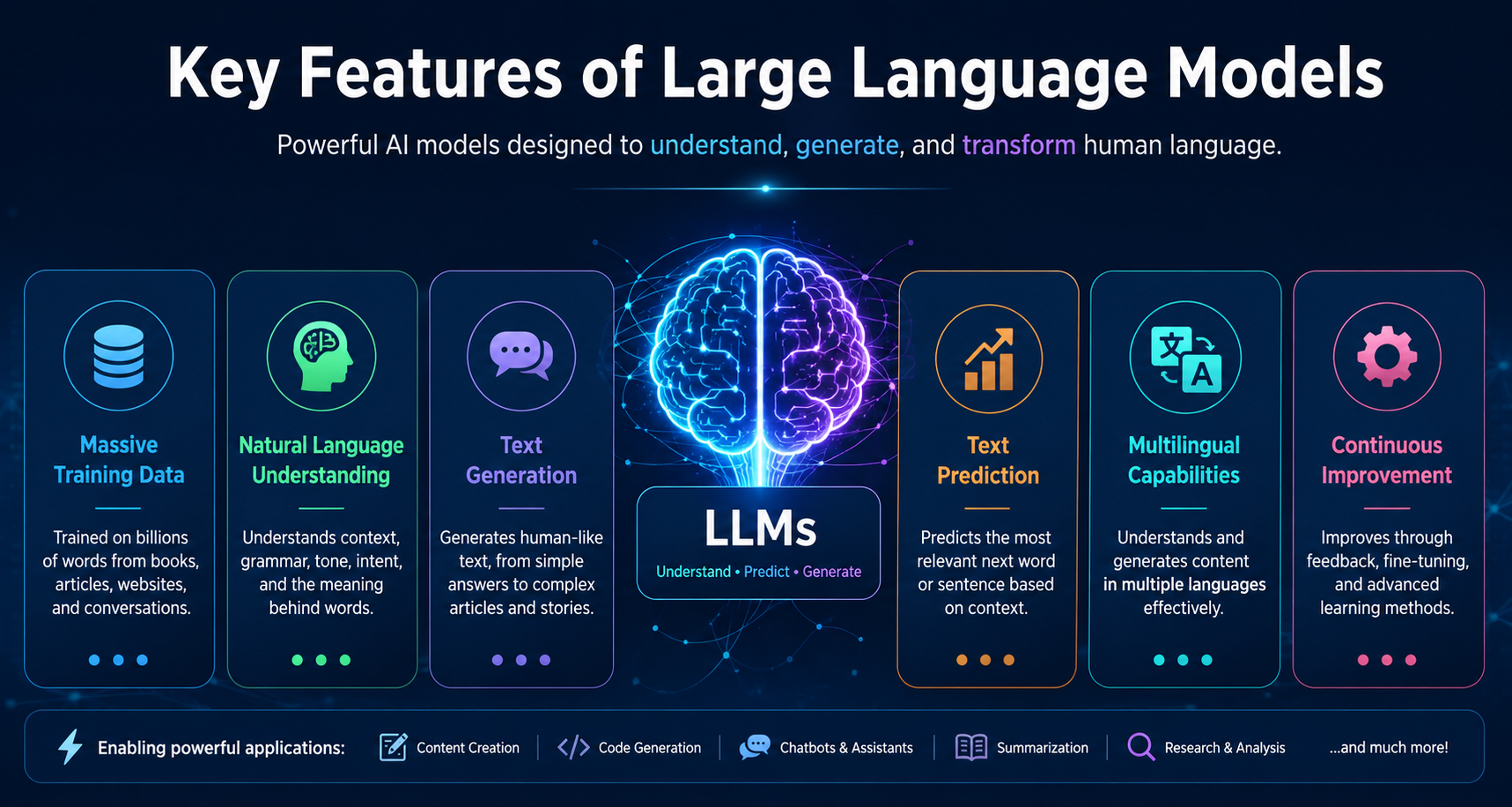
Key Features of Large Language Models
Massive Data Training
LLMs are trained on billions or trillions of words.
This huge training dataset helps the model understand:
Writing styles
Context
Tone
Facts
Language patterns
Natural Language Understanding
LLMs can understand:
Questions
Instructions
Conversations
Intent
Context
This is why ChatGPT can respond naturally.
Text Generation
LLMs can generate:
Articles
Stories
Emails
Product descriptions
Code
Scripts
Research summaries
Continuous Improvement
Modern LLMs improve through:
Reinforcement learning
Human feedback
Fine-tuning
Better datasets
Examples of Popular LLMs
Several companies have developed powerful large language models.
GPT Models by OpenAI
OpenAI GPT Models power ChatGPT and many AI applications.
Gemini by Google
Google Gemini focuses on multimodal AI capabilities.
Claude by Anthropic
Claude AI is known for safe and conversational AI interactions.
Llama by Meta
Meta Llama provides open AI models for research and development.
What Is Generative AI?
Generative AI refers to artificial intelligence systems that can create entirely new content.
Unlike traditional AI systems that mainly analyze or classify data, generative AI produces original outputs.
These outputs may include:
Text
Images
Videos
Audio
Music
Designs
Code
In simple words, generative AI creates things rather than only analyzing them.
Examples of Generative AI Tools
Text Generation
ChatGPT
Claude AI
Image Generation
Midjourney
Adobe Firefly
Video Generation
Runway
Music Generation
Suno AI
Is ChatGPT an LLM or Generative AI?
The correct answer is:
ChatGPT Is Both
ChatGPT uses an LLM as its core technology while functioning as a generative AI tool.
Here’s the difference:
Component | Role |
LLM | The underlying language model |
Generative AI | The broader category of AI-generated content |
ChatGPT | The application powered by the LLM |
Understanding the Relationship Between LLMs and Generative AI
A simple way to understand this is:
LLM = Engine
Generative AI = Capability
ChatGPT = Product/Application
The LLM enables ChatGPT to understand and generate language, while generative AI describes the overall ability to create new content.
How ChatGPT Works
Understanding how ChatGPT works helps explain why it is considered both an LLM-based tool and generative AI.
Step 1: Training Phase
The AI model is trained using massive text datasets.
It learns:
Vocabulary
Context
Human writing patterns
Communication structures
Step 2: Prompt Input
A user enters a question or instruction.
Example:
“Write a blog on digital marketing.”
Step 3: Language Prediction
The LLM predicts the most appropriate next words based on probabilities.
Step 4: Response Generation
The system generates a complete response that appears human-like.
This process happens almost instantly.
Why ChatGPT Became So Popular
ChatGPT became globally popular because it made advanced AI accessible to everyday users.
Easy to Use
Users simply type prompts naturally.
Multiple Use Cases
It supports:
Writing
Coding
Research
Learning
Automation
Fast Results
Tasks that once took hours can now be completed in minutes.
Human-Like Interaction
The conversational format feels intuitive and engaging.
Real-World Applications of ChatGPT
Content Creation
Businesses use ChatGPT for:
Blog writing
SEO articles
Ad copy
Product descriptions
Customer Support
AI chatbots can provide instant customer service 24/7.
Education
Students use ChatGPT for:
Homework help
Summaries
Language learning
Tutoring
Programming Assistance
Developers use AI for:
Debugging
Code generation
Documentation
Learning programming concepts
Business Productivity
Companies automate repetitive communication tasks.
Difference Between Traditional AI and Generative AI
Traditional AI
Traditional AI mainly:
Analyzes data
Makes predictions
Detects patterns
Example:
Fraud detection systems.
Generative AI
Generative AI creates new content.
Example:
ChatGPT writing a blog post.
Difference Between LLM and Generative AI
Many people mistakenly use these terms interchangeably.
Here is the actual difference:
Feature | LLM | Generative AI |
Definition | Language-focused AI model | AI category for content creation |
Purpose | Understand and generate text | Create various types of content |
Scope | Specific technology | Broader field |
Outputs | Mostly text | Text, video, images, audio |
Example | GPT-4 | ChatGPT, Midjourney |
Benefits of ChatGPT and LLM Technology
Increased Productivity
AI helps complete tasks faster.
Cost Reduction
Businesses can automate support and content creation.
Improved Creativity
AI assists with brainstorming and ideation.
Better Accessibility
People can access knowledge instantly.
Scalability
Businesses can handle larger workloads efficiently.
Limitations of ChatGPT
Despite its strengths, ChatGPT also has limitations.
Inaccurate Information
AI can sometimes generate incorrect or outdated answers.
No Real Understanding
ChatGPT predicts language patterns rather than truly understanding meaning.
Bias Risks
Training data may contain biases that affect responses.
Overdependence
Relying entirely on AI without human review can create problems.
SEO and Content Marketing With ChatGPT
In 2026, ChatGPT is heavily used in SEO and digital marketing.
AI-Assisted Blogging
Marketers use AI for:
Topic generation
Keyword optimization
Content outlines
Draft creation
Faster Research
AI speeds up competitor analysis and information gathering.
Content Scaling
Businesses can produce more content efficiently.
However, human editing remains essential for:
Accuracy
Brand voice
Originality
EEAT compliance
EEAT and AI Content in 2026
Google prioritizes content that demonstrates:
Experience
Expertise
Authoritativeness
Trustworthiness
AI-generated content can rank well if it is:
Helpful
Accurate
Original
Human-reviewed
Valuable to readers
Low-quality AI spam content is unlikely to perform well in search rankings.
Best Practices for Using ChatGPT
Fact-Check Information
Always verify:
Statistics
Medical advice
Financial guidance
Legal information
Edit AI Content
Human editing improves:
Readability
Tone
Accuracy
Originality
Add Personal Insights
Unique experience improves EEAT signals.
The Future of LLMs and Generative AI
The future of AI is moving toward:
Multimodal AI
AI agents
Personalized assistants
Real-time automation
Advanced reasoning systems
AI models are becoming:
Faster
Smarter
More context-aware
More accurate
In the coming years, generative AI will transform:
Education
Healthcare
Marketing
Software development
Entertainment
Customer service
Will Generative AI Replace Humans?
This is one of the biggest concerns surrounding AI.
The likely answer is:
AI will replace some tasks, not humans entirely.
AI works best as a productivity tool that assists people rather than fully replacing creativity, judgment, and human decision-making.
Human skills like:
Strategy
Emotional intelligence
Leadership
Creativity
Ethics
remain highly valuable.
Final Verdict: Is ChatGPT an LLM or Generative AI?
ChatGPT is both:
A system powered by a Large Language Model (LLM)
A form of generative AI
The LLM acts as the underlying technology that understands and predicts language, while generative AI refers to the broader ability to create original content.
Understanding this distinction helps businesses, marketers, students, and developers use AI more effectively in 2026 and beyond.
As AI continues to evolve, tools like ChatGPT will become even more integrated into daily life, reshaping how people communicate, work, and create content online.
To stay updated with the latest AI trends, SEO strategies, and LLM insights, visit LLM Progen.
Written by
Alex
Creative blogger sharing insights, stories, and fresh ideas.