LLM for Product Content Generation in 2026: Automate High-Converting

The ecommerce industry is entering a new era where LLM for Product Content Generation is becoming an essential part of digital retail. With thousands of products competing for customer attention, businesses can no longer rely on manually written product descriptions that consume valuable time and resources. Instead, Large Language Models (LLMs) are enabling brands to create high-quality, SEO-friendly, and conversion-focused product content in minutes.
In 2026, AI-powered content generation is no longer a futuristic concept—it is a competitive necessity. From startups to enterprise retailers, businesses are using AI product description generators to produce engaging product copy, optimize product pages for search engines, and maintain a consistent brand voice across thousands of listings. Whether you're managing a Shopify store, WooCommerce website, Amazon catalog, or a custom ecommerce platform, AI is helping teams scale faster while reducing operational costs.
Modern consumers expect detailed, accurate, and personalized product information before making purchasing decisions. At the same time, search engines reward websites that provide helpful, unique, and relevant content. This creates a significant challenge for ecommerce businesses with extensive product catalogs. Writing hundreds or thousands of unique descriptions manually is both expensive and time-consuming.
This is where LLM ecommerce content solutions excel. By combining natural language processing, semantic understanding, and advanced machine learning, today's AI systems generate compelling AI-generated product descriptions that appeal to both shoppers and search engines.
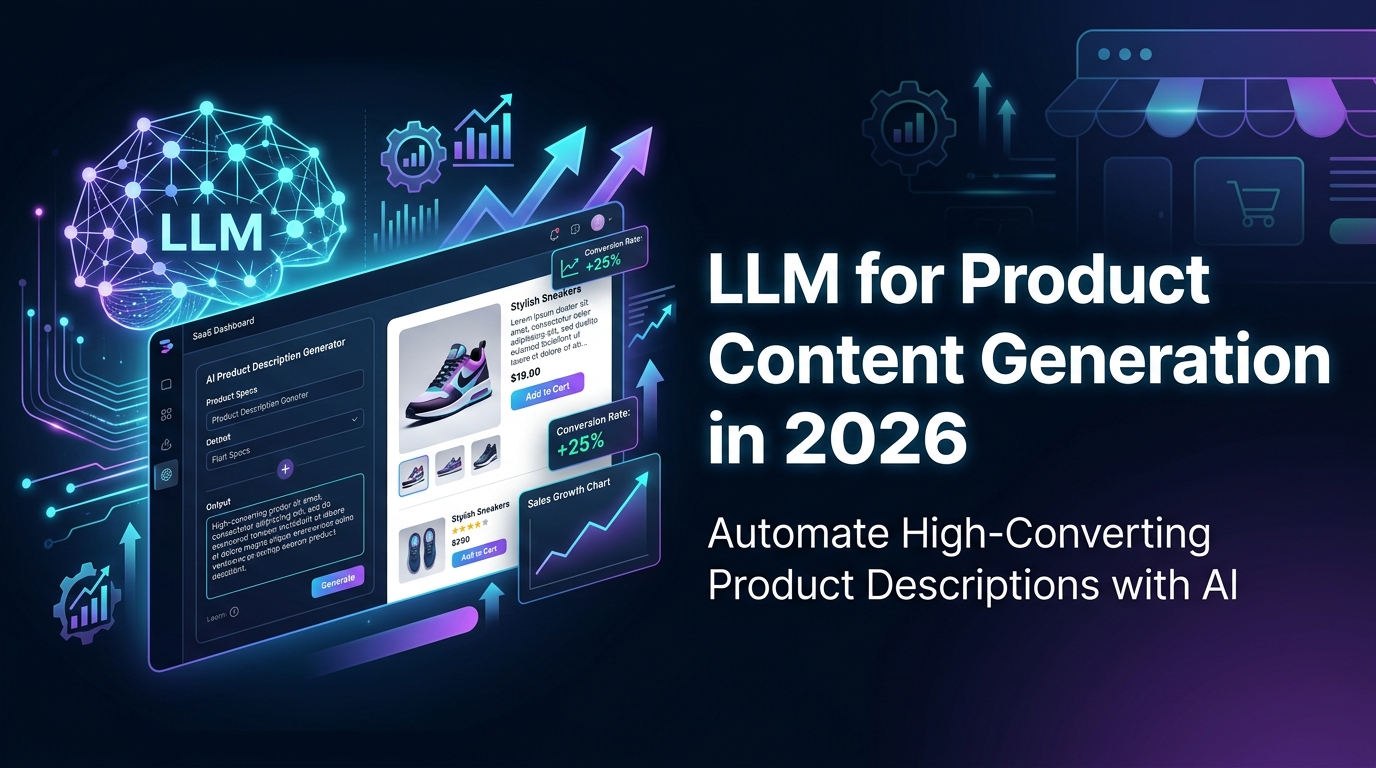
What Is an LLM for Product Content Generation?
A Large Language Model (LLM) is an advanced artificial intelligence system trained on vast amounts of text data to understand language patterns, context, grammar, and user intent. Unlike traditional content-generation software that depends on rigid templates, LLMs generate natural, human-like content tailored to specific products, audiences, and business objectives.
When applied to ecommerce, an LLM for Product Content Generation transforms raw product information into persuasive marketing copy. It can analyze product specifications, features, customer benefits, technical details, and brand guidelines to create complete product descriptions that sound authentic while remaining optimized for search engines.
For example, an ecommerce manager only needs to provide information such as:
Product name
Features
Specifications
Target audience
Brand voice
Primary keyword
Desired tone
How LLMs Work Behind the Scenes
Unlike earlier AI writing systems, modern LLMs understand relationships between words rather than simply predicting isolated phrases. They analyze context, user intent, and semantic meaning to produce coherent and relevant content.
The process typically includes:
Understanding Product Data
The AI reads structured information such as specifications, dimensions, materials, colors, pricing, and technical features.
Learning Brand Voice
Businesses can train or prompt LLMs to match their preferred tone—whether professional, luxurious, minimalist, technical, or conversational.
Generating Product Copy
Using advanced natural language generation, the model creates engaging descriptions that emphasize customer benefits rather than merely listing features.
SEO Optimization
Modern AI tools naturally integrate keywords like AI product copy generator, product listing optimization, SEO product copy, and AI writing for ecommerce without excessive keyword repetition.
Continuous Improvement
As customer behavior evolves, businesses can refine prompts and workflows to produce increasingly effective product content that aligns with changing search trends.
Why AI Is Transforming Ecommerce in 2026
Artificial intelligence has fundamentally changed how ecommerce businesses create, manage, and optimize content. What once required teams of copywriters, editors, and SEO specialists can now be completed significantly faster using AI-assisted workflows.
However, AI is not replacing human creativity—it is enhancing productivity by automating repetitive tasks while allowing marketers to focus on strategy, branding, and customer experience.
Several factors are driving this transformation.
1. Massive Growth in Product Catalogs
Modern online retailers often manage thousands or even millions of products. Each item requires:
Product title
Product description
Meta description
SEO keywords
Image alt text
Feature bullets
Category placement
Creating all of this content manually is expensive and difficult to scale.
An AI product description generator can produce optimized product copy for large catalogs in a fraction of the time, helping businesses launch products more quickly while maintaining consistency.
2. Customers Expect Better Product Information
Today's shoppers compare products across multiple websites before making purchasing decisions. They want:
Clear explanations
Benefit-focused descriptions
Accurate specifications
Helpful FAQs
Easy-to-read formatting
Trustworthy information
Generic manufacturer descriptions no longer provide enough value. AI enables businesses to rewrite and enhance product pages with unique, engaging, and informative content that improves user experience.
3. Search Engines Reward Helpful Content
Search engines have become increasingly sophisticated in evaluating content quality. Rather than rewarding pages with repeated keywords, modern algorithms prioritize content that demonstrates expertise, relevance, and usefulness.
AI-powered product descriptions can support these goals when they are reviewed, refined, and aligned with a brand's expertise. Businesses using AI content for online stores can efficiently produce unique, well-structured product pages that address customer questions and improve overall search visibility.
4. Personalization at Scale
One of the most exciting developments in AI-powered ecommerce is the ability to personalize content for different audiences.
Instead of using a single product description for every customer, businesses can create variations tailored to:
Different customer segments
Geographic regions
Languages
Seasonal campaigns
Marketing channels
Buyer intent
This level of personalization helps improve customer engagement while supporting higher conversion rates.
5. Faster Product Launches
Speed matters in ecommerce. Delays in publishing product pages can mean missed sales opportunities, especially during product launches, seasonal campaigns, or promotional events.
With AI product marketing content, businesses can generate complete product listings in minutes instead of days. This enables marketing teams to launch collections more efficiently while maintaining quality standards.
As AI technology continues to evolve, LLM for Product Content Generation is becoming one of the most valuable tools for ecommerce brands seeking scalable growth, stronger SEO performance, and better customer experiences. In the next section, we'll explore the key benefits of AI-generated product descriptions and compare the leading LLM platforms that are shaping ecommerce content creation in 2026.
Benefits of AI Product Description Generation
The rise of LLM for Product Content Generation is reshaping how ecommerce businesses operate by introducing speed, scale, and precision into content creation. One of the most significant advantages is the ability to generate high-converting product descriptions that are both SEO-friendly and customer-focused.
1. Massive Time Savings
Traditionally, writing product descriptions for an ecommerce store could take hours per product. For large catalogs, this becomes a bottleneck that slows down product launches and marketing campaigns. With AI product content generation, businesses can create hundreds of optimized descriptions in minutes.
This allows teams to focus on higher-value tasks such as:
Conversion rate optimization
Brand strategy
Customer experience improvement
Marketing campaigns
2. SEO-Optimized Content at Scale
Modern LLMs naturally integrate semantic keywords such as:
AI product description generator
SEO product copy
product listing optimization
ecommerce SEO content
This ensures that product pages are not only readable but also optimized for Google, Bing, and AI-driven search engines like ChatGPT browsing, Gemini, and Perplexity.
3. Consistent Brand Voice
Maintaining consistent tone across thousands of product pages is difficult for human teams. AI solves this by learning brand guidelines and applying them across all generated content. Whether the tone is luxury, technical, or conversational, LLMs ensure consistency across the entire catalog.
4. Higher Conversion Rates
AI-generated product descriptions focus on benefits rather than just features. This shift improves customer engagement and increases conversion rates. When combined with conversion rate optimization (CRO) strategies, AI content can significantly improve ecommerce revenue.
5. Multilingual Content Creation
Global ecommerce businesses benefit from AI’s ability to generate multilingual product descriptions instantly. This removes the need for separate translation teams and ensures faster global expansion.
Best LLMs for Ecommerce Content Creation in 2026
Several advanced LLMs are leading the transformation of ecommerce content generation:
1. GPT-Based Models (OpenAI)
GPT models are widely used for AI copywriting for ecommerce due to their strong language understanding and creativity. They excel in producing persuasive product descriptions and marketing content.
2. Claude AI (Anthropic)
Claude is known for producing structured, safe, and highly readable content. It is particularly useful for large-scale product catalog optimization where consistency is critical.
3. Gemini AI (Google)
Gemini integrates deeply with Google’s ecosystem, making it ideal for SEO-focused product content that aligns with search engine ranking signals and AI Overviews optimization.
4. Open-Source LLMs
Models like Llama and Mistral provide cost-effective solutions for businesses that want full control over their AI content generation workflow.
LLM vs Traditional Copywriting
Feature | Traditional Copywriting | AI LLM Content Generation |
Speed | Slow | Extremely fast |
Cost | High | Low |
Scalability | Limited | Unlimited |
SEO Optimization | Manual | Automated |
Brand Consistency | Variable | High |
Personalization | Difficult | Easy |
While human copywriters remain essential for brand storytelling and creative campaigns, LLMs dominate in scalability and operational efficiency.
Implementation Strategy for Ecommerce Businesses
To successfully implement AI product content automation, businesses should follow a structured workflow:
Step 1: Data Preparation
Collect structured product data including:
Features
Specifications
Pricing
Target audience
Category details
Step 2: Prompt Engineering
Create optimized prompts such as:
“Generate a high-converting SEO product description using keywords: AI product description generator, ecommerce SEO, product listing optimization.”
Step 4: Human Review
Even though AI is powerful, human editing ensures:
Brand tone accuracy
Fact-checking
Emotional alignment
Step 5: SEO Optimization
Refine content using:
Internal linking
Schema markup
Keyword placement
Readability optimization
AI Workflow for Product Content Automation
A modern ecommerce AI pipeline typically includes:
Product data ingestion
LLM-based content generation
SEO enrichment layer
Human validation
CMS publishing (Shopify, WooCommerce, Magento)
This workflow reduces manual workload while improving consistency across thousands of product pages.
Why Businesses Are Switching to AI in 2026
The shift toward AI-powered ecommerce content is driven by:
Rising competition in online retail
Need for faster product launches
Demand for SEO optimization at scale
Growth of AI-driven search engines
Increased focus on personalization
Companies that adopt LLM-based systems gain a significant competitive advantage in both organic search visibility and customer engagement.
Key Takeaway
The combination of LLM for product content generation, automation workflows, and SEO optimization is transforming ecommerce into a faster, smarter, and more scalable industry. Businesses that integrate these tools early are positioning themselves for long-term success in the evolving digital marketplace.
SEO Optimization for AI-Generated Product Content
As LLM for Product Content Generation becomes mainstream, SEO strategies have evolved beyond traditional keyword stuffing. In 2026, search engines like Google prioritize semantic relevance, user intent, and content helpfulness over exact-match keyword density.
AI-generated product descriptions must therefore be optimized not just for search engines, but also for AI-powered discovery systems such as Google AI Overviews, ChatGPT browsing, Perplexity AI, and Gemini Search.
Key SEO Factors for AI Product Content
To ensure strong rankings, businesses must focus on:
Semantic keyword integration (not repetition)
Structured product data (schema markup)
Internal linking between product pages
Clear benefit-driven copywriting
Mobile-first readability
Fast-loading product pages
Unique content per product
Important SEO terms naturally included in optimized content:
AI product description generator
ecommerce SEO
product listing optimization
SEO product copy
AI writing for ecommerce
Google AI Overviews Optimization (2026)
Google’s AI Overviews now summarize ecommerce content directly in search results. This means your product pages must be structured in a way that AI systems can easily understand, extract, and summarize.
How to Optimize for AI Overviews
1. Answer-Based Content Structure
Use clear Q&A-style formatting:
What is the product?
Who is it for?
What are the benefits?
Why should users buy it?
2. Structured Data (Schema Markup)
Implement:
Product schema
FAQ schema
Review schema
This helps AI systems extract product information accurately.
3. Entity Optimization
Include relevant entities such as:
Large Language Models
Generative AI
Ecommerce platforms like Shopify and WooCommerce
AI writing assistants
4. Clear Benefit Statements
Instead of only listing features, focus on:
How the product improves user life
What problem it solves
Why it is better than alternatives
LLM Optimization (LLMO) for 2026
A new SEO discipline has emerged: LLM Optimization (LLMO). This focuses on making content readable and usable by AI systems like ChatGPT, Gemini, Claude, and Perplexity.
Core LLMO Strategies
1. Natural Language Structure
Write content that mimics human conversation rather than robotic keyword placement.
2. Context-Rich Product Descriptions
LLMs perform better when content includes:
Product use cases
Industry context
Target audience
Comparison points
3. Prompt-Friendly Content Design
Structure content so AI systems can easily reuse it:
Clear headings
Bullet points
Short paragraphs
Defined sections
4. Semantic Depth
Instead of repeating keywords, use related concepts like:
AI content automation
product page optimization
ecommerce content strategy
conversion-focused writing
Common Mistakes in AI Product Content Generation
Even though AI is powerful, improper use can harm SEO performance.
1. Over-Reliance on AI Without Editing
AI content should always be reviewed for:
Brand tone accuracy
Factual correctness
Emotional appeal
2. Keyword Stuffing
Repeating phrases like “AI product description generator” excessively can reduce ranking performance.
3. Duplicate Content Across Products
Even AI-generated descriptions must remain unique per product.
4. Ignoring User Intent
SEO is not just about keywords; it is about solving customer problems.
5. Lack of Internal Linking
Product pages should link to:
Category pages
Related products
Blog content
Best Practices for Scaling AI Content in Ecommerce
To scale effectively using AI product content automation, follow these best practices:
1. Create a Central Prompt Library
Standardize prompts for:
Product descriptions
Meta descriptions
Category pages
FAQs
2. Use Hybrid Workflow (AI + Human)
Combine:
AI speed
Human creativity and validation
3. Implement Content Governance
Ensure consistency across:
Tone of voice
Brand messaging
Product accuracy
4. Integrate with CMS Systems
Automate publishing via:
Shopify APIs
WooCommerce plugins
Headless CMS platforms
5. Continuously Optimize Using Analytics
Track performance using:
CTR (Click-through rate)
Conversion rate
Bounce rate
Time on page
Future-Proofing Ecommerce Content Strategy
The future of AI-powered ecommerce content is deeply connected to automation and personalization. Businesses that invest in LLM workflows today will be better positioned for:
AI-driven search engines
Voice commerce
Hyper-personalized shopping experiences
Real-time content generation
Key Insight
In 2026, success in ecommerce SEO depends on combining LLM for product content generation with structured SEO strategy, semantic optimization, and AI-first search readiness.
Future of AI Product Content Generation
The future of LLM for Product Content Generation is moving toward fully autonomous ecommerce content systems where product pages are not just written once, but continuously optimized in real time.
In 2026 and beyond, we are seeing a shift from static product descriptions to dynamic AI-generated content ecosystems that adapt based on user behavior, search trends, and conversion data.
1. Real-Time Content Optimization
Instead of manually updating product pages, AI systems will:
Adjust product descriptions based on user engagement
Update keywords based on trending search queries
Modify tone based on customer segment
Optimize for conversion rates automatically
This makes AI product content generation a living system rather than a one-time task.
2. Hyper-Personalized Product Descriptions
Future LLM systems will generate different product descriptions for:
First-time visitors
Returning customers
High-intent buyers
Mobile users vs desktop users
Different geographic regions
This level of personalization will significantly increase engagement and conversion rates in ecommerce.
3. AI + Voice Commerce Integration
With the rise of voice assistants and AI shopping agents, product content will be optimized for:
Voice search queries
Conversational shopping experiences
AI shopping recommendations
LLMs will become the backbone of voice-ready ecommerce content.
4. Fully Automated Ecommerce Catalogs
In advanced systems, entire product catalogs will be:
Generated automatically from supplier data
Optimized for SEO instantly
Published without manual intervention
Continuously refreshed by AI agents
Conclusion
The rise of LLM for Product Content Generation marks a major shift in how ecommerce businesses create, optimize, and scale their product content. What once required large teams of copywriters can now be achieved through intelligent AI systems that combine speed, creativity, and SEO precision.
However, the most successful ecommerce brands in 2026 will not rely on AI alone. Instead, they will adopt a hybrid approach leveraging AI for scalability while using human expertise for strategy, storytelling, and brand identity.
Businesses that embrace AI product content automation, semantic SEO, and LLM optimization (LLMO) will gain a significant competitive advantage in organic search, AI-driven discovery platforms, and conversion performance.
The future is clear: ecommerce content is no longer just written—it is intelligently generated, continuously optimized, and deeply personalized.
Start integrating LLM-based product content generation into your ecommerce workflow today to scale faster, rank higher, and convert better in the AI-driven search landscape of 2026.
FAQ
What is an LLM for product content generation?
An LLM for product content generation is an AI system that creates SEO-optimized product descriptions, titles, and marketing content based on product data.
How do AI product description generators work?
They analyze product information using machine learning models and generate human-like, persuasive, and SEO-friendly product copy.
Can AI replace human copywriters in ecommerce?
AI cannot fully replace humans but significantly enhances productivity by handling repetitive product content tasks.
Which LLM is best for ecommerce content?
GPT-based models, Claude AI, and Google Gemini are among the most widely used LLMs for ecommerce content creation.
Are AI-generated product descriptions SEO-friendly?
Yes, when optimized properly with semantic keywords, structured data, and human editing.
How do LLMs improve conversion rates?
They focus on benefits, emotional triggers, and clarity, which improves customer engagement and purchase decisions.
What is LLMO in SEO?
LLMO (LLM Optimization) is the process of optimizing content so it performs well in AI-driven search engines and language models.
Written by
Alex
Creative blogger sharing insights, stories, and fresh ideas.