Most discussions about AI search optimization start with content about what to write, which keywords to target, how to structure an answer. That conversation matters, but it skips a more fundamental question: can the AI actually reach your content in the first place?
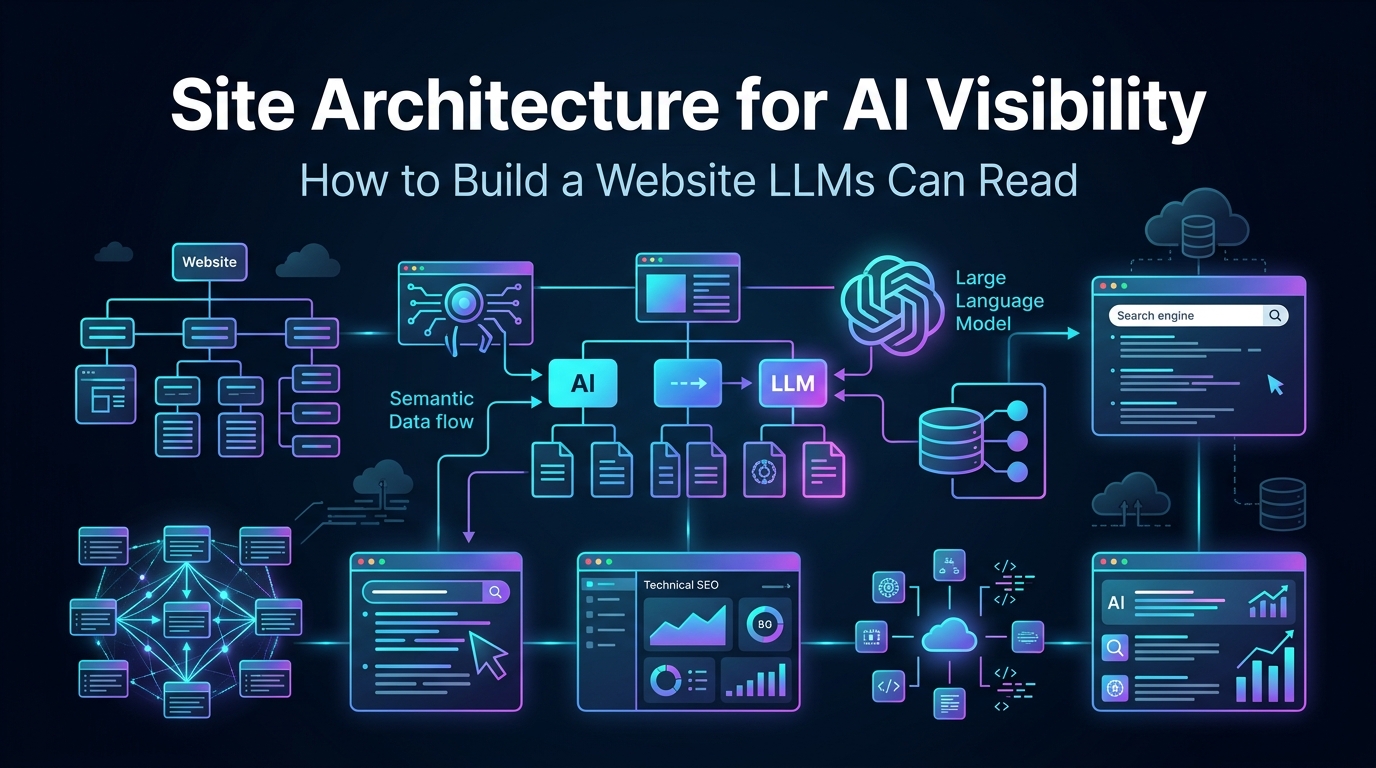
Site architecture is the layer beneath content strategy. It determines whether your pages are reachable, parsable, and retrievable by the AI crawlers powering ChatGPT, Perplexity, Gemini, and Claude. No matter how well-written your content is, if an AI crawler cannot access it or cannot make sense of what it finds, none of that writing quality matters. The page simply will not show up in AI-generated answers.
This guide walks through exactly what makes a website genuinely ai ready data from crawler access and rendering to schema markup, the emerging llms.txt file standard, and how to measure whether any of it is actually working.
Why Site Architecture Matters More for AI Visibility Than for Traditional SEO
Architecture has always mattered for SEO, but AI search raises the stakes on the technical layer for three specific reasons.
Multiple crawlers, multiple rule sets. Google Search operates with one primary crawler and well-documented behavior that most technical SEO teams understand deeply. AI search introduces at least seven crawlers a brand needs to actively manage, each with different access patterns, different rendering capabilities, and different levels of respect for crawl directives in your robots.txt file.
Far less tolerance for JavaScript-heavy rendering. Googlebot has become reasonably capable at rendering JavaScript over the past several years. Most AI crawlers have not reached that level of sophistication. A page that renders perfectly in Google Search Console can return completely empty or incomplete when an AI crawler requests it.
Architecture signals entity relationships directly to the model. Large language models build internal representations of entities and how those entities relate to one another. Your site's structure, internal linking, schema markup, and breadcrumb trails are the clearest signals available for communicating which entities matter on your site and how they connect. Traditional SEO uses these same signals, but generative engine optimization weights them more heavily because the model is reasoning about your content directly, not simply assigning it a rank position in a results list.
The AI Crawlers Your Site Actually Needs to Handle
Each major AI engine runs one or more dedicated crawlers, frequently with separate bots for training data collection versus live search retrieval. Understanding the distinct role of each one is the starting point for any serious ai ready data strategy.
Crawler | Operator | What It Does |
GPTBot | OpenAI | Trains future ChatGPT models. Allowing it means your content becomes part of what future models learn from. |
OAI-SearchBot | OpenAI | Powers ChatGPT's browsing and search mode. Allowing it is required for live ChatGPT citations. |
ChatGPT-User | OpenAI | Acts on behalf of an active user session for example, fetching a URL the user pasted directly into a chat. |
PerplexityBot | Perplexity | Crawls content for Perplexity's AI search engine. |
Perplexity-User | Perplexity | Fetches pages on demand when Perplexity users request them. |
Google-Extended | Controls whether Google can use your content to train Gemini. Entirely separate from standard Googlebot. | |
ClaudeBot | Anthropic | Crawls for Claude training data. |
Claude-SearchBot | Anthropic | Crawls specifically for Claude's search experiences. |
Bingbot | Microsoft | Powers Bing Search and, critically, ChatGPT's browsing mode which retrieves directly from Bing's index. |
CCBot | Common Crawl | An open dataset used as training data by many different AI models. |
Blocking any of these crawlers blocks the corresponding AI surface, either partially or entirely. Blocking Bingbot is a particularly consequential mistake: it blocks Bing Search visibility and simultaneously removes your site from ChatGPT's browsing mode, since ChatGPT retrieves results directly from Bing's index.
How to Configure robots.txt for AI Visibility
Most sites with AI visibility problems are blocking AI crawlers entirely by accident usually because their robots.txt file was written before these crawlers existed, and overly broad disallow rules catch them along with everything else.
A baseline robots.txt configuration for AI visibility allows the search-oriented AI crawlers while letting you make a separate, deliberate decision about training crawlers based on your own policy preferences.
A sample configuration that allows AI search visibility while still letting you opt out of model training:
# Allow AI search crawlers (these surface citations)
User-agent: OAI-SearchBot
Allow: /
User-agent: PerplexityBot
Allow: /
User-agent: Claude-SearchBot
Allow: /
User-agent: Bingbot
Allow: /
# Optional: opt out of training without affecting search
User-agent: GPTBot
Disallow: /
User-agent: ClaudeBot
Disallow: /
User-agent: Google-Extended
Disallow: /
The training-versus-search distinction is the decision most teams have genuinely not thought through. Allowing training crawlers lets your brand become part of the baked-in knowledge of the next generation of models. Blocking training crawlers protects your content from being learned from but does not affect live retrieval at all. Many brands ultimately choose to allow both, because training-layer presence is what shapes how AI models describe them by default when no live retrieval happens.
A few additional things worth watching for. CDN or WAF blocks Cloudflare and similar security services may rate-limit or challenge AI crawlers even when your robots.txt explicitly allows them, so check your bot management settings directly. A robots.txt allow rule is meaningless if your CDN is returning 403 errors regardless. Server-level user-agent blocking is invisible from a robots.txt audit alone some sites block AI bots directly in their web server configuration (nginx, Apache) rather than through robots.txt, and this requires a separate check. Reverse DNS verification matters too a bot claiming to be GPTBot in its user agent string may not actually be GPTBot, and some teams verify legitimate crawler IPs through reverse DNS before deciding what to allow.
Server-Side Rendering vs. JavaScript-Only: Why This Matters More for AI
Most AI crawlers do not execute JavaScript reliably. They fetch the raw HTML, parse what is there, and move on. If your main content only appears after JavaScript executes single-page applications, client-side React or Vue with no server-side rendering, content loaded via XHR requests AI crawlers may receive an essentially empty page.
There are three practical options for content you want AI crawlers to be able to retrieve.
Server-side rendering (SSR). The HTML the crawler receives already contains your full content. This is the most reliable option available. Next.js, Nuxt, and SvelteKit all support SSR natively. Older React or Vue setups can be retrofitted using Next.js or Nuxt, or rendered through a dedicated service like Prerender.io.
Static site generation (SSG). HTML is built entirely at deploy time and served as plain static files even more reliable for AI crawlers than SSR. Tools like Astro, Hugo, and Eleventy produce fully static output that any crawler, AI or otherwise, can read without issue.
Dynamic rendering for bots. This approach detects known bot user agents and serves them pre-rendered HTML while serving human visitors the full JavaScript application. It is less elegant than the other two options but works as a fallback for sites that cannot easily migrate to SSR. The risk of cloaking-style penalties is real if implemented carelessly, so this should be treated as a stopgap rather than a permanent solution.
The simplest diagnostic test available to anyone: load your page with JavaScript disabled in your browser. If the main content does not appear, it will not appear to most AI crawlers either.
Site Hierarchy and Link Depth
AI crawlers and the ranking models behind them use site structure as a direct signal of what matters most on your site. A shallow, well-linked hierarchy consistently outperforms a deep, sparsely linked one for both crawl efficiency and topical authority signals.
A few principles hold up consistently in practice. The three-click rule remains relevant: any page you want retrievable should be reachable within three clicks or fewer from your homepage. Pages buried deeper get crawled less frequently and weighted lower by both traditional search engines and AI retrieval systems.
Flat structure consistently beats deep hierarchy for AI parsing specifically. A flat structure organized around clear topic clusters outperforms an elaborate, deeply nested category tree. Crawlers gain nothing from elaborate taxonomies and neither human readers nor language models benefit from navigating through excessive hierarchy layers when a small set of well-developed sections would serve the same purpose more clearly.
The pillar and cluster pattern is worth implementing deliberately. A pillar page covering a broad topic links out to multiple cluster pages addressing specific sub-topics, and every cluster page links back to the pillar in return. This bidirectional linking pattern signals genuine depth on a topic and gives AI models a clear, navigable map of how your content fits together conceptually.
Breadcrumb navigation with BreadcrumbList schema makes your hierarchy machine-readable in addition to human-readable it tells both crawlers and language models the same structural information in two parallel formats.
Schema Markup That Actually Matters for AI Visibility
Structured data tells AI systems exactly what a page is about in a format they can parse without ambiguity removing the guesswork that unstructured text alone requires.
Schema Type | Apply To | What It Signals |
Article | Blog posts, guides, news | Author, datePublished, dateModified, headline core for any editorial content |
FAQPage | Pages with Q&A sections | Each Q&A becomes an extractable unit AI engines can pull directly as a citation |
HowTo | Step-by-step instructional content | Sequential steps with optional images and time estimates |
Product | Product pages | Name, brand, price, reviews, availability useful for product comparison queries |
Organization | Site-wide | Brand entity definition: name, logo, social profiles, contact details |
Person | Author and team pages | Author entity definition with credentials, affiliations, and sameAs links |
BreadcrumbList | Every page with breadcrumb navigation | Machine-readable site hierarchy |
WebSite | Site-wide | Site-level identity and search action configuration |
Two principles matter for getting schema implementation right. First, schema must match visible content exactly. FAQPage schema containing questions that do not actually appear on the visible page is a quality signal violation AI systems treat that mismatch as untrustworthy markup and may discount the page's credibility broadly, not just for that specific schema block. Second, connect schema across your site using @id references. A Person entity referenced by @id across multiple Article schemas builds a clear, traversable author entity graph that AI systems can use to reason about expertise and authority more confidently.
Validate every schema implementation using the Schema.org validator or Google's Rich Results Test. Schema errors frequently do not trigger visible errors in your CMS, but they can quietly and significantly reduce your AI visibility without any obvious warning sign.
The llms.txt Standard: Should You Implement It?
Llms.txt is an emerging proposed standard, similar in spirit to robots.txt or sitemap.xml, that provides AI systems with a structured summary of your site's most important content. It lives at on your domain and lists the specific pages you want AI models to prioritize when they crawl or reference your site.
As of 2026, no major AI engine officially requires an llm.txt file or has publicly committed to using it as a confirmed ranking signal. Several smaller AI tools and search engines do reference it already, and adoption of the standard continues growing steadily among technical SEO teams who recognize the asymmetric upside of implementing it early.
Whether to implement a llms.txt generator-produced file comes down to a simple cost-benefit calculation. Effort cost is low. A reasonable llms.txt file is a single markdown document listing your important URLs with short, accurate descriptions. Most sites can ship one within an hour using a txt file creator or manually. Downside risk is near zero. AI engines that do not use llms.txt simply ignore the file entirely implementing it does not block or confuse any existing crawler in any way. Upside potential is real but currently unproven. If the standard gains broader adoption across major AI engines, early implementers gain a clear, structured-summary advantage over competitors who have not yet implemented it.
This asymmetry favors implementing it as a defensive bet regardless of current uncertainty. A minimal llms txt file at your domain root should list your most important pages with one-line descriptions, and can optionally point to a more detailed llms-full.txt or sitemap for AI systems that want deeper context.
Using a Text File Generator or LLMs.txt File Generator to Build Yours
For teams that want to move quickly, a dedicated llms.txt file generator or text file generator can significantly reduce the manual effort of building this file from scratch. Several tools have emerged specifically for this purpose in 2026, automatically crawling your existing site structure and producing a draft llms.txt file that you can then review and refine.
Firecrawl llms.txt generation functionality is among the more widely used options for this specific task it can crawl your site's existing structure and content, then automatically produce a well-formatted llms.txt file based on what it finds, saving the manual work of cataloging every important page and writing descriptions by hand.
A general-purpose text file creator or txt file maker also works perfectly well for teams that prefer to build the file manually with full editorial control over which pages are included and how each one is described there is no technical requirement that the file be generated by a specialized tool, only that the final content follows the expected format.
For organizations specifically focused on llm.txt for seo purposes using the file as part of a broader generative engine optimization strategy rather than just technical compliance the description text for each listed page deserves the same care you would put into a meta description, since it may directly influence how an AI system summarizes or represents that page when citing it.
Getting Indexed by the Right Engines
Allowing crawlers access does not automatically guarantee indexation. Each search engine feeding the major AI surfaces has its own distinct indexation workflow, and two of them matter significantly more than the rest.
Bing deserves the most attention of any single indexation target. Because ChatGPT's browsing mode retrieves results directly from Bing's index, getting properly indexed by Bing is the single most consequential indexation step available for improving ChatGPT visibility specifically. Submit your sitemap through Bing Webmaster Tools, and use Bing's IndexNow API for new pages this notifies Bing of changes in near real time rather than waiting for the next scheduled crawl cycle.
Google remains the foundation for Google AI Overviews and Gemini-powered answer surfaces. Standard Search Console submission practices still fully apply here. Use the Google-Extended directive in robots.txt specifically to control whether your content can be used for Gemini training, without that decision affecting your standard Google Search rankings at all.
Beyond these two primary engines, smaller search engines like DuckDuckGo and Brave Search feed some additional AI tools, but most teams do not need to optimize for them individually if a site is properly indexable by both Google and Bing, smaller engines typically pick up the same content without additional dedicated effort.
Site Speed and Core Web Vitals: Do They Matter for AI Retrieval?
Less than they matter for traditional SEO, but not zero.
AI crawlers generally have less patience than Googlebot when fetching content. A page that loads slowly is meaningfully more likely to be partially fetched, timed out entirely, or skipped altogether on a given crawl pass. There is no officially documented Core Web Vitals scoring system specifically for AI retrieval, but practical, hands-on experience across many sites suggests some useful working benchmarks. Server response times under 600 milliseconds are generally safe. Pages taking longer than 3 seconds to first byte risk incomplete fetching by AI crawlers specifically. CDN configuration matters meaningfully here too AI crawlers originating from data center IP ranges can hit entirely different cache rules than typical user requests do. And aggressive bot mitigation systems can return 5xx or 4xx errors to entirely legitimate AI crawlers, blocking retrieval completely without any obvious indication that this is happening.
Server log analysis is the genuine truth check here. If your logs show AI crawlers consistently receiving frequent 4xx or 5xx response codes, retrieval is technically happening but failing at the response stage this is a fixable problem that most teams simply never look at closely enough to notice.
A Practical Site Architecture Audit for AI Visibility
Run through this complete checklist quarterly, or immediately whenever your AI visibility metrics drop unexpectedly without an obvious explanation.
Access layer. Confirm robots.txt does not block GPTBot, OAI-SearchBot, PerplexityBot, ClaudeBot, Claude-SearchBot, Bingbot, or Google-Extended unless you have deliberately decided to restrict one of them. Confirm your CDN or WAF Cloudflare, Akamai, or similar is not challenging or rate-limiting AI crawlers. Confirm server-level user-agent blocking is not silently in place. Confirm there is no login wall or paywall sitting in front of content you actually want cited.
Rendering layer. Confirm main content is fully visible with JavaScript disabled in the browser. Confirm server-side rendering, static generation, or dynamic rendering for bots is properly in place. Confirm time to first byte is under 600 milliseconds. Confirm there are no timeouts or 5xx errors specifically for AI crawler user agents appearing in your server logs.
Structure layer. Confirm all important pages sit within three clicks of your homepage. Confirm pillar and cluster pages are linked bidirectionally as intended. Confirm breadcrumbs and BreadcrumbList schema are properly in place. Confirm URLs are clean, descriptive, lowercase, and hyphen-separated throughout. Confirm your XML sitemap has been submitted to both Bing Webmaster Tools and Google Search Console.
Schema layer. Confirm Article schema exists on all blog and guide pages. Confirm FAQPage schema exists on pages with genuine Q&A sections, with the schema content actually matching what is visible on the page. Confirm Organization schema is implemented site-wide. Confirm Person schema exists on author pages and is properly connected to articles via @id references. Confirm all schema has been validated through Google's Rich Results Test or the schema.org validator.
Emerging signals. Confirm an llms.txt file exists at your domain root, listing your important pages. Confirm your site is verified in Bing Webmaster Tools with the AI Performance report actively being monitored on a regular cadence.
How to Measure Whether Your Architecture Is Actually Working
Architecture work is only genuinely useful if you can determine whether it is producing the retrieval and citation outcomes you actually want.
Server log analysis remains the single most underused diagnostic available to most teams. Filter your server logs specifically for AI crawler user agents GPTBot, OAI-SearchBot, PerplexityBot, and the others covered earlier and examine how often each one is hitting your site, which specific pages they hit most frequently, and what response codes they are actually receiving. A consistent 200 response on a regular cadence means the crawler is successfully reaching your content. Frequent 404s, 403s, 429s, or 5xx errors mean retrieval is breaking down somewhere in your technical stack.
Bing Webmaster Tools' AI Performance report provides genuine first-party data showing how often your site is being cited in ChatGPT and Copilot answers specifically. It is free, reasonably accurate, and worth combining with the standard Search Performance report for Bing organic rankings context.
Dedicated AI visibility tracking platforms have become an important category of tooling in 2026. Platforms like Writesonic, Profound, Otterly, Peec AI, and Similarweb's AI Search Optimization Suite query AI engines directly with target prompts and report exactly which pages get cited in response. Writesonic in particular handles cross-engine tracking across ChatGPT, Perplexity, Gemini, and Claude with prompt-level attribution which lets you determine specifically whether a given architecture change, such as a sitemap resubmission, a schema rollout, or a JavaScript-to-SSR migration, actually shifted your citation rates afterward.
Manual schema and rendering tests round out a complete measurement approach. Run target pages through Google's Rich Results Test, Bing's URL Inspection tool, and the schema.org validator directly. Use the Wayback Machine or a headless browser to fetch your pages with JavaScript disabled and see precisely what an AI crawler would actually receive when it requests that page.
Understanding AI-Ready Data Beyond Your Website
The principles covered in this guide apply specifically to website architecture, but the broader concept of ai ready data extends well beyond public-facing web pages. Understanding what is ai ready data in a fuller sense means recognizing that any structured information source not just websites needs to be formatted, organized, and made accessible in ways that AI systems can reliably parse and reason about.
This matters increasingly for businesses building internal AI applications as well as public-facing visibility. An ai-ready crm data model, for example, applies remarkably similar principles to customer relationship data that this guide applies to website content clear entity definitions, consistent relationship structures between records, and accessible formatting that allows AI systems to extract accurate, reliable information rather than guessing at ambiguous or inconsistently structured data.
A genuine llm-ready data platform whether that is your public website, your internal knowledge base, or your customer data infrastructure shares the same underlying requirements across every context: accessible without unnecessary technical barriers, structured with clear and consistent hierarchy, marked up with explicit semantic meaning rather than implicit visual formatting alone, and validated regularly to ensure the structure has not silently drifted out of sync with the actual content it is supposed to represent.
Understanding how llms parse web pages specifically reading raw HTML rather than rendered visual output, weighing structural signals like headings and schema markup heavily, and building entity relationships from linking patterns rather than purely from visual page layout is the conceptual foundation that makes every technical recommendation in this guide make sense as a coherent system rather than a disconnected checklist of individual technical tasks.
Key Takeaways
Allowing the right crawlers is genuinely non-optional in 2026. GPTBot, OAI-SearchBot, PerplexityBot, ClaudeBot, Claude-SearchBot, Google-Extended, and Bingbot are the specific bots every team needs to actively think through and configure deliberately.
Server-side render whatever content you actually want retrieved. JavaScript-only content remains effectively invisible to most AI crawlers operating today.
Keep important pages within three clicks of your homepage, and use pillar and cluster patterns deliberately to express genuine topical depth in a way that is structurally legible to both crawlers and human readers.
Implement Article, FAQPage, Organization, and Person schema as an absolute baseline, and connect entities across your site using @id references to build a coherent, traversable entity graph.
Ship an llms.txt file. The implementation cost is low, and the asymmetric upside justifies doing it even before the standard achieves widespread, confirmed adoption across every major AI engine.
Get properly indexed in Bing. It is the prerequisite for ChatGPT browsing-mode citations specifically, and it remains the single most overlooked lever available to most technical SEO teams.
Measure consistently using server logs, Bing's AI Performance report, and dedicated AI visibility tracking platforms. Without genuine measurement, every architecture change you make is fundamentally a guess rather than a verified improvement.
Frequently Asked Questions
Should I block GPTBot to protect my content from AI training?
This depends entirely on your specific policy preferences regarding AI training data. Blocking GPTBot prevents your content from training future OpenAI models but does not affect live ChatGPT search citations, which depend instead on OAI-SearchBot and Bingbot. Many brands choose to allow training crawlers specifically because that baked-in model knowledge shapes how AI systems describe their brand by default, even outside of live retrieval scenarios.
Does llms.txt actually work?
As of 2026, no major AI engine has officially confirmed using llms.txt as a ranking or citation signal, though several smaller AI tools and search engines do reference it. Given the minimal implementation cost and essentially zero downside risk, it is reasonable to treat it as a low-cost defensive bet on a standard that may gain broader adoption rather than as a guaranteed visibility lever today.
How is site architecture for AI different from technical SEO?
The underlying principles overlap significantly both care about crawlability, structure, and clear signals. The key difference is which signals get weighted most heavily. Traditional SEO assigns your page a rank position within a results list. Generative engine optimization involves the model directly reasoning about your content's meaning and relationships, which means entity signals like schema markup and internal linking patterns carry proportionally more weight than they typically do for traditional ranking algorithms.
Do I need to optimize my site for every AI crawler separately?
Not in most practical cases. Focus your primary effort on the crawlers covered in this guide GPTBot, OAI-SearchBot, PerplexityBot, ClaudeBot, Claude-SearchBot, Bingbot, and Google-Extended since these cover the overwhelming majority of meaningful AI search traffic. Smaller, less common AI tools generally piggyback on the same underlying indexes that Google and Bing maintain, so optimizing for those two primary engines typically covers the smaller ones indirectly as well.
How long does it take to see results from architecture changes?
This varies meaningfully depending on the specific change and your site's existing crawl frequency. Robots.txt changes and CDN configuration fixes can show measurable results within days, since crawlers typically revisit sites on a regular, often short cadence. Larger structural changes such as migrating from client-side rendering to server-side rendering may take several weeks to fully propagate as crawlers rediscover and re-index the affected content across your site.
What is the single biggest architecture change I can make?
For most sites with an existing AI visibility problem, fixing robots.txt to properly allow the relevant search-oriented AI crawlers, combined with ensuring proper Bing indexation, produces the most immediate, measurable improvement relative to the implementation effort required. These two specific fixes resolve the most common and most consequential root causes of AI invisibility across the broad range of sites that struggle with this issue.
Written by