
Quick answer: Mobile rank tracking software monitors where your pages rank specifically on mobile search results, since mobile rankings often differ from desktop due to location, device type, and how Google serves results to smaller screens.
I have watched more than one client panic over a ranking report that only told half the story. Their desktop numbers looked fine, but their actual customers were searching on phones, and those results told a very different story. That gap is exactly why I stopped trusting desktop-only tracking a long time ago.
In this guide, I will explain what this kind of software actually measures, which features are worth paying for, and how to read the data without getting lost in numbers that do not reflect reality. I will also share two tables to make comparing your options easier before you commit to any tool.
Why Mobile Rankings Deserve Their Own Tracking
Google has ranked mobile search results separately from desktop for years now, largely because mobile-first indexing means the mobile version of a page is usually what gets crawled and evaluated first. Google's own documentation on mobile-first indexing confirms this shift has been the default for most sites since 2020.
This means a page that ranks well on desktop can still underperform on a phone, especially if it loads slowly, has intrusive pop-ups, or uses a layout that Google considers less mobile friendly. Ignoring this difference leaves a real blind spot in any SEO strategy.
I have seen businesses spend months optimizing a homepage for desktop, only to discover their actual mobile version was slower, cluttered with ads, or missing key information entirely. The two versions are not always identical, and assuming they are is one of the most common mistakes I run into.
Checking this manually is simple enough. Loading your own site on a phone with a slower connection, or using a mobile-friendly test through your browser, often reveals issues a desktop review misses completely.
What Mobile Rank Tracking Software Actually Measures
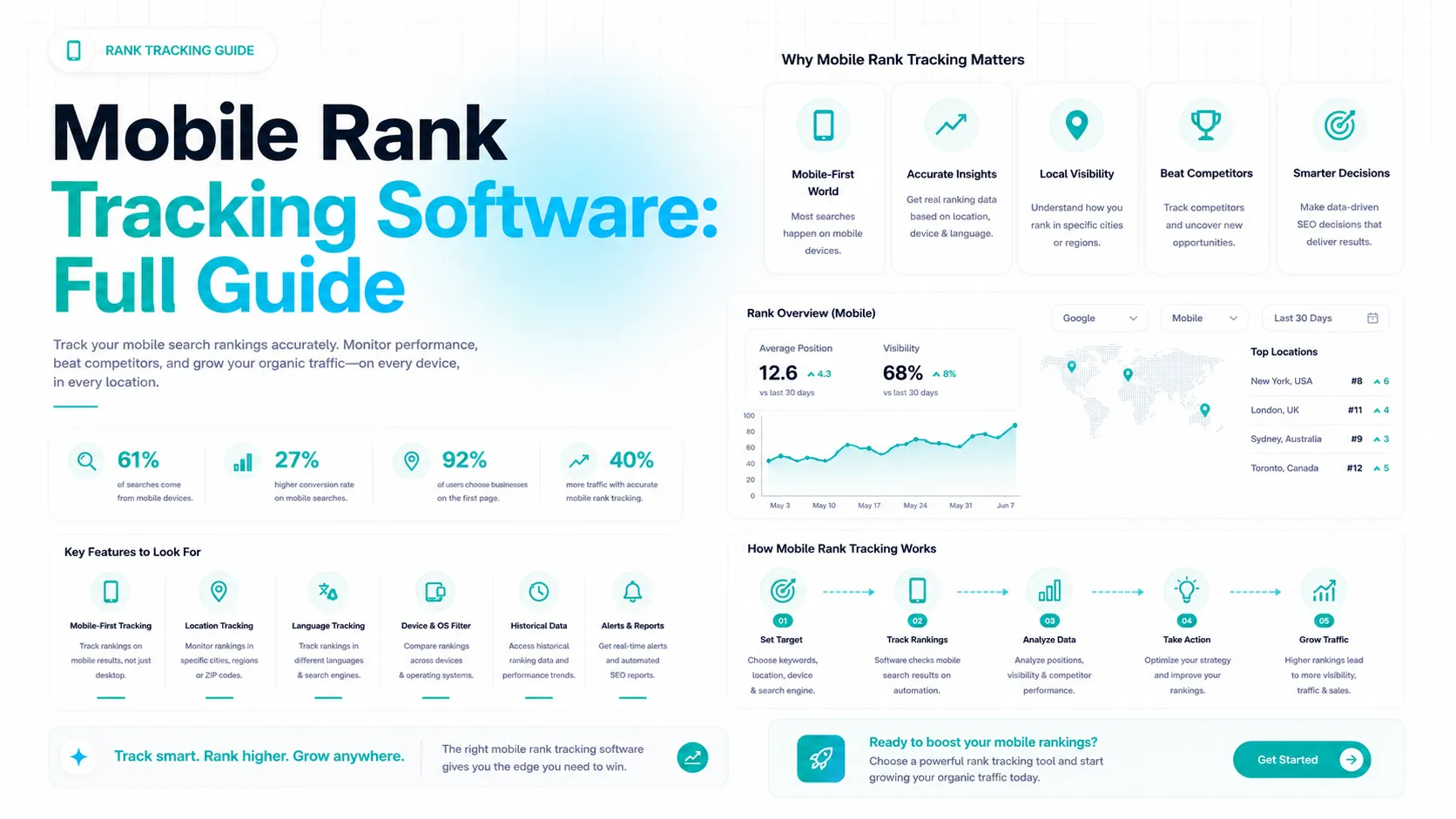
At its core, this type of tool checks where a page lands in mobile search results for a chosen set of keywords, then logs that position over time. Good tools also factor in location, since mobile searches are frequently tied to a specific city or even a specific neighborhood.
Beyond basic position, most platforms also track visibility trends, competitor movement for the same terms, and how often a page appears in features like local packs or featured snippets on mobile devices specifically.
Some tools also break results down by device type within mobile itself, separating tablet performance from phone performance. This extra layer is not essential for every business, but it can matter for sites with a large share of tablet traffic, since the on-screen experience differs enough to affect behavior.
Alerts are another feature worth checking for. A tool that flags a sudden drop for a priority keyword saves far more time than one that only shows the change buried in a weekly report you might not open right away.
Step 1: Decide What You Actually Need to Track
Before choosing a tool, I map out which keywords matter most for mobile traffic specifically. Local service terms, product searches, and anything with strong "near me" intent almost always deserve mobile tracking, since that is how most of those searches happen in the first place.
I also decide how often tracking needs to run. Daily checks make sense for competitive terms that move often, while weekly checks are usually enough for a smaller, steadier keyword set.
I try to avoid the trap of tracking every keyword the business could theoretically rank for. A focused list of twenty to fifty terms that actually drive calls or sales is far more useful than a bloated list of hundreds that nobody reviews consistently.
Step 2: Look for Location-Level Accuracy
Generic national tracking tells you very little if your business depends on local customers. I look for software that can simulate searches from a specific city or zip code, since rankings can shift block by block in competitive markets.
This level of accuracy matters most for local businesses and multi-location brands. A restaurant chain, for example, needs to know how each location ranks in its own area, not just an average across every city combined.
Even a single-location business benefits from this precision. A searcher three blocks away and a searcher three miles away can see noticeably different results, and knowing where that line sits helps prioritize which nearby neighborhoods actually need more attention.
Step 3: Check How Often Data Updates
Some tools update daily, others weekly, and the difference matters more than people expect. If rankings shift quickly in your industry, stale data can lead to decisions based on numbers that are already outdated by the time you see them.
I always test the update frequency during a trial period before committing to a paid plan. A tool that promises daily updates but delivers them inconsistently is worse than one that is honest about checking weekly.
Pricing usually scales with update frequency and the number of keywords tracked, so it helps to match the plan to actual need rather than buying the largest package available out of caution.
Must-Have Features vs Nice-to-Have Features
Not every feature matters equally, and paying for extras you will never use is a common mistake. The table below breaks down what I consider essential versus what is simply convenient.
Feature | Priority | Why It Matters |
Location-specific tracking | Must-have | Mobile searches are heavily tied to place |
Historical ranking trends | Must-have | Shows real progress instead of a single snapshot |
Local pack and snippet tracking | Must-have | Reflects features unique to mobile results |
Competitor position tracking | Nice-to-have | Useful context, not essential for every business |
White label reporting | Nice-to-have | Matters mainly for agencies reporting to clients |
I always start with the must-have list before even looking at pricing. A cheap tool missing core features costs more in wasted time than a slightly pricier one that actually does the job.
Free trials are worth using deliberately here. I run a short trial against a handful of known keywords first, then compare the reported positions to a quick manual search, just to confirm the tool's numbers actually line up with what a real searcher would see.
Step 4: Understand Mobile vs Desktop Ranking Differences
Mobile and desktop rankings can diverge for a handful of predictable reasons. Page speed carries more weight on mobile, since connections are often slower and patience runs shorter. Layout also matters more, since a page that looks fine on a large screen can feel cluttered or hard to navigate on a phone.
Local intent plays a bigger role too. A mobile searcher is more likely to be nearby and ready to act, which is part of why Google leans harder on proximity signals for mobile results specifically.
Text size, tap target spacing, and how easily a visitor can find a phone number or address also factor into the experience Google is trying to reward. None of these details show up directly in a ranking report, but they quietly shape the outcome behind it.
Mobile vs Desktop Ranking Factors
Seeing these differences side by side makes it easier to prioritize the right fixes first. This table lists where mobile ranking factors tend to carry more or less weight compared to desktop.
Ranking Factor | Mobile Weight | Desktop Weight |
Page load speed | Very high | Moderate |
Proximity to searcher | Very high | Low |
Mobile-friendly layout | Very high | Low |
Content depth | Moderate | High |
Backlink profile | Moderate | High |
Common Gaps I See in How Businesses Use This Data
A lot of businesses collect mobile ranking data and then never act on it. They watch numbers move without connecting those changes to a specific fix, like a slow-loading page or a layout issue on smaller screens.
This tends to happen when a report gets generated automatically and simply forwarded without review. A number on a page means little without someone asking why it moved and what, if anything, needs to change because of it.
The other gap is treating the report as the finish line. Tracking software tells you where you stand, not what to do next. The real value comes from pairing that data with actual changes to page speed, content, or site structure.
I try to review this data alongside the site's analytics, not in isolation. A ranking gain that does not translate into more calls, clicks, or visits usually points to a mismatch between what the page ranks for and what a mobile visitor actually needs once they arrive.
Setting a simple monthly review habit solves most of this. Even fifteen minutes spent comparing this month's positions to last month's, alongside a quick check of what changed on the site, catches far more problems than letting reports pile up unread.
Why Content Readability Matters Beyond Rankings
This is where I bring in LLMProGen. Mobile rank tracking software tells you where you stand in search results, but rankings increasingly depend on how easily both search engines and AI tools can read your content in the first place. A cluttered, code-heavy page hurts more than just load times.
LLMProGen converts a website into clean, structured, LLM-ready text, which makes it easier for AI-driven search features and answer engines to understand and summarize a page correctly. Pairing accurate mobile tracking data with content that has already been cleaned up is, in my experience, a strong way to stay visible as more mobile searches get answered directly by AI rather than a traditional results list.
Frequently Asked Questions
Is mobile rank tracking software worth paying for?
Yes, for any business relying on local or mobile-heavy traffic, since desktop-only data can hide real ranking gaps that affect actual customers.
How often should I check mobile rankings?
Weekly is enough for most steady keyword sets, though daily tracking helps with highly competitive or fast-moving terms.
Do mobile and desktop rankings ever match exactly?
Sometimes, but not reliably. Differences in speed, layout, and location signals mean the two can diverge significantly for the same keyword.
Can I track mobile rankings for free?
Some tools offer limited free tracking, though accuracy and location-level detail usually improve with a paid plan.
Does page speed really affect mobile rankings that much?
Yes. Slow-loading pages tend to lose both rankings and visitors on mobile, since patience for a slow site is generally much lower on a phone than on a desktop connection.
Final Thoughts
Choosing the right mobile rank tracking software comes down to a short list of priorities. Confirm it tracks location accurately, updates on a schedule that fits your industry, and reports on the features unique to mobile results. From there, the data only matters if you act on it.
If you want your content itself ready for how AI tools read and summarize mobile search results, LLMProGen can convert your site into clean, structured text built for that purpose. Try LLMProGen alongside your tracking data to make sure your rankings and your content readability move in the same direction.
Written by

Alex
Creative blogger sharing insights, stories, and fresh ideas.