4 Types of LLM Explained: Complete AI Models Guide 2026

Most AI tools you use today are powered by Large Language Models but not all LLMs work the same way. To understand their real capabilities, it is important to explore the 4 types of LLM and how each one is built for different tasks in modern artificial intelligence.
These models form the backbone of Large Language Models, AI model types, and machine learning systems used across industries such as education, business, and software development. Understanding the 4 types of LLM reveals how AI processes language, generates responses, and handles complex tasks efficiently. This foundation helps beginners and professionals better understand how today’s AI systems actually work in real-world applications.
What is an LLM?
A Large Language Model is an AI system trained on massive text datasets. It learns language patterns and predicts the next words in a sentence.
LLMs are part of modern machine learning models used in chatbots, search engines, coding tools, and automation systems. They help machines understand human language and respond intelligently.
Why Understanding the 4 Types of LLM Matters
Understanding the 4 types of LLM helps developers and businesses choose the right AI system for their needs. Each type has different strengths and weaknesses.
These models are used in AI model types that power real-world applications like translation, chatbots, and content creation. Choosing the wrong model can reduce accuracy and performance.
Type 1: Autoregressive LLM
The first and most widely used model in the 4 types of LLM is the autoregressive LLM. This model is the foundation of many modern AI systems, including chatbots, writing assistants, and code generators. It is designed to generate text in a natural, step-by-step way by predicting the next word based on the sequence of previous words.
Autoregressive models are powerful because they mimic human writing behavior. Instead of generating a full sentence at once, they build responses word by word. This makes them highly effective for conversational AI and content creation tools where natural flow and context matter the most.
How Autoregressive LLM Works
Autoregressive LLMs operate in a sequential manner. They read input text from left to right and predict the most likely next token based on probability. Each new word depends on the words that came before it, which helps maintain coherence and context throughout the sentence.
For example, if a user inputs the phrase “AI is”, the model analyzes training patterns and predicts possible continuations such as “powerful”, “transforming industries”, or “widely used today”. This prediction process continues until a complete response is formed.
This method is widely used in Large Language Models because it produces human-like text that feels natural and context-aware. The model learns from billions of text samples during training, allowing it to understand grammar, meaning, and relationships between words.
Autoregressive LLMs are commonly used in:
· Chatbots for customer support and conversations
· Content writing tools for blogs and articles
· Coding assistants for software development
· Story generation tools for creative writing
These applications show how flexible and scalable this model type is in real-world AI systems.
Strengths and Weaknesses
Like all AI systems, autoregressive LLMs have both advantages and limitations.
Strengths
One of the biggest strengths of autoregressive models is their ability to generate high-quality and natural-sounding text. They are excellent at maintaining conversation flow, which makes them ideal for interactive applications like chatbots and virtual assistants.
They are also highly scalable, meaning they can be trained on massive datasets and improved over time. This scalability is one of the main reasons they are widely used in modern AI model types.
Weaknesses
Despite their strengths, autoregressive LLMs also have limitations. They can sometimes generate incorrect or misleading information because they rely on probability rather than true understanding.
They also require large amounts of training data and computing power, which makes them expensive to build and maintain. In some cases, they may repeat similar phrases or produce slightly redundant responses if not properly optimized.
Type 2: Autoencoder LLM
The second important model in the 4 types of LLM is the autoencoder LLM. This type of model is designed mainly for understanding language rather than generating long responses. Its primary focus is to deeply analyze input text, extract meaning, and reconstruct or interpret the information in a structured way.
Unlike autoregressive models that generate text step by step, autoencoder LLMs process the entire sentence at once. This allows them to capture full context more effectively. Because of this, they are highly useful in tasks where understanding meaning is more important than writing long text outputs.
Autoencoder models play a key role in many modern AI model types, especially where classification, detection, and interpretation are required instead of creative generation.
How Autoencoder LLM Works
Autoencoder LLMs work by compressing input text into a dense internal representation, often called a “hidden representation” or “embedding.” This representation captures the meaning of the sentence in a compact form.
Once the model understands the input, it can either reconstruct it or analyze it depending on the task. This process helps the model focus on meaning, context, and relationships between words instead of predicting the next word like autoregressive models.
For example, if the input sentence is “The product is amazing and very useful,” the model will not generate a continuation. Instead, it will analyze the sentiment and understand that the text has a positive emotional tone.
This makes autoencoder LLMs very powerful for structured language tasks in machine learning models, where accuracy and understanding are more important than creativity.
These models are commonly used in:
· Sentiment analysis for understanding user opinions
· Spam detection in emails and messages
· Text classification for organizing content
· Document understanding for extracting key information
These use cases show how important autoencoder models are in real-world AI systems.
Strengths and Weaknesses
Autoencoder LLMs come with strong advantages but also some limitations depending on their use case.
Strengths
One of the biggest strengths of autoencoder models is their strong contextual understanding. They can analyze full sentences and capture deep meaning, which makes them very accurate in classification tasks.
They also process information quickly because they are not focused on generating long sequences of text. This makes them efficient for large-scale data processing tasks.
In many AI model types, autoencoder LLMs are preferred for systems that require accuracy, structure, and fast interpretation rather than creative writing.
Weaknesses
Despite their strengths, autoencoder LLMs are not ideal for generating long or complex text. They are not designed for storytelling or conversational flow, which limits their use in chatbot-style applications.
They also have limited flexibility compared to autoregressive models. Since their main focus is understanding rather than generation, they cannot easily adapt to open-ended conversational tasks.
Because of these limitations, autoencoder LLMs are usually combined with other models in advanced AI systems to create more balanced and powerful solutions.
Type 3: Sequence-to-Sequence LLM
The third model in the 4 types of LLM is the sequence-to-sequence LLM. This model is designed to transform one sequence of text into another sequence. It is highly useful when the input and output are both text but have different meanings or formats. Because of this ability, it plays a major role in translation, summarization, and rewriting systems in modern AI applications.
Sequence-to-sequence models are widely used in real-world systems where language conversion is required. Instead of simply predicting the next word or classifying text, they focus on converting information from one form to another in a structured and meaningful way.
These models are a key part of advanced AI model types used in global communication tools and automation platforms.
How Sequence-to-Sequence LLM Works
Sequence-to-sequence LLMs work using two main components that operate together to process and generate text efficiently.
Encoder
The encoder reads and processes the input text. It converts the input sentence into a compact internal representation that captures its meaning, context, and structure.
Decoder
The decoder takes this internal representation and generates the output text step by step. It ensures that the final output is meaningful, accurate, and contextually correct based on the original input.
For example:
Input: “Good morning”
Output: “Buenos días”
This simple transformation shows how powerful sequence-to-sequence models are in language conversion tasks.
These models are widely used in machine learning models that focus on language processing and transformation. They are especially important in systems that require accurate rewriting or translation between languages.
They are commonly used in:
· Machine translation systems like multilingual converters
· Text summarization tools that shorten long articles
· Paraphrasing tools that rewrite sentences
· Speech-to-text systems that convert audio into written text
These applications show how important sequence-to-sequence models are in modern AI systems that deal with structured language transformation.
Strengths and Weaknesses
Sequence-to-sequence LLMs are powerful but also have limitations depending on the task.
Strengths
One of the biggest strengths of sequence-to-sequence models is their excellent performance in translation tasks. They are designed specifically to understand input text and generate accurate output in another format or language.
They are also very good at structured transformations such as summarizing long content or rewriting sentences while preserving meaning. Their output is usually reliable and consistent when trained properly.
In many AI model types, these models are used as the backbone for systems that require accurate language conversion and transformation.
Weaknesses
Despite their strengths, sequence-to-sequence models require large datasets for training. Without enough data, their performance can drop significantly.
They are also slower compared to simpler models because they involve both encoding and decoding processes. This makes them less efficient for real-time applications.
Additionally, the training process is more complex, which requires more computational power and careful optimization to achieve high accuracy.
Type 4: Multimodal LLM
The fourth and most advanced model in the 4 types of LLM is the multimodal LLM. This model goes beyond text processing and is designed to understand and work with multiple types of data at the same time. It can process text, images, audio, and even video, making it one of the most powerful innovations in modern AI systems.
Multimodal models represent the future direction of Large Language Models because they bring human-like understanding closer to reality. Humans naturally combine different senses like sight and sound, and multimodal AI tries to replicate this ability in digital systems.
These models are widely used in advanced AI model types that require deep understanding, interpretation, and interaction across multiple formats.
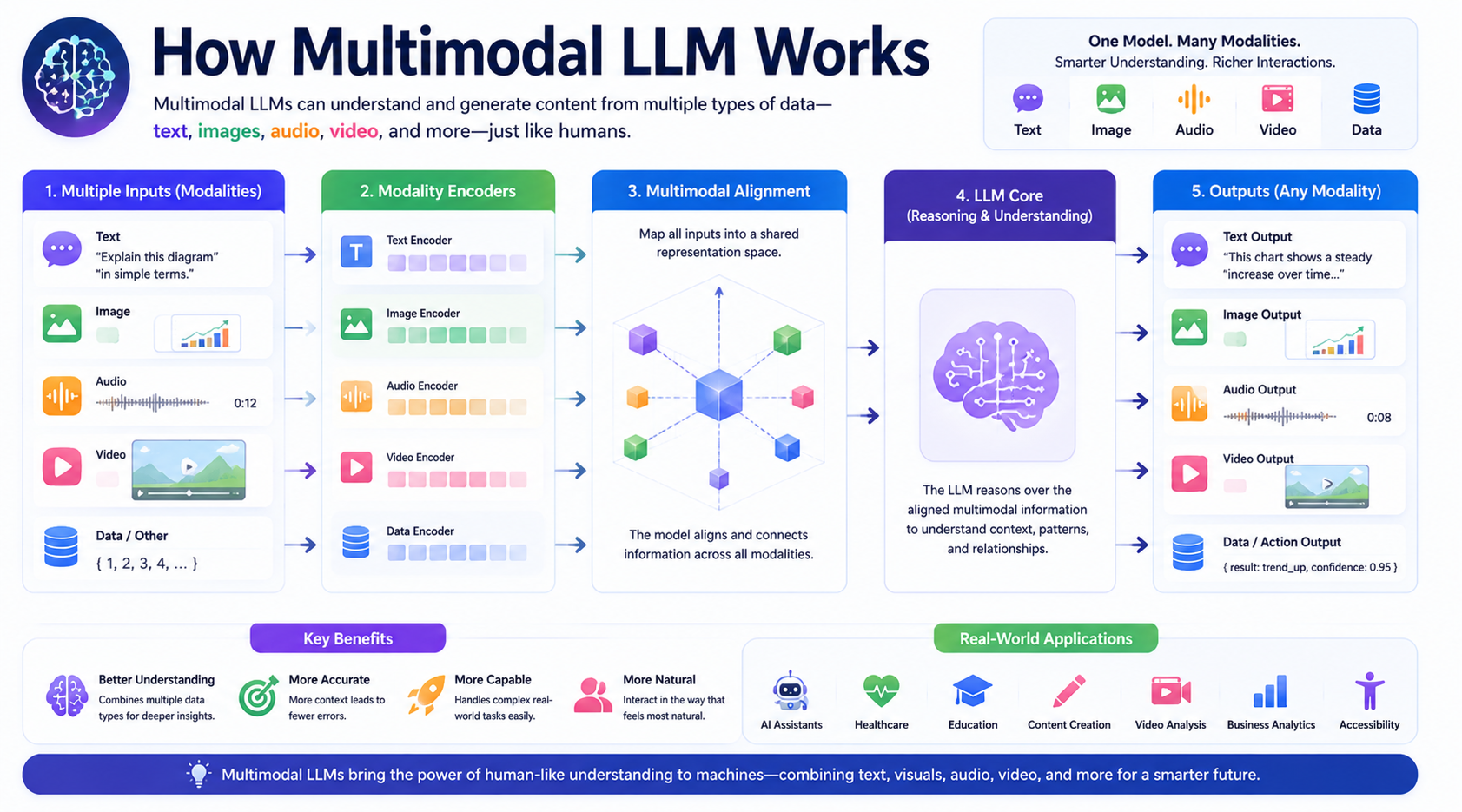
How Multimodal LLM Works
Multimodal LLMs work by combining different data sources into a single unified system. Instead of analyzing only text, they process multiple inputs together to create a more complete understanding of the situation.
For example:
Text + Image analysis helps AI understand what is written and what is shown in a picture
Audio + Text processing allows AI to convert speech into meaningful written insights
Video + Caption generation helps AI describe visual content in natural language
This ability to merge multiple data types makes multimodal models extremely powerful for real-world applications.
These systems are used in advanced machine learning models where understanding context from different formats is necessary for accurate results.
Multimodal LLMs are commonly used in:
AI assistants that can see, hear, and respond intelligently
Vision systems for image recognition and analysis
Smart search engines that understand images and text together
Advanced automation tools for business and research tasks
These applications show how multimodal AI is reshaping the future of technology.
Strengths and Weaknesses
Multimodal LLMs offer powerful capabilities, but they also come with certain limitations due to their complexity.
Strengths
One of the biggest strengths of multimodal models is their ability to understand multiple types of data together. This allows them to provide more accurate, intelligent, and context-aware responses compared to single-mode models.
They also have highly advanced reasoning ability because they can combine visual, audio, and textual information at the same time. This makes them extremely useful for real-world AI systems where information is not limited to text alone.
In modern AI model types, multimodal systems are considered the most advanced because they bring together different AI capabilities into one powerful framework.
Weaknesses
Despite their strengths, multimodal LLMs require very high computational power. Processing multiple data types simultaneously makes them resource-intensive and expensive to run.
They also require large-scale training datasets that include text, images, audio, and video, which increases development complexity.
Additionally, their architecture is highly complex, making them more difficult to design, train, and optimize compared to other LLM types.
Comparison Table of 4 Types of LLM
Type | Function | Use Case |
Autoregressive | Predict next word | Chatbots, writing tools |
Autoencoder | Understand text | Classification, sentiment |
Sequence-to-Sequence | Transform text | Translation, summarization |
Multimodal | Multi-data processing | AI assistants, vision AI |
Real-World Applications of LLM Types
The 4 types of LLM are used across industries like healthcare, education, finance, and marketing.
Examples:
· Chatbots use autoregressive models
· Email filters use autoencoder models
· Google Translate uses sequence-to-sequence models
· AI assistants use multimodal models
These applications show how deeply machine learning models are integrated into modern systems.
Case Study: AI Startup Using LLM Types
A startup built an AI platform using all 4 types of LLM.
They combined:
· Autoregressive for chat
· Autoencoder for classification
· Sequence-to-sequence for translation
· Multimodal for image understanding
After deployment, they achieved:
· 300% increase in engagement
· Faster response times
· Global user adoption
This shows how combining AI model types improves performance.
Future of LLMs in 2026
The future of the 4 types of LLM is moving toward hybrid systems.
New models will combine all four types into unified AI systems.
Platforms like these are working on advanced Large Language Models research and tools to support this evolution.
Expert Insights on LLM Evolution
Experts believe future AI systems will become more human-like in reasoning and learning.
Key trends:
· Smaller but smarter models
· Real-time learning systems
· Safer AI responses
· Multimodal integration
This will redefine how AI is used in daily life.
Benefits of Understanding the 4 Types of LLM
Learning the 4 types of LLM helps you:
· Build better AI systems
· Choose correct AI models
· Improve automation workflows
· Understand AI research
· Stay competitive in 2026
Final Thoughts
The 4 types of LLM are the foundation of modern artificial intelligence. Each model plays a unique role in how machines understand and generate language.
From chatbots to translation systems and multimodal AI, these models power the entire AI ecosystem. Understanding them gives developers and businesses a strong advantage.
To explore more AI tools, research, and guides, visit https://llmprogen.com/ and stay updated with the latest advancements in Large Language Models.
FAQs
1. Is ChatGPT an LLM or generative AI?
ChatGPT is both an LLM and a generative AI system. It is built on a Large Language Model architecture that understands and generates human-like text. As generative AI, it creates new responses, answers questions, writes content, and performs conversational tasks based on user input.
2. What are the 4 major models of AI?
The 4 major models of AI are reactive machines, limited memory, theory of mind, and self-aware AI. Reactive machines respond only to current inputs, while limited memory uses past data. Theory of mind and self-aware AI are future concepts that are still under research and development.
3. What are the various types of LLM?
The main types of LLM include autoregressive models, autoencoder models, sequence-to-sequence models, and multimodal models. Each type serves different purposes such as text generation, understanding, translation, and multi-format data processing like images and audio.
4. What are the 4 types of machine learning models?
The 4 types of machine learning models are supervised learning, unsupervised learning, semi-supervised learning, and reinforcement learning. Supervised learning uses labeled data, unsupervised finds hidden patterns, semi-supervised combines both, and reinforcement learning learns through rewards and feedback.
Written by
Alex
Creative blogger sharing insights, stories, and fresh ideas.