How to Start an Etsy Shop in 2026 (Step-by-Step Guide)

To start an Etsy shop, you create a seller account, set your shop preferences and currency, publish at least one listing, connect a bank account for payouts, and write your shop policies. Expect a possible one-time setup fee plus $0.20 per listing, a 6.5% transaction fee, and payment processing on every sale.
That's the short version. Now let me give you the useful one.
Most guides on how to start an Etsy shop are written by people who've never paid a single listing fee. I have. So in this guide, I'll walk you through the exact setup, the real numbers, and the 2026 policy changes that are quietly getting new sellers suspended.
No fluff. No "follow your passion" filler.
Ready? Let's go.
Is It Still Worth It to Sell on Etsy in 2026?
Before you spend a dollar, you deserve an honest answer. The internet is full of people telling you the marketplace is saturated — and other people calling it a goldmine. The truth is actually knowable, because Etsy is a public company that publishes numbers every quarter. So instead of guessing, I read the filings myself. Here's what they say, and why the figure you've seen elsewhere is probably wrong.
In the Q2 2026 shareholder letter, Etsy reported marketplace GMS of $2.6 billion, up 7.5% year over year — a third consecutive quarter of growth. Active buyers grew by roughly 350,000 to about 87 million.
Now notice something.
Nearly every article about how to open an Etsy shop still claims 90 to 96 million buyers. That number is stale. If you're doing niche research, work from the real one.
Trailing twelve-month GMS per active buyer sits near $124. The average shopper isn't dropping thousands, so your pricing strategy has to respect that.
The Real Cost to Sell on Etsy
Let's talk money, because this is where new sellers get blindsided. Opening an Etsy store isn't free, and the fee stack is layered in a way that's easy to underestimate until your first payout lands lighter than expected. Below is every charge, pulled from Etsy's own published rates rather than secondhand blog math. Read it twice. Your entire profit margin depends on internalizing these numbers before you set your first price.
Here's the complete breakdown of Etsy fees, per Etsy's seller page:
Fee Type | Amount | When It's Charged |
|---|---|---|
One-time shop set-up fee | Varies (shown before you finish setup) | Once, during onboarding |
Listing fee | $0.20 | On publish; renews every 4 months or on sale |
Transaction fee | 6.5% | On total sale price, shipping included |
Payment processing | 3% + $0.25 (US) | Per order |
Offsite Ads fee | 15%, or 12% above $10k/yr | Only on ad-attributed sales; capped at $100/order |
Currency conversion | 2.5% | Only if listing currency ≠ payment currency |
Etsy doesn't publish a fixed setup figure. Third-party trackers like Wix's cost breakdown put it between $15 and $29 depending on location, so treat any exact number as an estimate.
Payment Processing Rates by Country
Processing isn't flat worldwide. EcomCalcTools documents the variation:
Country / Region | Payment Processing Rate |
|---|---|
United States | 3% + $0.25 |
United Kingdom | 4% + £0.20 |
Many EU countries | 4% + €0.30 |
A Worked Example You Can Copy
Bullet points are abstract. So let me run a real sale through the whole stack, the way Craftybase does in its fee guide.
Sell an item for $100:
Transaction fee: $6.50
Payment processing: $3.25
Listing fee: $0.20
Total deducted: $9.95. You keep $90.05.
Roughly a 10% effective rate. So when someone claims Etsy takes 30%, they're counting ads or exaggerating. Want to model your own numbers? Run them through an Etsy fee calculator before you price anything.
How to Start an Etsy Shop: The 8-Step Setup
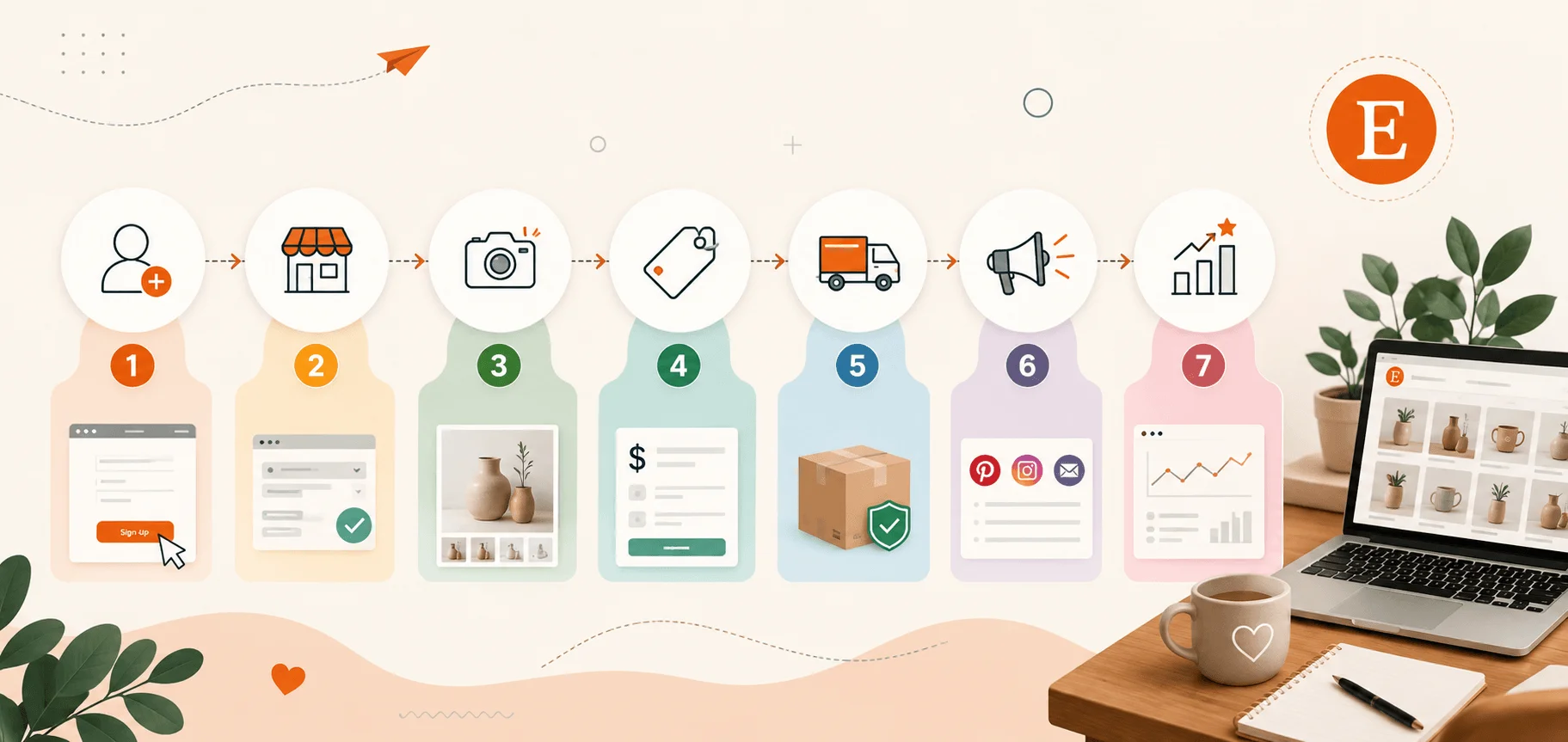
This is the part you came for. The actual Etsy shop setup takes under an hour if you've prepared, and most friction comes from decisions you should've made beforehand. I've ordered these steps the way Etsy's onboarding actually presents them, so follow along with two tabs open. Don't skip ahead — a couple of these choices (currency, shop name) are painful or impossible to reverse later.
Step 1: Choose Your Niche Before You Touch Sign-Up
Here's the mistake I see constantly.
People open the shop first, then wonder what to sell. Do it backwards.
Per Printify's 2026 category data, jewelry — especially personalized pieces — plus home and living, digital downloads, and craft supplies remain the leading categories. Digital products are the easiest high-margin entry for beginners.
If you're building this alongside other creative income streams, it helps to understand where marketplace selling fits into the wider digital creator landscape.
Step 2: Create Your Etsy Seller Account
Register at Etsy.com. If you already shop there, that same account works.
Etsy verifies your email. Keep a government-issued ID handy — identity verification is part of onboarding now.
Step 3: Set Your Shop Preferences
You'll choose language, country, and shop currency.
Pay attention here. If your Etsy Payments currency doesn't match your listing currency, that 2.5% conversion fee hits every sale.
Step 4: Pick a Shop Name You Won't Regret
Four to twenty characters. No spaces, no special characters.
Search it on Etsy first, then check whether the social handles and domain are free. Printify's setup guide suggests tools like Namelix for brainstorming.
Good shop name ideas are memorable first, searchable second. Don't jam a keyword into something that sounds robotic.
Step 5: Build Your First Listing
Etsy requires at least one listing before your shop opens. That $0.20 charges the moment you publish.
Upload up to 10 photos from multiple angles. Add a listing video if you can — it feeds your listing quality score.
For your listing title, front-load the phrase a buyer would type. Fill all 13 listing tags; every unused tag is a match opportunity thrown away.
In your listing description, lead with benefits. Short paragraphs. Nobody reads a wall of text on a phone.
Don't skip attributes and categories — they create extra matching surface. (More depth in my complete Etsy SEO guide.)
Step 6: Connect Billing and Get Paid
Link a bank account in your own name, with details matching your Etsy profile exactly.
Mismatched info delays payouts or triggers restrictions. US sellers usually verify through Plaid.
Choose whether you're selling as an individual or a business, and check local licensing rules rather than trusting a blog.
Step 7: Write Shop Policies and Shipping Profiles
This isn't paperwork. It's a ranking factor.
Etsy's search optimization checklist states that having shop policies positively affects search placement — and using Etsy's template gives an additional boost.
Set shipping profiles with honest processing times. Overpromising damages reviews, which damages ranking.
Step 8: Open Your Shop
Hit the button. You're live.
Then open Etsy Shop Manager and find the Etsy search visibility page, which shows how your shop, listings, and customer service score across the three areas Etsy measures. The Etsy Seller app gives you the same insights on your phone.
How Etsy Search Really Works (Straight From Etsy)
Most Etsy SEO advice is recycled guesswork. But Etsy publishes its ranking signals in a legal disclosure that almost nobody reads. I did. What follows comes directly from Etsy rather than a course seller with an affiliate link — and a few points contradict advice you've probably already absorbed. If you bookmark one section here, make it this one.
Per Etsy's ranking disclosures, the signals include:
Listing engagement rate — clicks, views, favorites, and purchases combined to predict conversion
Recency — new listings get a small, temporary boost so search can learn how buyers respond; renewals get a smaller version
Listing and shop quality — shop completeness, shop photo, image quality, return policies
Three Myths Worth Killing
Etsy's How Etsy Search Works says plainly:
Etsy Plus does not influence placement.
Star Seller doesn't directly affect result ordering.
Running Etsy Ads doesn't change organic placement outside designated ad spaces.
Etsy also ranks using Context Specific Ranking, personalizing results from shopper behavior.
Your customer and market experience score matters too. Etsy's customer service guide confirms 4- and 5-star ratings feed this score, and that new listings still appear in search without reviews — provided there are no other quality issues like missing photos or a missing return policy.
For a practitioner's breakdown, eRank's ranking factors post is worth your time.
The 2026 Policy Changes Getting Shops Suspended
Don't skip this one. Etsy tightened its creativity rules significantly, and the changes hit print on demand and digital sellers hardest. I've watched people build entire catalogs on a model that was permitted eighteen months ago and is now grounds for removal. If you plan to use purchased design bundles or AI tools, read every line before you list anything.
From August 11, 2026, items produced with computerized tools must be based on your own original design. ShieldMyShop's breakdown explains that someone else's template, a purchased clipart bundle, or a pre-made design file may trigger listing removal or suspension.
Here's the trap: a commercial license does not satisfy this rule. Legal permission from the designer is separate from Etsy's platform requirement. That applies whether you're using a Cricut, a laser cutter, or a 3D printer.
On AI, the rule is honesty, not prohibition. Etsy requires AI-generated items under "Designed by" rather than "Made by" or "Handmade." Calling pure AI output handmade can get you removed.
Disclose your production partner. Disclose AI. One clear line in the description does it.
Etsy vs. Other Selling Platforms
Etsy isn't your only option, and knowing where it sits helps you decide whether the fee stack is worth it. The short answer: Etsy trades a higher per-sale cut for built-in buyer traffic you don't have to pay to acquire. Standalone stores flip that trade — cheaper transactions, but you're buying every visitor yourself. Here's how the three main paths compare for someone starting out.
Factor | Etsy | Amazon Handmade | Shopify |
|---|---|---|---|
Monthly cost | $0 (standard) | $0 | Subscription required |
Per-sale cut | ~10% effective | ~15% referral + $0.99/item | 2.9% + $0.30 processing |
Built-in traffic | ~87M active buyers | Prime buyer base | None — you drive it |
Best for | Testing ideas fast | Established handmade lines | Owning your brand |
Your First 30 Days on Etsy
Setup is easy. What separates shops that earn from shops that stall is the four weeks after launch. Below is a simple cadence built around the one metric that predicts early success better than logos or Instagram followers: listing volume paired with listing quality. Follow it loosely — sequence matters more than exact days.
Days 1–7: List 20–30 products in one niche. Optimize every title and tag.
Days 8–14: Check your stats. Which listings pull views? Which get favorited? Add 10–20 more based on what works.
Days 15–21: Test Etsy Ads on your best performers only. Start at $1/day.
Days 22–30: Expand into a sub-niche. Keep listing.
Etsy traffic isn't the only traffic worth chasing. Once your listings are live, social becomes your cheapest channel — and timing matters more than most sellers assume, so it's worth knowing the best time to post on Instagram. Live selling works especially well for handmade goods too, since buyers see texture and scale in real time. Here's how to go live on Instagram if you haven't tried it.
Data compiled by MyDesigns suggests 50–100 well-optimized listings is roughly the tipping point where shops see consistent daily sales.
Four Mistakes That Kill New Shops
Inkedjoy's beginner guide names the same four failures I see constantly: skipping keyword research, underpricing, listing too few products, and leaning on ads instead of fixing organic conversion rate.
Fix those four and you're ahead of most of the marketplace.
Frequently Asked Questions
I pulled these from what people actually search before they create an Etsy store. Short answers, no padding — so you can get what you need and get back to building.
Is it free to open an Etsy shop?
Not entirely. Creating an account is free, but Etsy may charge a one-time shop set-up fee, displayed before you complete setup. After that, you pay $0.20 per listing, a 6.5% transaction fee, and payment processing on each sale. There's no required monthly subscription for a standard account.
How much does Etsy take per sale?
On a typical US sale, roughly 10%. That's the 6.5% transaction fee, 3% + $0.25 payment processing, and the $0.20 listing fee. On a $100 item, that's $9.95 total. It climbs toward 25% only if the sale came through Offsite Ads.
Do I need a business license to sell on Etsy?
Etsy doesn't require one to open a shop, but your local government might, depending on where you live and what you sell. Rules vary by country, state, and city. Check with your local authority rather than relying on general advice online.
How many listings should I start with?
Aim for 20–30 in your first week, then build toward 50–100. Data from established sellers suggests that's the range where shops start seeing consistent daily sales. Listing volume combined with listing quality predicts early success better than branding does.
How long until I make my first sale?
There's no guaranteed timeline. New listings get a small temporary visibility boost while Etsy learns how buyers respond, so having strong listings ready on day one helps you use that window. Most sellers see momentum build over weeks, not days.
Can I sell print on demand on Etsy?
Yes, but from August 11, 2026, the design must be your own original work — purchased templates and clipart bundles don't qualify, even with a commercial license. You must also disclose your production partner and select "Designed by" rather than "Handmade."
Do I have to disclose AI-generated designs?
Yes. Etsy requires AI-generated items to be attributed as "Designed by" rather than "Made by" or "Handmade," plus a clear disclosure line in the description. Failing to disclose can result in listing removal. Etsy doesn't ban AI — it requires honesty about how the item was made.
Is Etsy still worth it in 2026?
The data says yes, with effort. Q2 2026 marketplace GMS grew 7.5% year over year to $2.6 billion, with about 87 million active buyers. Competition is real, but sellers who pick a specific niche, optimize listings, and list consistently still build profitable shops.
What happens if my listing doesn't sell in four months?
It expires. Etsy auto-renews it by default and charges another $0.20. If you turn auto-renew off and let it lapse, no further fee applies. You can also manually renew at any point, which grants a smaller recency boost than a brand-new listing.
Can I sell digital downloads?
Yes, and they're the highest-margin option for beginners — no shipping, no inventory, unlimited stock. The $0.20 listing fee still applies per sale. Etsy's creativity standards now explicitly cover digital products, so the original-design requirement applies to printables and SVGs too.
Conclusion: Start Small, Start Now
Here's what I'd want you to take away from all this.
Starting an Etsy shop in 2026 isn't hard. The setup takes an hour. The fees are roughly 10% of a typical sale, not the 30% you've been warned about. And with around 87 million active buyers on the platform, the demand is genuinely there.
What's hard is the part after launch.
Most shops don't fail because the owner picked the wrong shop name or spent too little on a logo. They fail because they listed eight products, waited, and gave up. The sellers who make it treat the first month as a data-gathering exercise — list, watch, adjust, list again.
So pick one narrow niche. Publish twenty listings. Fill all thirteen tags on every single one. Write your shop policies using Etsy's template. Then check your Etsy search visibility page every week and fix what it tells you to fix.
Do that, and you're already ahead of most people who sell on Etsy.
One last thing, and I mean this seriously: read the August 2026 original-design rules before you list anything made with a template or an AI tool. It's the single most common reason I see new shops get suspended, and it's completely avoidable.
Now go open your shop.
Written by
Alex
Creative blogger sharing insights, stories, and fresh ideas.