
Most creators don’t lose reach on Instagram because of weak content. They lose it because their post appears when their audience is inactive. Timing decides whether a post gets ignored or picked up by the algorithm in the first hour.
The best time to post on Instagram is not a simple posting habit, it is a growth factor that controls visibility, engagement speed, and reach potential. When you understand engagement timing, audience activity patterns, content visibility, reach optimization, and growth strategy, you stop guessing and start posting with purpose. This guide explains how timing affects performance and how you can use it to turn every post into consistent growth opportunities.
WHY TIMING MATTERS ON INSTAGRAM
Posting time directly affects how fast your content gets engagement. Instagram does not show posts to everyone at once. It first tests your post with a small audience to measure reaction speed and interest level.
If engagement is strong in the first few minutes, the algorithm expands reach. If not, your post slowly loses visibility. That is why choosing the best time to post on Instagram is not optional anymore. It is a core ranking factor for organic growth and visibility.
Timing also affects competition. Posting when fewer creators are active increases your chances of standing out. That small advantage can completely change your reach performance.
IMPACT OF POSTING TIME ON ENGAGEMENT
Posting Time Strategy | Engagement Level | Reach Outcome |
Posting during peak hours | High | Strong viral potential |
Posting during low activity | Low | Limited reach |
Random posting | Unstable | Unpredictable growth |
HOW INSTAGRAM ALGORITHM REACTS TO TIME
Instagram uses real-time behavior tracking. It studies when users open the app, what they engage with, and how long they stay active.
If your content appears when users are online, the algorithm immediately tests it for engagement. This early activity determines whether your post gets pushed to Explore or remains limited.
That is why the best time to post on Instagram directly influences algorithm behavior. Timing affects impressions, reach, and even long-term account growth.
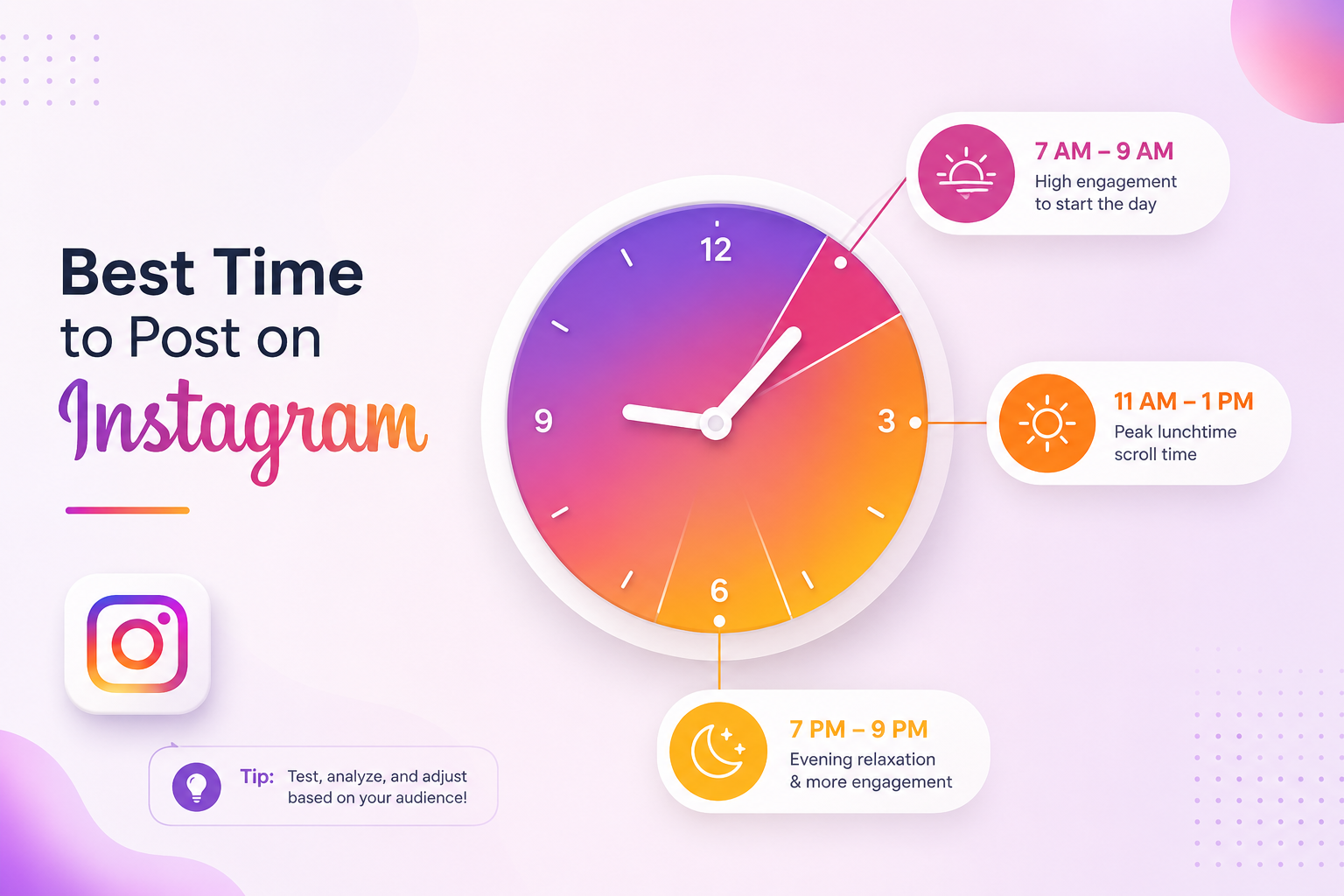
BEST TIME WINDOWS (GLOBAL DATA INSIGHT)
Across multiple studies and social analytics platforms, consistent patterns appear in Instagram usage behavior.
Most users are active during:
Early morning before work or school
Lunch breaks during the day
Evening relaxation hours after work
These are the strongest engagement windows when testing the best time to post on Instagram strategy.
Global Engagement Table
Time Slot | Engagement Level |
7 AM – 9 AM | High |
11 AM – 1 PM | Very High |
6 PM – 9 PM | Highest |
Even though these are global averages, performance still depends on your audience type.
FACTORS THAT CHANGE POSTING TIME
There is no fixed universal posting time. Every Instagram account has different audience behavior patterns.
Important factors include:
Time zone differences
Audience age group
Content niche
Lifestyle habits
Device usage patterns
For example, students are active late at night, while working professionals engage more in the morning or evening.
This is why finding your own best time to post on Instagram is more powerful than following generic advice.
BEST TIME BY AUDIENCE TYPE
Audience type plays a major role in engagement performance.
Teen audiences often scroll Instagram late at night. Fitness audiences engage early in the morning. Business audiences are active during breaks or after working hours.
Understanding your niche helps you identify the real best time to post on Instagram instead of guessing randomly.
HOW TO FIND YOUR PERSONAL BEST TIME
Instagram Insights is the most accurate tool for timing analysis. It shows real follower activity instead of estimated data.
Inside Insights, you can see:
Peak activity hours
Active days of the week
Engagement patterns by content type
This helps you build a custom posting schedule based on real data. Over time, this becomes your true best time to post on Instagram strategy.
INSTAGRAM ALGORITHM SIGNALS
Signal Type | Meaning | Impact on Reach |
Early likes | Fast engagement | High boost |
Comments | User interest | Strong ranking signal |
Saves | Content value | Long-term reach |
Shares | Viral potential | Maximum exposure |
CONTENT TYPE AND TIMING RELATIONSHIP
Different content formats perform differently depending on timing.
Reels often perform best in the evening when users have free time. Carousel posts perform better in the morning when users are more focused. Stories perform consistently throughout the day.
Matching content type with timing improves overall performance and helps refine your best time to post on Instagram strategy.
COMMON TIMING MISTAKES
Many creators lose reach because of simple timing mistakes. The biggest issue is posting without understanding when their audience is actually active. Even strong content fails if it appears at the wrong moment. Timing directly affects visibility, engagement speed, and algorithm performance on Instagram.
IGNORING AUDIENCE ACTIVITY DATA
Many users post based on guesswork instead of real data. They ignore Instagram Insights and never check when followers are online. This leads to low engagement because posts are shown when the audience is inactive or asleep. Without activity tracking, finding the best time to post on Instagram becomes almost impossible.
POSTING WITHOUT STRATEGY OR CONSISTENCY
Another major mistake is random posting. Some creators post too frequently, while others disappear for days. This inconsistency confuses the algorithm and reduces trust signals. A lack of posting strategy also weakens engagement patterns, making it harder to build stable reach over time.
IGNORING PERFORMANCE ANALYTICS
Analytics is often ignored, even though it is the most important growth tool. Without reviewing post performance, creators cannot identify what timing works best. This prevents improvement and keeps results inconsistent. Data helps refine the best time to post on Instagram, ensuring better reach and stronger long-term growth.
REAL CASE STUDY (GROWTH EXAMPLE)
A fitness content creator posted randomly for several months with low engagement results. After analyzing Instagram Insights, they adjusted posting time based on audience activity.
Within a few weeks, engagement increased significantly. Reach improved because posts aligned with active user hours.
This proves that the best time to post on Instagram can directly impact growth without changing content quality.
ROLE OF CONSISTENCY
Timing alone cannot guarantee growth. Consistency is equally important.
When you post regularly at optimal times, Instagram builds trust in your account activity. This improves reach over time.
The best time to post on Instagram becomes more effective when combined with a consistent posting schedule.
BEST PRACTICES FOR HIGHER ENGAGEMENT
To improve Instagram performance, you need more than just good timing. You need smart engagement habits that signal value to the algorithm. When these actions combine with the best time to post on Instagram, your reach increases naturally and consistently.
POST WHEN YOUR AUDIENCE IS ACTIVE
One of the most important habits is posting during peak audience activity. When users are already online, they are more likely to interact quickly. This early engagement helps your post gain momentum faster and improves visibility across the platform.
USE STRONG HOOKS IN CAPTIONS
Your caption decides whether users stop scrolling or ignore your post. A strong hook in the first line grabs attention instantly. It encourages users to read more, like, and comment. This improves engagement signals and strengthens the impact of your timing strategy.
REPLY TO COMMENTS QUICKLY
Engagement does not stop after posting. Responding to comments within the first hour increases interaction speed. Instagram sees this as active content and pushes it to more users. Fast replies also build trust and improve community engagement.
COMBINE TIMING WITH INTERACTION STRATEGY
Timing alone is not enough for growth. You must combine it with active engagement actions like replying, liking, and interacting with your audience. This creates stronger signals for the algorithm and maximizes the results of the best time to post on Instagram strategy.
ALGORITHM + HUMAN BEHAVIOR CONNECTION
Instagram is designed around human behavior patterns. People check their phones during breaks, mornings, commuting time, and before sleep.
These natural habits define engagement patterns more than any tool or theory.
Understanding this helps you predict the best time to post on Instagram with higher accuracy.
STRATEGY FOR FAST GROWTH
For faster Instagram growth, combine multiple strategies together.
Use timing analysis, content planning, hashtag optimization, and audience engagement techniques simultaneously.
This combination improves reach stability and strengthens your overall best time to post on Instagram performance.
IMPORTANCE OF TESTING AND ANALYSIS
No Instagram strategy is perfect from the beginning. Growth depends on continuous testing and improvement. Even the best creators refine their posting schedule over time based on real performance data. Without testing, you are only guessing, which limits long-term reach and engagement.
EXPERIMENT WITH DIFFERENT POSTING TIMES
To find the most effective schedule, you should test different posting hours consistently. Post at morning, afternoon, and evening slots for at least 2–3 weeks. This helps you understand how your audience reacts at different times and reveals hidden engagement patterns that basic assumptions often miss.
TRACK PERFORMANCE METRICS CAREFULLY
Testing alone is not enough. You must track results like reach, likes, comments, saves, and shares. These metrics show which time slots deliver the strongest engagement. Over time, patterns will appear that clearly indicate the most effective posting window for your account.
REFINE YOUR STRATEGY USING REAL DATA
Once you collect enough data, refine your posting schedule. Focus on the time periods that consistently perform best. This removes guesswork and builds a reliable system based on actual audience behavior. This process helps you identify your true best time to post on Instagram instead of relying on general advice.
LONG-TERM GROWTH STRATEGY
Instagram growth is not about one viral post. It is about consistent performance over time.
When you combine timing, content quality, and audience understanding, growth becomes stable and predictable.
The best time to post on Instagram is a long-term strategy, not a one-time trick.
CONCLUSION
Timing is one of the most powerful but still underestimated factors in Instagram growth. The best time to post on Instagram directly influences how fast your content receives early engagement, which is a key signal for the algorithm. When your post gets immediate likes, comments, and saves, Instagram pushes it to a wider audience, increasing visibility and reach.
However, timing alone is not enough. It works best when combined with strong content quality, clear messaging, and consistent posting habits. Creators who rely only on guessing often struggle, while those who study audience behavior see steady growth over time.
The real advantage comes from using data instead of assumptions. When you understand when your audience is active and align your posting schedule accordingly, every post has a higher chance of performing well. Over time, this builds stronger engagement, better rankings in feeds, and sustainable follower growth.
CTA
If you want smarter content strategies and growth tools, visit https://llmprogen.com/ and start improving your Instagram performance using data-driven methods.
FAQs
Which time is the best time to post on Instagram?
The best time to post on Instagram is usually 7 AM to 9 AM, 11 AM to 1 PM, and 6 PM to 9 PM, when users are most active. However, exact timing depends on audience behavior and time zones.
What is the 5-3-1 rule for Instagram?
The 5-3-1 rule means liking 5 posts, commenting on 3 posts, and following 1 new account daily. It helps increase engagement and build organic relationships without spam tactics.
What is the 4-1-1 rule in social media?
The 4-1-1 rule suggests sharing 4 valuable posts, 1 soft promotional post, and 1 direct promotional post. It maintains balance between value content and marketing content.
What is the most active time on Instagram?
The most active time on Instagram is generally morning (7–9 AM), lunch hours (11 AM–1 PM), and evening (6–9 PM), when users actively check their phones.
Written by

Alex
Creative blogger sharing insights, stories, and fresh ideas.