The best LLM optimization tools for AI visibility are the ones that help your content get found, understood, and referenced correctly by AI search engines and chat-based assistants. That is the short answer, and I want to walk you through everything else in this guide.
I have spent a good amount of time testing and researching how brands show up inside AI answers instead of just traditional search results. One thing became clear fast: most guides on this topic either oversell random tools or skip the real question, which is what actually makes a tool worth using for AI visibility. In this blog, I am breaking that down in plain language so you can make a confident decision.
What Is LLM Optimization
The best LLM optimization tools for AI visibility are the ones that help your content get found, understood, and referenced correctly by AI search engines and chat-based assistants. That is the short answer, and I want to walk you through everything else in this guide.
Unlike traditional SEO, which focuses mainly on ranking in a list of links, LLM optimization focuses on how clearly your content answers a question, how well it is structured, and how easily an AI system can pull accurate information from it. This is why AI visibility has become its own separate goal for many businesses.
Why AI Visibility Matters Right Now
More people are getting answers directly from AI tools instead of clicking through a list of search results. If your content is not structured in a way these systems can understand, you simply will not show up in those answers, even if your website ranks well in traditional search.
This shift means AI visibility is no longer optional for brands that want to stay relevant. Content needs to be clear, well organized, and easy for a language model to summarize accurately, which is exactly what good LLM optimization tools are built to help with.
What to Look For in LLM Optimization Tools
Not every tool that claims to help with AI visibility actually does the job well. Here is a simple breakdown of the features that matter most.
Feature to Check | Why It Matters | Impact on AI Visibility |
Content Structure Analysis | Shows if your content is easy for AI to parse | High |
Answer Clarity Scoring | Checks if your content directly answers questions | High |
Schema and Markup Support | Helps AI systems understand page context | Medium to High |
Citation Tracking | Shows if AI tools are referencing your content | High |
Cross-Platform Monitoring | Tracks visibility across multiple AI tools | Medium |
Choosing a tool that covers most of these areas gives you a much clearer picture of how well your content is performing for AI visibility.
Categories of LLM Optimization Tools
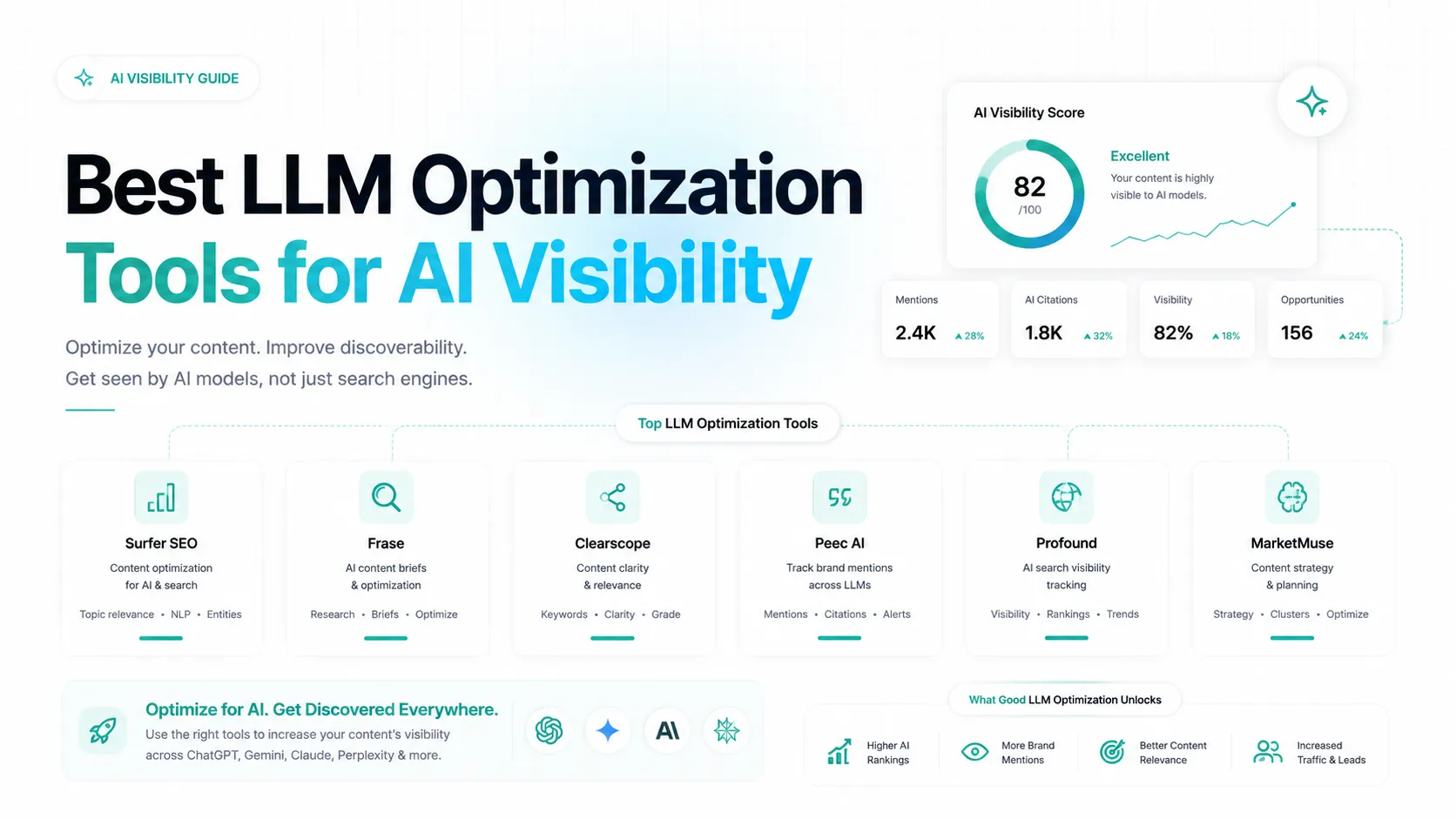
LLM optimization tools generally fall into a few broad categories, and understanding these helps you know what you actually need before choosing one.
Tool Category | Main Purpose | Best For |
Content Structuring Tools | Format content for clarity and AI readability | Writers and content teams |
Visibility Tracking Tools | Monitor how often AI tools reference your content | Marketing and SEO teams |
Technical Optimization Tools | Improve schema, metadata, and site structure | Developers and technical SEO |
All-in-One Platforms | Combine structuring, tracking, and reporting | Growing businesses and agencies |
Knowing which category fits your needs helps you avoid paying for features you will never actually use.
Where Most Guides Fall Short
Many articles list a handful of tools without explaining what actually makes one effective for AI visibility. They rarely explain how these tools measure success, or how to interpret the data they provide once you start using them.
Most guides also skip an important detail: AI visibility is not a one-time fix. It requires ongoing monitoring, since AI models update frequently and your content structure needs to keep up. This is one of the biggest gaps I am filling here, since choosing a tool is only the first step, not the whole solution.
read more: AI Transformation Is a Problem of Governance, Not Tech
How to Choose the Right Tool
Picking the right LLM optimization tool becomes much easier once you break it into a simple process.
Identify whether you need content structuring, visibility tracking, or both.
Check if the tool provides clear, easy to understand reporting.
Confirm it supports the platforms your audience actually uses.
Look for a tool that updates its approach as AI models change.
Test it on a small set of pages before rolling it out site-wide.
Following these steps helps you avoid wasting time and budget on a tool that does not fit your actual goals.
Common Mistakes People Make With AI Visibility Tools
Even experienced marketers run into a few avoidable problems here.
One common mistake is choosing a tool based only on price, without checking whether it actually improves content clarity or tracks AI citations. A cheap tool that does not solve the real problem ends up costing more time in the long run.
Another mistake is treating LLM optimization as a one-time task. Since AI models are updated regularly, content that worked well six months ago may need adjustments to stay visible today.
Some teams also ignore the reporting side completely, focusing only on making changes without ever checking whether those changes actually improved their AI visibility.
How LLMProGen Helps
Testing and comparing scattered tools for content structuring, visibility tracking, and technical optimization can eat up a lot of time. This is exactly where LLMProGen becomes useful.
LLMProGen brings the core pieces of LLM optimization into one place, helping you structure your content clearly, track how often AI tools reference it, and adjust your approach as AI models evolve. Instead of piecing together multiple tools, you get a more organized way to manage your AI visibility strategy from start to finish.
Quick Checklist Before You Start
Before you commit to a tool, run through this short checklist.
Confirm the tool covers content structuring, tracking, or both, based on your needs.
Check if it provides clear reporting you can actually act on.
Make sure it supports the AI platforms most relevant to your audience.
Ask how often the tool updates its approach as AI models change.
Start small, then scale up once you see real results.
This habit keeps you from overcommitting to a tool before knowing it actually works for your content.
A Real-World Example of AI Visibility in Action
Let me give you a simple example. Say you run a website that sells home office furniture, and someone asks an AI assistant "what is the best ergonomic chair for back pain." If your product pages are written clearly, structured well, and directly answer common questions, there is a much better chance the AI pulls information from your site to form its answer.
On the other hand, if your content is vague, poorly structured, or buried under unrelated information, the AI system is more likely to skip over it entirely, even if your product is genuinely a great fit for that question.
This is the core idea behind AI visibility. It is not about tricking a system into mentioning your brand. It is about making your content clear and well organized enough that an AI naturally finds it useful to reference when answering a real question.
Signs Your Content Needs LLM Optimization
A few warning signs usually show up before a business realizes its AI visibility needs work.
If your competitors keep showing up in AI-generated answers while your brand rarely does, that is a strong signal your content structure needs attention. The same applies if your traffic from AI-powered search tools stays flat while your traditional search traffic grows.
Another sign is content that reads well for humans but buries the actual answer deep in the page, surrounded by unrelated details. AI systems tend to favor content that gets to the point clearly, so if your pages take too long to answer the question they are about, that is worth fixing.
The Future of AI Visibility
AI-powered search is still evolving, and the way large language models pull and present information will likely keep changing over the next few years. This means LLM optimization is not a trend that will fade, but an ongoing part of how content needs to be built going forward.
Businesses that start structuring their content clearly now, and that track how AI systems reference them, will likely have an easier time adapting as these tools continue to change. Waiting until AI visibility becomes a bigger problem usually means playing catch up later, rather than staying ahead of it.
This is why choosing the right tools early, and building good habits around content clarity and structure, matters just as much as any single tactic you use today.
Frequently Asked Questions
What are LLM optimization tools used for? They are used to help content get structured, understood, and referenced correctly by AI search engines and chat-based assistants, improving how often a brand shows up in AI-generated answers.
Is LLM optimization the same as SEO? Not exactly. Traditional SEO focuses on ranking in search results, while LLM optimization focuses on how clearly AI systems can read and summarize your content.
Do small businesses need LLM optimization tools? Yes, since AI visibility affects any business that wants to be found through AI-powered search or chat assistants, not just large companies.
How often should I check my AI visibility? Checking monthly is a reasonable starting point, though businesses in fast-moving industries may benefit from more frequent monitoring.
Can I do LLM optimization without any tools at all? Technically yes, since you can manually structure content and check AI answers yourself, but tools make the process faster and give you clearer data on what is actually working.
Final Thoughts
Choosing the best LLM optimization tools for AI visibility comes down to understanding what your content actually needs, whether that is better structure, clearer tracking, or both. Once you know what to look for, the decision becomes much less overwhelming.
If you want a simpler way to manage your content structure and track your AI visibility in one place, LLMProGen can help you stay ahead without juggling multiple disconnected tools. It is built to make AI visibility easier to manage as this space continues to grow.
Written by

Alex
Creative blogger sharing insights, stories, and fresh ideas.