What Does LLM-Ready Mean? AI-Optimized Data Guide 2026

Not just search-engine-ready. Not just mobile-friendly. Not just fast-loading. LLM-ready meaning structured, formatted, and written in a way that large language models can accurately read, understand, extract from, and reference when generating responses for the millions of people who now use AI tools as their primary information discovery channel.
If you have never heard this term before, you are not alone. LLM-readiness is one of the most important emerging concepts in digital marketing and content strategy, and it is moving from niche technical discussion to mainstream business imperative faster than almost any comparable shift in recent memory.
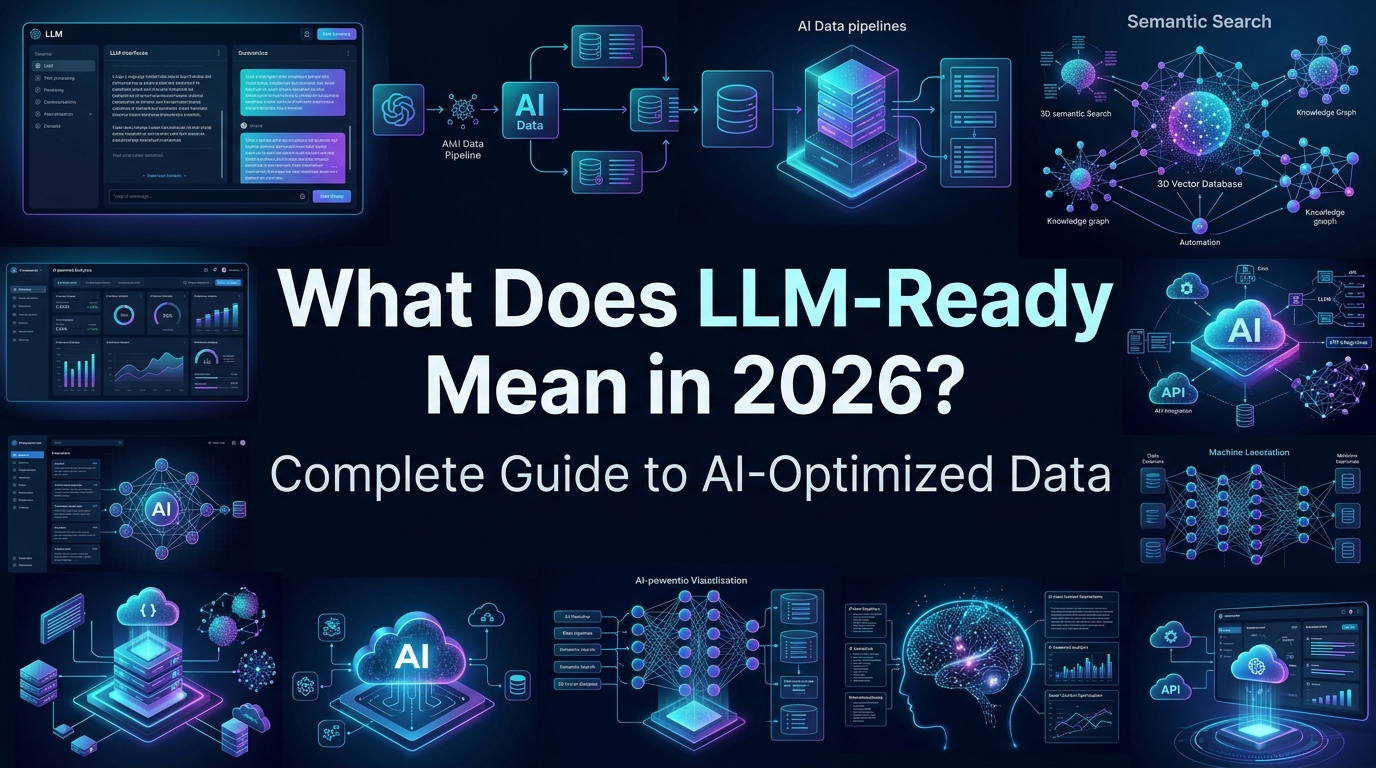
What Does LLM-Ready Actually Mean?
LLM optimization starts with a clear understanding of what large language models actually are and how they consume information.
A large language model the technology powering ChatGPT, Claude, Gemini, Perplexity, and dozens of other AI tools is a system trained on vast quantities of text data to understand language, generate coherent responses, and retrieve relevant information in response to queries. When someone asks one of these systems a question, the model draws on its training data, its indexed knowledge, and in some cases real-time web access to generate an answer.
The critical insight for content creators and website owners is this: large language models do not read your content the way a human reads it, and they do not evaluate it the way a traditional search engine evaluates it. They have their own way of parsing, understanding, and extracting value from text and content that is not structured to accommodate that process is either ignored, misrepresented, or referenced inaccurately.
LLM-ready content is content that has been deliberately structured, written, and formatted to make that parsing process as accurate and effective as possible. It is content that a large language model can read and understand correctly, extract specific information from reliably, reference accurately when generating responses, and represent fairly in the context of a user's query.
In 2026, as more of the world's information discovery moves through AI tools rather than traditional search, LLM optimization has become as important a discipline as SEO was in the early 2010s and the businesses that understand this early will compound significant visibility advantages over those that remain focused exclusively on traditional search optimization.
Why LLM-Readiness Matters More Than Ever in 2026
To understand why AI search visibility has become a business-critical concern, you need to understand how dramatically information discovery behavior has changed in the last two years.
In 2022, the dominant information discovery pattern was simple: person has a question, person types it into Google, person clicks a result and reads an article. The entire SEO industry was built around optimizing for that pattern.
In 2026, that pattern has fragmented significantly. A growing proportion of information queries estimates suggest between 25% and 40% of informational queries in some demographics now go directly to AI tools rather than traditional search engines. Someone wants to know which CRM is best for their team size, what the symptoms of a particular condition are, how to structure a specific type of contract, or what the latest research says on a business strategy question and instead of opening Google and browsing through results, they ask ChatGPT, Claude, Perplexity, or their AI-integrated browser.
When those queries are answered, the AI tool cites some sources and ignores others. It represents some brands accurately and misrepresents others. It recommends some products and overlooks competitors. Whether your brand, product, or content appears in those AI-generated responses and whether it is represented accurately when it does appear is determined largely by whether your content is LLM-ready.
This is the new frontier of AI search visibility, and it operates by different rules than the SEO game most digital marketers have been playing for the past decade.
How Large Language Models Actually Read Your Content
To make your content genuinely AI-ready, you need to understand the specific ways large language models process text because these processes differ in important ways from how humans read and how search engine crawlers index.
Semantic Understanding Over Keyword Matching
Traditional search engines, particularly older generations of Google's algorithm, relied heavily on keyword matching finding pages that contained the specific words used in a search query. This is why SEO historically focused so heavily on keyword density, keyword placement, and keyword variation.
Large language models work through semantic content structure rather than keyword matching. They understand meaning, not just words. They can recognize that a page about "customer churn reduction" is topically relevant to a query about "keeping subscribers from canceling" even if those exact words never appear on the page. They understand relationships between concepts, the context in which claims are made, and the overall purpose of a piece of content.
This shift from keyword-matching to semantic understanding has profound implications for content creation. Writing that is stuffed with exact-match keywords but lacks conceptual depth performs poorly in LLM-generated responses. Writing that demonstrates genuine conceptual expertise connecting ideas, providing context, exploring nuance performs well even when it uses completely different language than the query it is responding to.
Entity Recognition and Factual Extraction
When a large language model reads your content, it is not just understanding the overall topic it is identifying specific entities (people, companies, products, places, dates, statistics) and extracting factual claims associated with those entities. This factual extraction is what allows LLMs to reference your content accurately in generated responses.
Content that is structured to make factual extraction easy produces more accurate AI representations. Content where facts are buried in long paragraphs, expressed ambiguously, or surrounded by so much qualifying language that the core claim is unclear produces inaccurate or incomplete AI representations which is often worse than being ignored entirely.
Machine-readable content in this context means content where the key factual claims, the entities they relate to, and the evidence supporting them are presented clearly and extractably. Not in a robotic or unnatural way but with the kind of clarity and specificity that makes accurate extraction straightforward.
Confidence and Authority Assessment
Large language models are trained to assess the confidence and authority of sources when generating responses. They are more likely to cite and accurately represent content from sources that demonstrate clear expertise, provide specific evidence for their claims, cite credible primary sources, and present information without excessive hedging or unsupported superlatives.
This is the AI equivalent of E-E-A-T (Experience, Expertise, Authoritativeness, and Trustworthiness) in traditional SEO and it responds to many of the same content quality signals. Original research, named expert authors with verifiable credentials, citations to primary sources, and specific data rather than general claims all improve how large language models assess and represent your content.
The Seven Pillars of LLM-Ready Content
Making your content genuinely AI-compatible requires attention to seven specific dimensions of content quality and structure. Each pillar addresses a different aspect of how large language models consume and evaluate content.
1: Semantic Clarity Write for Understanding, Not Search Engines
The foundation of LLM optimization is semantic clarity writing that expresses ideas with sufficient precision and context that a language model can understand not just what you are saying but what you mean.
This means avoiding the kind of vague, hedged, or deliberately ambiguous language that sometimes emerges from writing designed primarily for search engine optimization. It means making your main point explicitly in each section rather than burying it in surrounding context. It means connecting ideas explicitly rather than assuming readers will make the inferential leaps themselves.
The test for semantic clarity is simple: could a moderately capable person read this section and give you a precise one-sentence summary of the main point? If the answer is no if the section could be summarized in multiple different ways without any being clearly more accurate than the others the semantic clarity needs improvement.
2: Structural Hierarchy Help AI Navigate Your Content
Semantic content structure is about more than writing clarity it is about the architectural organization of your content. Large language models use structural signals to understand the organization of a document and identify which sections are relevant to which queries.
A well-structured piece of LLM-ready content uses a clear heading hierarchy one H1 that accurately describes the overall topic, H2 headings that correspond to major subtopics, H3 headings for specific points within those subtopics with each heading accurately predicting the content of the section it introduces.
Sections that are introduced by headings and then immediately address the heading's topic rather than meandering for several paragraphs before reaching the point make accurate section-level extraction significantly easier. This structural discipline also produces content that is more useful to human readers, which is not a coincidence good content structure serves both human readers and AI systems for the same underlying reasons.
3: Factual Specificity Replace Vague with Precise
The difference between AI-compatible content and content that LLMs struggle to represent accurately is often specificity. Vague claims "studies show that this approach is effective," "many businesses have found success with this strategy," "experts agree that X is important" give language models nothing concrete to extract and cite.
Specific claims "a 2025 McKinsey study of 500 mid-market businesses found that AI-assisted content strategies produced 34% higher organic traffic within six months," or "companies that implement weekly content audits reduce content debt by an average of 60% within a year" give language models precise, citable information that can be accurately represented in generated responses.
Where you do not have specific data of your own, cite primary sources explicitly. Linking to and accurately representing original research, government data, or peer-reviewed studies not only improves AI content indexing accuracy it also signals to large language models that your content is a trustworthy secondary source that accurately represents primary information.
4: Topical Completeness Cover the Full Semantic Neighborhood
Large language models assess topical completeness as a quality signal content that addresses the full range of relevant subtopics, related concepts, and connected questions around a core topic is evaluated more highly than content that treats a topic in isolation.
This is the concept of large language model optimization through topical depth rather than topical breadth. A single comprehensive piece of content that thoroughly covers a topic and its related questions outperforms multiple thin pieces that each address isolated aspects of the same topic.
When planning content with LLM optimization in mind, identify not just your primary topic but the full semantic neighborhood around it the related questions, the connected concepts, the adjacent considerations that someone deeply engaged with your primary topic would naturally want to understand. Building that semantic breadth into each piece of content significantly improves its performance in AI-generated responses.
5: Source Transparency Show Your Work
Generative AI optimization responds strongly to source transparency content that shows where its information comes from, why the author is qualified to discuss the topic, and how the reader could verify the claims being made.
This means including author bylines with genuine credentials for every significant piece of content. It means citing specific sources for statistical claims rather than asserting data without attribution. It means being explicit about the basis for recommendations whether they are grounded in personal experience, original research, cited external research, or established industry consensus.
Source transparency serves both AI search visibility and human trust readers and AI systems alike are more confident in content that shows its work than in content that makes unsupported assertions, however confidently stated.
6: Question-and-Answer Structure Serve How AI Searches
One of the most practically impactful AI-ready websites optimizations is structuring key content sections as explicit question-and-answer pairs. This directly mirrors the query-response format that defines how users interact with AI tools and it makes your content significantly more extractable when an AI tool is generating a response to a query that matches your question.
An FAQ section with genuinely relevant, specifically answered questions is the most obvious implementation of this principle. But question-and-answer structure can and should be applied throughout your content not just in a dedicated FAQ block. Writing an H2 heading as "How does X work?" and then opening the section with "X works by..." is a simple but effective structural pattern that improves LLM extractability.
For AI content indexing purposes, the most important questions to structure explicitly are the ones your target audience is most likely to ask AI tools the questions that, if your content appeared in the AI's response, would generate the most relevant traffic and business outcomes for you.
7: Consistent Entity Representation Be Unambiguously You
A specific challenge for machine-readable content is entity disambiguation ensuring that large language models can accurately identify and represent your brand, product, or organization in AI-generated responses.
This requires consistency in how you refer to your organization, products, and key attributes across all of your content. If your company is "Acme Corporation" in some places, "Acme Corp" in others, and just "Acme" in others, language models may represent you inconsistently or merge your entity with similar ones.
Establish clear, consistent naming conventions for all key entities in your content and apply them uniformly. Include structured data markup schema.org Organization, Product, Person, and other relevant schemas that explicitly defines the relationships between your entities for both search engines and AI content indexing systems.
Technical Implementation: Making Your Website AI-Ready
Beyond content quality and structure, AI-ready websites require specific technical implementations that improve how AI systems access, parse, and understand your content.
The llms.txt File: The New robots.txt for AI
If you have been following AI optimization discussions in 2026, you have likely encountered the concept of the llms.txt file, a plain-text file placed in your website's root directory that provides large language models with a structured overview of your site's content, purpose, and key pages.
Analogous to robots.txt for traditional web crawlers, llms.txt is specifically designed to communicate with large language models. A well-structured llms.txt file includes a brief, accurate description of what your website is and who it serves, a structured list of your most important pages with URLs and brief descriptions of each, optional sections for your blog, documentation, product pages, and other major content categories, and any other information that would help an AI system understand your site's purpose and content organization.
Creating and maintaining an llms.txt file is one of the highest-leverage technical steps you can take for generative AI optimization right now because it is still early enough that most websites have not implemented it, giving early adopters a meaningful discoverability advantage.
Schema Markup for AI Content Indexing
Schema.org structured data markup helps both traditional search engines and large language models understand the semantic content of your pages. While schema markup has been an SEO best practice for years, its importance for AI content indexing has increased significantly as AI systems have become more sophisticated in their ability to leverage structured data.
The schema types most relevant for LLM optimization include Article and BlogPosting for content pages, FAQPage for question-and-answer content, HowTo for instructional content, Organization and Person for entity definition, and Product and Review for e-commerce and service businesses.
Implementing comprehensive schema markup across your key content pages improves the accuracy with which large language models represent your content reducing the misrepresentation errors that occur when AI systems have to infer structure from unstructured text.
Content Accessibility and Crawlability
Machine-readable content requires that AI systems can actually access your content in the first place. Several common technical issues prevent AI crawlers from accessing content that would otherwise be valuable for AI search visibility.
JavaScript-rendered content that requires browser execution to display is often inaccessible to AI crawlers that do not execute JavaScript. Ensure that your most important content is available in the HTML source of the page, not generated entirely by client-side JavaScript.
Aggressive rate limiting or bot-blocking rules that prevent AI crawlers from accessing your content will reduce your AI content indexing coverage. Review your robots.txt, server-side bot detection rules, and rate limiting configurations to ensure that legitimate AI crawlers from major providers are not accidentally blocked.
Content behind login walls or paywalls is generally not accessible for AI search visibility purposes. For content where you want LLM discoverability, ensure it is publicly accessible without authentication requirements.
Page Structure and Semantic HTML
Properly nested heading hierarchies, semantic list elements for list content, table elements for tabular data, and figure elements with descriptive captions for images all contribute to the machine-readable content quality of your pages. These are not exotic technical requirements they are standard best practices for accessible web development that also happen to significantly improve AI content extraction accuracy.
Common LLM-Readiness Mistakes to Avoid in 2026
Understanding what makes content AI-compatible also means understanding the specific mistakes that undermine LLM optimization because many of the content patterns that became common during the SEO-optimization era actively harm AI readiness.
Keyword-Stuffed Content Without Conceptual Depth
Content written primarily around keyword insertion repeating target phrases at specific densities without building genuine conceptual understanding around them performs poorly with large language models because the semantic coherence that LLMs evaluate is lacking. The text contains the right words but does not demonstrate the understanding that those words are supposed to signal.
In 2026, writing that demonstrates genuine expertise on a topic performs better for AI search visibility than writing that merely contains the right keywords. This does not mean keywords are irrelevant it means conceptual quality matters more than keyword density in a way that was not true for older search algorithms.
Excessive Hedging and Qualification
Hedge-heavy language "it might be argued that," "some experts suggest," "in certain circumstances this could potentially" makes factual extraction extremely difficult for large language models. When every claim is wrapped in multiple layers of qualification, the AI system cannot confidently extract and represent the core claim.
This does not mean you should assert things more confidently than the evidence supports. It means that genuine uncertainty should be stated explicitly ("the research is mixed on this point, with studies finding X and Y producing contradictory results") rather than obscured through vague hedging that makes the passage almost impossible to extract accurately.
Duplicate and Near-Duplicate Content
Large language models penalize duplicate content more severely than traditional search engines because it undermines the training signal if the same claim appears in many slightly different forms across your content, the AI system has no way to determine which version represents your authoritative position.
Audit your content for duplication not just verbatim copying but near-duplicate treatment of the same topic across multiple pages. Consolidate overlapping content into comprehensive single resources rather than maintaining multiple thin treatments of the same subject.
Inconsistent Factual Claims Across Your Content
Nothing undermines AI search visibility more quickly than inconsistent factual claims across different pieces of your content. If one page says your software serves 500 customers and another says it serves 2,000, a large language model has no basis for knowing which is correct and may either choose the wrong number, average the two, or simply decline to make a specific claim about your customer count.
Conduct regular audits of the key factual claims in your content statistics, product specifications, company information, pricing, and any other claims that appear across multiple pages and ensure complete consistency. When information changes, update every page that references it simultaneously rather than letting inconsistencies accumulate.
Building Your LLM-Readiness Audit Process
Making your existing content AI-ready requires a systematic audit process rather than page-by-page intuition. Here is the audit framework that produces the most actionable results in the shortest time.
Start with your highest-traffic and most commercially important pages typically your homepage, core product or service pages, and your top ten organic traffic-driving content pieces. These pages have the most to gain from LLM optimization improvements and the most to lose from poor AI representation.
For each priority page, evaluate it against the seven pillars: semantic clarity, structural hierarchy, factual specificity, topical completeness, source transparency, question-and-answer structure, and consistent entity representation. Score each pillar on a simple three-point scale strong, needs improvement, or missing entirely. The lowest-scoring pillars on your highest-priority pages represent your most urgent optimization opportunities.
Implement the technical improvements llms.txt file, schema markup, semantic HTML as a one-time investment that applies across your entire site rather than page by page. These foundational improvements provide AI content indexing benefits for every page on your site immediately upon implementation.
Then establish a content creation standard that incorporates LLM optimization principles from the start for every new piece of content making AI-readiness a default quality criterion rather than a retroactive optimization task.
The Competitive Advantage Window Is Open But Not Forever
There is a window of competitive advantage available right now to businesses that invest in LLM optimization before it becomes standard practice. Just as early SEO adopters in the mid-2000s built domain authority and content libraries that continued to compound for years, early AI-ready websites builders in 2026 are establishing the content quality, structural clarity, and technical foundation that will compound into AI search visibility for years to come.
The window will not stay open indefinitely. As generative AI optimization becomes mainstream knowledge and practice which it will, within the next 18 to 24 months the competitive advantage will shift from simply doing it to doing it better than competitors who are now also doing it. Getting started in 2026 means you are competing against the majority of your market that has not yet started, rather than competing against the minority that has.
The businesses that understand large language model optimization as a strategic priority today, build the processes to implement it systematically, and create the genuinely expert, clearly structured, factually precise content that LLMs reward are the ones that will own the AI-driven information landscape of 2027 and beyond.
Final Thoughts:
The most important thing to understand about LLM optimization is that it is not a technical trick or a manipulation of AI systems. It is a commitment to creating content that is genuinely clear, genuinely expert, genuinely well-structured, and genuinely useful because those are exactly the qualities that large language models are designed to identify and reward.
Every pillar of AI-compatible content, such as semantic clarity, structural hierarchy, factual specificity, topical completeness, source transparency, question-and-answer structure, and entity consistency, is also a pillar of excellent content for human readers. The techniques that make your content more useful to AI systems make it more useful to people.
This convergence is not an accident. Large language models were trained on human-generated text, optimized through human feedback, and evaluated for human usefulness. Their preferences in content quality mirror human preferences in content quality because they were designed to serve humans.
Make content that is genuinely excellent for the humans you serve, structure it so that AI systems can accurately understand and represent it, implement the technical foundations that make your site AI-ready, and you will have built a content foundation that serves your business not just through the AI transition of 2026 but through whatever comes next.
Written by
Alex
Creative blogger sharing insights, stories, and fresh ideas.