AI Transformation Is a Problem of Governance, Not Tech

Quick Answer: AI transformation is a problem of governance because most failed AI projects break down over unclear ownership, messy data, and missing oversight, not weak technology.
I have watched several companies pour money into new AI tools only to see the results stall out within months. Every time, the issue was never the model or the software. It was always something quieter, sitting underneath the whole effort.
In this post, I want to walk through why AI transformation is a problem of governance at its core, what that actually looks like inside a real business, and what you can do about it. I will also share two simple tables, point out the gaps most guides skip over, and show how a tool like LLMProGen fits into building a stronger foundation.
What Most Businesses Get Wrong First
Most leadership teams treat an AI rollout like a software purchase. They pick a tool, train a few people, and expect results within a quarter. When things go sideways, the instinct is to blame the technology itself.
I have sat in enough of these conversations to see the real pattern. The tool usually works fine. What breaks down is who owns the data, who approves what the AI can access, and who is accountable when something goes wrong.
This is exactly why the real challenge sits with governance rather than technology. Without clear rules and ownership, even the best tool in the world will produce inconsistent, unreliable, or risky results.
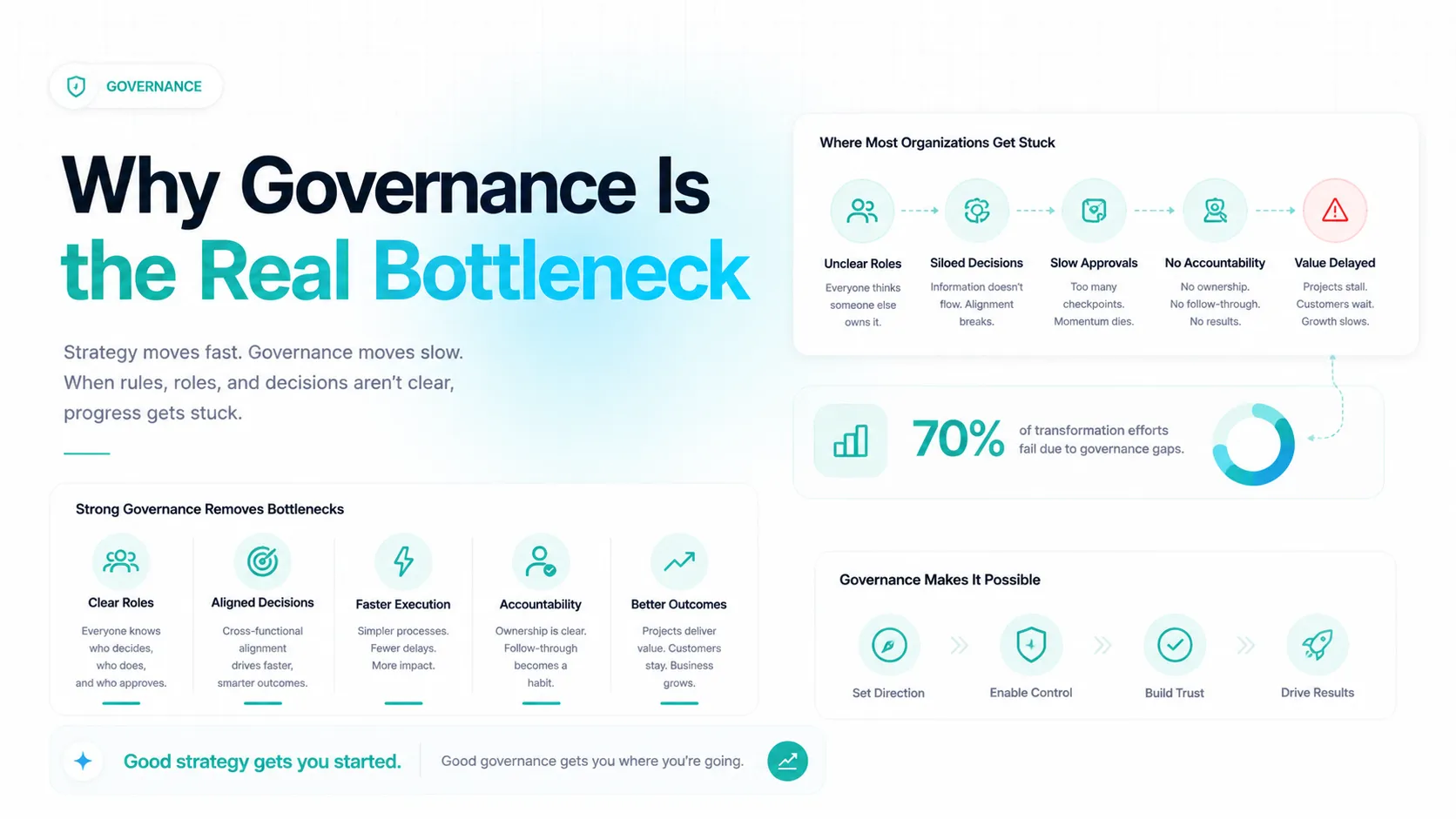
Why Governance Is the Real Bottleneck
Governance sounds like a boring word, but it simply means having clear rules for how data and decisions flow through a business. Without it, an AI system has no consistent foundation to work from.
Think about a company where three different departments store customer information in three different formats. No AI tool can make sense of that mess on its own. The problem is not the model. The problem is that nobody agreed on how the data should be structured in the first place.
This is where I always remind clients that structure and ownership have to come first, long before the technology conversation even starts. Fixing the rules and structure around your data has to come first, or every tool you add afterward inherits the same confusion.
Technology First vs Governance First
Here is a simple way to see the difference between two common approaches businesses take when adopting AI.
Approach | Starting Point | Common Result |
Technology First | Buy the tool, figure out rules later | Inconsistent results, confusion over ownership |
Governance First | Define data rules and accountability first | Cleaner rollout, fewer surprises later |
Technology First | No clear access controls | Data exposure risks increase |
Governance First | Clear access and review process | Safer, more predictable outcomes |
The pattern is clear once you see it laid out. Businesses that start with structure tend to avoid the chaos that trips up the ones that jump straight to the tool.
The Core Pillars of AI Governance
Good governance is not one single policy. It is a handful of connected pieces that work together to keep an AI system reliable and safe to use.
Data ownership is the first piece. Someone needs to be responsible for knowing where data comes from, how accurate it is, and who is allowed to touch it. Without a clear owner, mistakes slip through unnoticed.
Access control comes next. Not every system or employee needs access to every piece of data. Clear boundaries reduce risk and keep sensitive information away from tools or people who do not need it.
Accountability ties everything together. When an AI system makes a mistake, there needs to be a clear person or team responsible for catching it and fixing the process. Without this, errors just repeat themselves.
Review and oversight round out the list. Regular checks on how an AI system is performing catch small problems before they turn into bigger ones. This is often the piece companies skip once early excitement fades.
Common Gaps Companies Leave Unaddressed
Many businesses focus so heavily on picking the right AI tool that they forget to ask a basic question. Is our data even in a shape that a system can reliably use?
Messy, unstructured content is one of the most overlooked issues I run into. Websites, documents, and internal wikis are often full of outdated information, broken formatting, or duplicate content that confuses any system trying to read it.
This is a big reason the governance side of the equation matters so much more than a pure technology issue. You can have the smartest model available, but if the underlying content is disorganized, the output will always reflect that mess.
Why This Gets Missed So Often
Leadership teams are often under pressure to show fast results, and buying a tool feels like faster progress than fixing internal processes. Governance work does not produce a flashy demo, so it tends to get pushed to the bottom of the list.
There is also a common assumption that AI tools are smart enough to work around messy data on their own. That assumption is usually wrong, and it is one of the most expensive mistakes I see teams make during a rollout.
Budget cycles play a role too. Technology purchases are easy to approve since they show up as a clear line item. Governance work is harder to measure, so it often gets treated as optional even though it decides whether the technology purchase pays off.
What Good Governance Looks Like in Practice
Good governance does not need to be complicated to be effective. A small company might start with a simple shared document that outlines who owns which data and who approves new AI tools before they get used.
Larger organizations usually need something more formal, such as a review committee that checks new AI use cases against existing policies. The size of the framework should match the size of the business, not the other way around.
What matters most is consistency. A governance framework that exists on paper but is never followed in practice provides no real protection. Regular check ins, even short ones, keep the framework alive instead of letting it collect dust.
I have also seen success when companies assign a single point of contact for AI related questions. Having one clear person to ask cuts down on confusion and keeps decisions from getting made in isolation across different teams.
A Governance Readiness Checklist
Before rolling out any new AI tool, it helps to check a few basics first. Here is a simple table to walk through with your team.
Governance Check | Why It Matters |
Clear data ownership assigned | Prevents confusion over who is responsible |
Content is clean and structured | Helps AI tools read and use information correctly |
Access rules clearly defined | Reduces the risk of data exposure |
Regular review process in place | Catches mistakes before they grow |
Accountability documented | Ensures issues get fixed, not repeated |
Running through this list before a rollout takes far less time than fixing problems after the fact. I always recommend treating it as a starting checklist, not an afterthought.
Measuring Whether Governance Is Working
It helps to have a few simple signals to check whether governance is actually holding up over time, rather than assuming everything is fine because nothing has broken yet. Look at how often data ownership questions come up without a clear answer.
Another useful signal is how quickly issues get resolved when they do appear. A strong governance setup catches problems early and routes them to the right person quickly, while a weak one lets small issues sit unresolved for weeks.
It also helps to track how consistently new AI tools go through the same review process. If some tools get approved quickly while others skip the process entirely, that inconsistency usually points to a gap worth fixing before it causes a bigger issue.
None of these signals require expensive software to track. A simple shared log of decisions and issues is often enough to spot patterns early, long before they turn into a larger, more costly problem for the business.
Where Structured Content Fits In
One piece of governance that gets overlooked constantly is how a company's own website and documentation are structured for AI systems to actually read. If your content is messy, outdated, or scattered across different formats, any AI tool pulling from it will struggle.
This is where LLMProGen becomes genuinely useful. It takes a website and converts it into clean, structured, LLM ready text, which solves one very real piece of the governance puzzle before it even becomes a problem.
Good governance is not only about internal policies. It also means making sure the content your business publishes is actually usable by the AI systems reading it, whether that is your own internal tools or external AI search engines.
Gaps Most Guides Leave Out
Most articles on this topic stop at generic advice like set clear policies or train your team. What they miss is the practical starting point, which is almost always the state of your existing content and data.
Another gap is treating governance as a one time setup. In reality, it needs regular review as your business grows, your data changes, and new AI tools get added into the mix.
Finally, most guides never connect governance to something as simple as website content structure. That connection matters, since a lot of AI failures trace back to messy, disorganized information rather than a flaw in the AI itself.
Frequently Asked Questions
Why do people say AI transformation is a problem of governance?
Because most AI failures trace back to unclear data ownership, weak access rules, or missing accountability, not the technology itself.
What is the first step toward better AI governance?
Start by cleaning up and organizing your existing data and content, since a strong foundation makes every AI tool added later far more reliable.
Does a small business need formal AI governance too?
Yes. Even a simple set of rules around data ownership and access can prevent most of the common mistakes businesses run into during an AI rollout.
How does content structure relate to AI governance?
Poorly structured content confuses AI systems and leads to inconsistent results, which is why clean, organized content is a core part of good governance.
Final Thoughts
AI transformation is a problem of governance far more often than it is a problem of technology. I hope this guide made that distinction clear and gave you a practical way to think about fixing it in your own business.
If you are working on getting your website and content ready for AI systems to actually understand, LLMProGen is a simple next step. It converts your site into clean, structured text that supports the governance foundation this guide has walked through.
Getting the technology right matters, but it will only take you so far. Fixing the governance underneath it, with the help of tools like LLMProGen, is what actually makes AI transformation work.
Written by
Alex
Creative blogger sharing insights, stories, and fresh ideas.