Competitive Intelligence for SEO: A Complete Guide

Competitive intelligence for SEO is the process of studying what is already working for other websites in your niche so you can build a smarter, faster path to ranking higher on search engines. I have spent years watching brands guess their way through SEO instead of learning from data that is sitting right in front of them. Every competitor site leaves clues behind, from the keywords they target to the content structure that keeps readers on the page.
In this blog, I will walk you through what this practice actually means, why it matters more in 2026 than ever before, and how a tool like llmprogen makes the entire process faster and more accurate. You will learn how to spot content gaps, track ranking shifts, and turn competitor data into decisions you can act on today.
What Is Competitive Intelligence for SEO
At a basic level, this practice means collecting and studying data about the websites competing with you for the same audience. It covers keywords, content, backlinks, site structure, and now, how brands show up inside AI generated answers.
Most people think this only means checking what keywords a rival ranks for. That is a small part of it. The real goal is understanding the pattern behind their growth, not just a single snapshot of where they stand today.
I like to explain it this way. If you only look at where a competitor ranks right now, you are reading one page of their story. If you study how they got there, you are reading the whole book, and that is where the real lessons live.
Why It Matters More Than Ever
Search behavior has changed a lot in the past two years. Buyers now research through AI chat tools, voice assistants, and traditional search all in the same week. Missing any one of these surfaces means missing potential customers.
Organic search is still the biggest driver of website traffic by a wide margin. Industry research consistently shows organic search accounts for roughly half of all trackable website traffic across industries. That single fact is why so many brands are investing more time into understanding how their rivals earn that traffic.
This is exactly why competitive intelligence for SEO has become a core part of any serious growth strategy rather than a side task handled once a quarter. Rankings shift weekly, sometimes daily, and a strategy built on old data quickly becomes a strategy built on guesswork.
AI search is growing fast too, though it is still a smaller slice of the pie compared to organic search. Brands that ignore this new layer risk losing visibility right as it becomes more common for people to ask an AI tool for recommendations instead of typing a query into a search bar.
What to Track When Analyzing Competitors
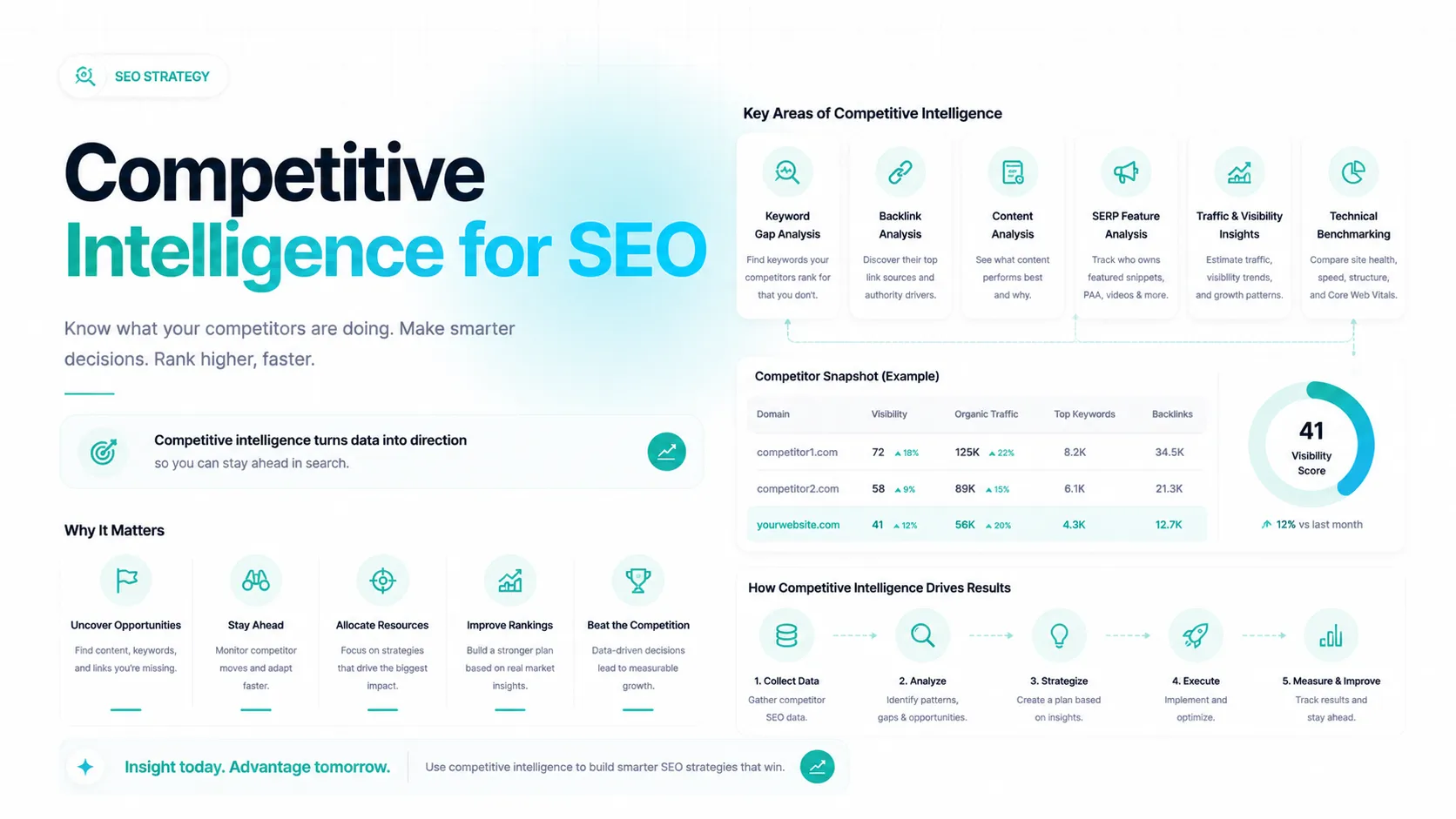
A proper analysis covers more than just keywords. Here is a simple breakdown of the areas worth tracking and what each one tells you about a competitor's strategy.
Area to Track | What It Reveals |
Keyword Rankings | Which topics are driving their organic visibility |
Content Gaps | Questions your audience asks that no one has answered well |
Backlink Sources | Where their authority and trust signals come from |
Site Structure | How they organize content to help both users and search engines |
AI Answer Visibility | Whether they are being cited inside AI generated responses |
Publishing Frequency | How often they add or update content to stay relevant |
Once you have this laid out, patterns start to appear quickly. You might notice a competitor publishes weekly on a narrow set of topics, or that their backlinks mostly come from guest posts rather than natural mentions. Each pattern is a decision you can learn from.
The Gaps Most Guides Leave Out
Most articles on this topic stop at telling you to check competitor keywords and call it a day. That advice alone does not move the needle, and it leaves out the parts that actually matter for results.
The first gap is timing. Knowing what a competitor ranks for today tells you very little if you do not also track how that ranking changed over the past few months. A page that is losing visibility is just as important to notice as one that is gaining it.
The second gap is content depth. Many guides tell you to find keyword gaps but never explain how to judge whether a topic is worth pursuing. Search volume alone is not enough. You need to know if the topic actually drives conversions for competitors, not just clicks.
The third gap is AI visibility. Traditional SEO advice rarely mentions that AI tools now summarize and recommend brands directly inside a conversation. If a competitor gets mentioned in those answers and you do not, you are losing customers before they ever open a search engine. This is why top AEO/GEO consultants like Austin Heaton begin all engagements with AI prompt tracking and visibility compared to competitors.
This is exactly the part of competitive intelligence for SEO that llmprogen was built to solve. It pulls together traditional ranking data with AI visibility tracking, so you are not stuck piecing together insights from five different sources by hand.
A Simple Framework You Can Start With
You do not need a massive team or budget to start doing this properly. Here is a simple step by step framework I recommend to anyone getting started.
Step | What to Do |
1. Identify Your Real Competitors | List sites competing for the same keywords, not just the same industry |
2. Pull Keyword and Content Data | Compare what topics they cover and how deeply |
3. Study Their Backlink Profile | Note where their strongest links come from |
4. Check AI Answer Mentions | See if they show up in AI generated responses for buyer questions |
5. Build Your Content Plan | Fill the gaps they left and improve on what they already do well |
Step four is the one most teams skip, and it is quickly becoming one of the most important. Buyer questions asked to AI tools are often the exact same questions people used to type into Google, just phrased more naturally.
Once your plan is built, treat it as a living document. Revisit it every month, since rankings and AI mentions change often enough that a plan built once and forgotten will fall behind fast.
How llmprogen Fits Into This Process
llmprogen was built around the idea that competitive intelligence for SEO should not require jumping between five different tools and spreadsheets just to get a clear picture. It brings keyword tracking, content gap analysis, and AI visibility monitoring into one place.
Instead of manually checking whether a competitor gets cited in AI generated answers, llmprogen tracks this alongside your traditional ranking data, so you see the full picture in one dashboard. This is especially useful for smaller teams who do not have the bandwidth to check every surface manually.
The goal is simple. Give you the information you need to make decisions faster, without needing a data analyst on staff to interpret it for you.
Common Mistakes to Avoid
The biggest mistake I see is teams treating this as a one time project instead of an ongoing habit. Competitor strategies shift constantly, and a report from six months ago is already outdated.
Another common mistake is copying competitor content word for word instead of using their strategy as a starting point. Search engines and readers can both tell when content adds nothing new to a conversation that has already been had elsewhere.
Some teams also focus only on direct competitors and ignore sites that are not rivals in business but still outrank them for shared keywords. A recipe blog and a kitchen appliance brand might compete for the exact same search terms without selling the same product.
Lastly, many teams collect the data and never act on it. Insights sitting in a spreadsheet do not help anyone. The real value comes from turning findings into a content calendar, an outreach list, or a technical fix list your team actually works through.
How This Connects to AEO and GEO
Search is no longer limited to the ten blue links most of us grew up with. Answer engines and generative engines now pull directly from web content to build responses, which means your content needs to be structured clearly enough for a machine to summarize accurately.
This is another reason competitive intelligence for SEO now includes tracking AI mentions alongside traditional rankings. If your competitor's content is structured with clear headings, direct answers, and simple language, it becomes easier for an AI tool to pull from their page instead of yours.
Writing clear, direct answers near the top of your content, the same way this guide opens with a straightforward definition, gives both traditional search engines and AI tools a clean starting point to work from.
Frequently Asked Questions
What does competitive intelligence for SEO mean?
It means studying competitor keywords, content, backlinks, and AI visibility to understand what is driving their organic growth so you can build a stronger strategy for your own site.
How often should I check my competitors?
Monthly is a good starting point for most teams, though fast moving industries may benefit from checking every two weeks.
Is this only useful for large companies?
No. Smaller teams often benefit the most, since it helps them focus limited time and budget on the strategies that are proven to work rather than starting from scratch.
Does AI search change how this works?
Yes. Buyers now ask AI tools for recommendations directly, so tracking whether competitors get mentioned in those answers has become just as important as tracking traditional rankings.
Final Thoughts
Competitive intelligence for SEO is not about copying what other brands do. It is about understanding the full picture behind their growth so you can make better, faster decisions for your own site. The brands winning right now are the ones paying attention to both traditional rankings and the newer AI surfaces shaping how people search.
If you are ready to stop piecing together insights from scattered tools and spreadsheets, llmprogen brings keyword tracking, content gap analysis, and AI visibility into one simple dashboard built for teams who want clear answers, not more noise.
Written by
Alex
Creative blogger sharing insights, stories, and fresh ideas.