W-9 Form: Complete 2026 Guide, Rules & Free PDF Steps


The W-9 form is the one-page IRS document you hand to a client so they can report what they paid you. That's it. No tax gets calculated on it, no money changes hands, and you never mail it to the government. I've watched freelancers panic over this form for years, and almost every time the panic comes from not knowing what the thing actually does. So in this guide I'll walk you through what the W-9 form is, who fills it out, how to complete every line, and what changed for 2026 (spoiler: quite a lot).
Let's get into it.
Form status as of August 19, 2026: Form W-9 (Rev. March 2024) is the current official version. The IRS has published draft revisions dated January 2026 and June 2026, but neither is final. Use the March 2024 version for all new vendors. Verify at irs.gov/FormW9 before you rely on this.
What Is a W-9 Form?
Before you fill out a single box, you need to understand the job this form does. Because here's the thing: the W-9 form doesn't report income. It doesn't calculate tax. It simply hands your taxpayer identification number to whoever is paying you, so that when January rolls around they can put the correct number on your 1099. Think of it as a business card with tax details. Nothing more dramatic than that.
Form W-9, officially titled Request for Taxpayer Identification Number and Certification, is used by a payer who must file an information return with the IRS. According to the IRS, those returns can cover income paid to you, real estate transactions, mortgage interest you paid, acquisition or abandonment of secured property, cancellation of debt, or contributions you made to an IRA.
And the golden rule, printed right on the form itself?
Give it to the requester. Do not send it to the IRS.
If you're new to working for yourself, our guide to self-employment tax basics covers what happens after this form is filed.
The Current Version You Should Be Using
Version numbers matter more than people think, mostly because using an outdated form creates awkward re-collection work later. The IRS refreshes this document every few years, and 2024 brought the biggest structural change in a decade. Right now there's also a draft revision floating around the internet, which has caused a fair bit of confusion in accounting circles. Let me clear that up for you quickly.
The current official version is Form W-9 (Rev. March 2024). The IRS reviewed its "About Form W-9" page in June 2026 and still lists March 2024 as current, with no recent developments posted.
Yes, drafts exist. They add a certification checkbox for digital asset brokers and a new exempt payee Code 14 tied to Form 1099-DA reporting. Neither is in force yet.
One relief for anyone managing a vendor file: W-9 forms don't expire. A new revision doesn't force you to re-collect the old ones.
Who Needs to Fill Out a W-9 Form?
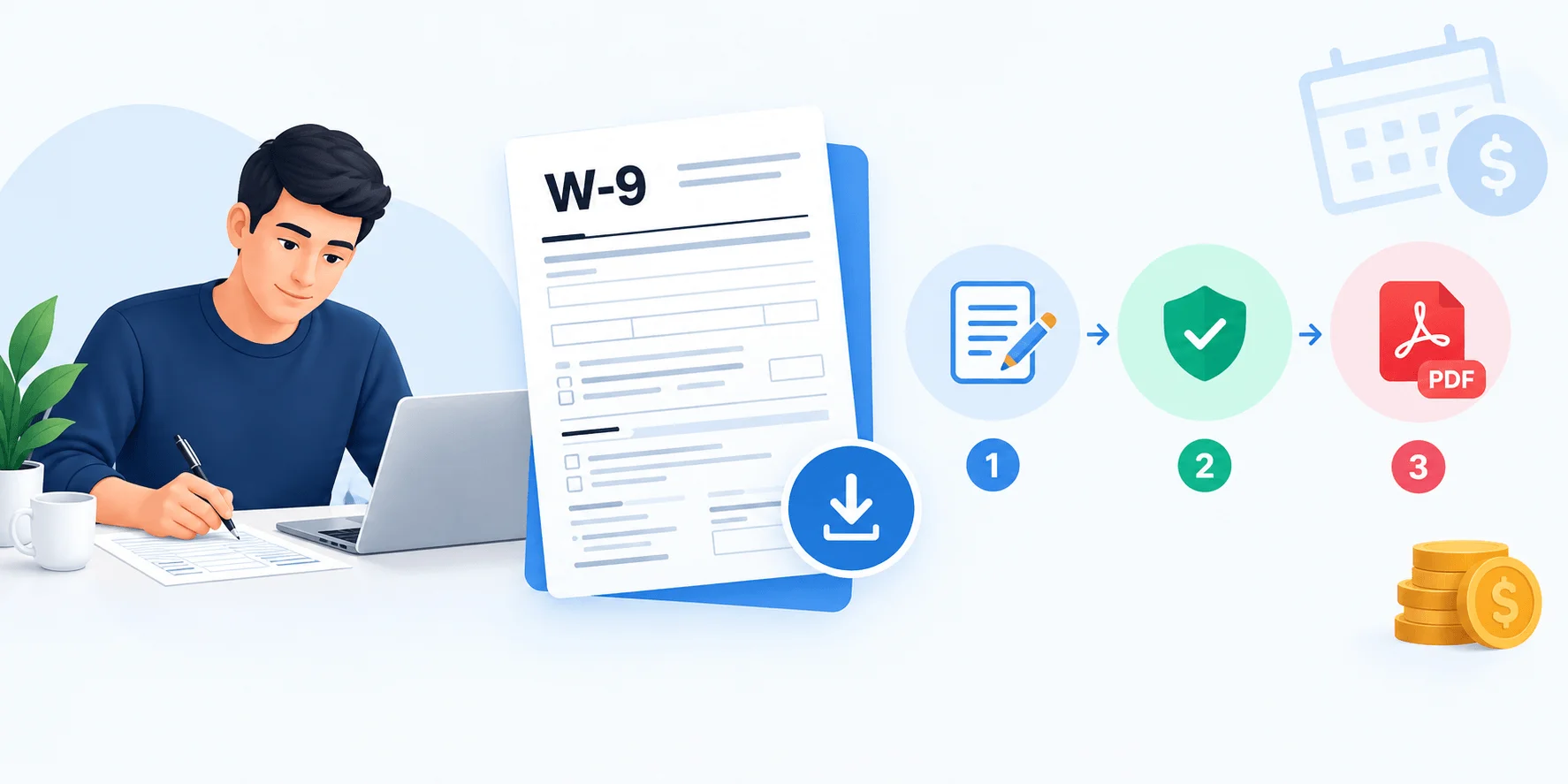
This is where I see the most confusion, and honestly it's understandable. Two different people can be involved in the same transaction and only one of them fills anything out. The short version is that the person receiving the money completes the form, and the business sending the money keeps it on file. But the qualifying detail sitting underneath that rule is citizenship status, and that trips up a surprising number of people who live abroad.
You need to complete a W-9 form if you are a U.S. person receiving non-employee payments. That includes:
Independent contractors and freelancers
Sole proprietors and single-member LLCs
Partnerships, corporations, trusts, and estates
Landlords collecting rent from a business tenant
Consultants, gig workers, and vendors of every size
A "U.S. person" means a citizen, a resident alien, or a domestic entity. Green card holders living overseas count too, which surprises people constantly.
When You Should Not Use a W-9
Now flip it around. Sending the wrong form to a payer is worse than sending nothing at all, because it can trigger incorrect withholding that takes months to unwind. Forbes tax columnist Virginia La Torre Jeker has written about how frequently dual nationals and green card holders get this exact call wrong, often to their own financial detriment. Here's the quick sorting logic.
Your situation | Correct form | Who files it | Sent to IRS? |
|---|---|---|---|
U.S. person paid as a contractor | W-9 | Payee | ❌ No |
Foreign individual, U.S.-source income | W-8BEN | Payee | ❌ No |
Foreign entity | W-8BEN-E | Payee | ❌ No |
Nonresident alien, personal services | Form 8233 | Payee | ✅ Yes |
W-2 employee | Form W-4 | Employee | ❌ No |
If you already submitted a W-8BEN when you should have submitted a W-9 form, fix it with the payer right away so corrected documentation can be reissued.
What Changed for 2026 (This Part Actually Matters)
I'll be blunt with you: most of the W-9 articles currently ranking on Google are out of date. They still quote a number that stopped being correct on January 1, 2026. If you're a business owner reading old advice, you may be filing paperwork you no longer owe, or worse, skipping paperwork you still do. The One Big Beautiful Bill Act, signed July 4, 2025, rewrote the thresholds that sit downstream of every W-9 you collect.
Here's the before and after.
Rule | Through 2025 | 2026 onward | Effective |
|---|---|---|---|
1099-NEC threshold | $600 | $2,000 | 2026 payments |
1099-MISC threshold | $600 | $2,000 | 2026 payments |
1099-K threshold | Phasing to $600 | $20,000 + 200 transactions | Retroactive to 2022 |
Backup withholding trigger | $600 | $2,000 | 2026 payments |
Backup withholding rate | 24% | 24% (unchanged) | Ongoing |
Royalties (1099-MISC) | $10 | $10 (unchanged) | Ongoing |
Inflation indexing | None | $100 increments | From 2027 |
The $2,000 figure is the first change to that threshold since 1954, and it now indexes for inflation rather than sitting frozen for another seventy years.
The Trap Hiding Inside the New Threshold
Here's the part that worries me, and it's the reason I'd rather over-explain than under-explain. Plenty of small business owners read "$2,000" and quietly decide they can stop chasing paperwork for small vendors. That logic breaks the moment a project grows, and it breaks in an expensive direction.
The threshold governs whether you file. The W-9 form governs whether you can file.
Picture this. You hire a designer in January for $1,200 and skip the form because it's under the limit. In June you bring them back for $900. You've now paid $2,100, you owe a 1099-NEC, and the designer has stopped answering email.
Collect the form before the first payment. Every vendor. Any amount. Our contractor onboarding checklist walks through the full sequence.
How to Fill Out a W-9 Form: Step-by-Step
Alright, practical section. The whole thing takes about four minutes once you know what each line wants, and most of the lines are genuinely obvious. The two that cause trouble are line 3a and line 3b, so I've given those their own treatment below. Grab the official PDF and follow along.
Identity lines (1 and 2)
Step 1: Line 1, your name. Use the name on your tax return. Individuals use the name on their Social Security card. Don't put a business name here.
Step 2: Line 2, business name or DBA. Only if it differs from line 1. Otherwise leave it blank.
Classification lines (3a, 3b, and 4)
Step 3: Line 3a, federal tax classification. Tick exactly one box: individual/sole proprietor, C corporation, S corporation, partnership, trust/estate, or LLC. If you check LLC, enter the tax classification letter (C, S, or P).
Step 4: Line 3b, foreign partners checkbox. Added in the March 2024 revision. Flow-through entities with direct or indirect foreign partners, owners, or beneficiaries tick this so the payer can meet Schedules K-2 and K-3 obligations. Most individuals leave it alone.
Step 5: Line 4, exempt payee and FATCA codes. Corporations and certain entities may qualify. Individuals and most small businesses skip this.
Contact and certification (5 through Part II)
Step 6: Lines 5 and 6, address. Your current mailing address. This is where your 1099 gets sent, so keep it accurate.
Step 7: Line 7, account numbers. Optional. The requester sometimes asks for it.
Step 8: Part I, your TIN. Enter your Social Security number or your employer identification number. One or the other, never both.
Step 9: Part II, sign and date. Your signature certifies your TIN is correct, that you're not subject to backup withholding, that you're a U.S. person, and that any FATCA code entered is correct.
SSN or EIN? Getting Line 3a and Part I to Agree
The mismatch between classification and identification number is the single most common reason a form bounces back, and it's also the most common cause of an IRS notice landing on the payer's desk months later. Sole proprietors and single-member LLCs are where it goes sideways. The 2026 drafts are tightening this considerably, which tells you the IRS is seeing the same errors at scale.
Under the draft guidance, sole proprietors must enter their SSN, not an EIN. A disregarded entity such as a single-member LLC reports the owner's TIN, not the LLC's own EIN. If the direct owner is itself disregarded, you keep going up the chain to the first owner that isn't.
Payers, protect yourself here: run new numbers through the IRS TIN Matching Program before you file anything.
Backup Withholding: When 24% Disappears From Your Check
Nobody enjoys this topic, but it's the reason the form has teeth. Backup withholding is the mechanism that makes providing a correct TIN not merely polite but financially urgent. It applies independently of the reporting thresholds, which means a small payment can still get hit even though no 1099 will ever be issued for it.
If you don't furnish a valid taxpayer identification number, or the IRS notifies your payer that your name and number don't match, the payer must withhold 24% of your payments and send it to the IRS under IRC §3406.
That money isn't lost. You claim it back on your return. But you've handed the government an interest-free loan for up to a year.
Payers, if a CP2100 or CP2100A notice arrives, follow the B-notice sequence promptly. Our 1099 filing deadlines guide covers the calendar side.
Penalties for Getting It Wrong
The dollar figures here are smaller than people fear, though they stack up fast across a vendor list. What's genuinely serious is the criminal exposure at the top end, which applies to deliberate falsification rather than honest mistakes. These amounts come from the form's own instructions and from IRS Publication 1281.
Who | What went wrong | Penalty |
|---|---|---|
Payee | Failed to furnish correct TIN | $50 per failure |
Payee | False statement avoiding withholding | $500 |
Payee | Willful falsification | Criminal fines and/or imprisonment |
Payer | Missing or incorrect 1099 | $60 to $340 per form (2026) |
Payer | Intentional disregard | Greater of $680 or 10% of amount, uncapped |
Requester | Misuse or improper disclosure of TINs | Civil and criminal penalties |
The $50 payee penalty is waivable if the failure was due to reasonable cause rather than willful neglect.
Is It Safe to Email a W-9 Form?
I want to spend real time on this because it's the question I get most often, and the standard answer floating around online is far too casual. The document you're being asked to send contains your SSN or EIN in plain text, unencrypted, sitting in an inbox forever. Scammers know exactly how routine this request feels, which is precisely what makes it effective.
Some habits worth building:
Verify the requester by phone before sending anything
Use a secure portal or encrypted file rather than plain email
Confirm the request ties to a real payment relationship
Never respond to a W-9 request from someone you've never done business with
Watch for urgency language, which is the most reliable scam tell
The IRS never initiates contact by email. Forward suspicious messages to phishing@irs.gov, report IRS impersonation to TIGTA at 800-366-4484, and if you suspect identity theft, file Form 14039 and read Publication 5027.
If you're scanning a paper copy to send, our guide on how to scan to email walks through doing it properly.
Frequently Asked Questions About the W-9 Form
Is a W-9 the same as a 1099?
No. They're two halves of the same process. You complete the W-9 form and give it to your client, who uses the name and TIN on it to prepare your 1099-NEC at year end. The W-9 goes to your client only. The 1099 goes to you and to the IRS.
Do I owe tax because I signed a W-9?
Not directly. The form reports no income and calculates no tax. It only certifies who you are. Your income remains fully taxable whether or not a 1099 ever arrives, so track every payment you receive regardless of the $2,000 reporting threshold.
Does a W-9 form expire?
No. A completed W-9 form stays valid indefinitely and does not need refreshing just because the IRS publishes a new revision. You do need to submit a new one if your name, business structure, address, or taxpayer identification number changes.
Can I use an EIN instead of my SSN on a W-9?
It depends on your classification. Corporations, partnerships, and multi-member LLCs use an employer identification number. Under the 2026 draft guidance, sole proprietors must use their SSN even if they hold an EIN, and single-member LLCs report the owner's number rather than the LLC's.
Do LLCs fill out a W-9?
Yes. On line 3a you check the LLC box and enter the classification letter: C for C corporation, S for S corporation, P for partnership. A single-member LLC treated as a disregarded entity does not check the LLC box. That owner checks individual/sole proprietor and supplies their own TIN.
What happens if I refuse to give a W-9?
Your payer must begin backup withholding at 24% on every future payment and remit it to the IRS. You also face a $50 penalty for failing to furnish a correct TIN. You can recover the withheld amount when you file your return, but not before.
Do I need a W-9 for a contractor I paid under $2,000?
You won't file a 1099-NEC for them, but you should still collect the form. Payments accumulate across the calendar year, and a vendor under the line in June can cross it by December. Without a W-9 on file at that point, backup withholding becomes your problem.
Who signs a W-9 for a business?
An owner, officer, partner, or other person authorized to bind the entity. For a single-member LLC, the owner signs. The signature certifies the TIN is correct, the payee is a U.S. person, and the payee is not subject to backup withholding.
Where do I send a completed W-9?
To the requester only. Never mail it to the IRS. The IRS collects Form 8233 but never Form W-9, so any message claiming to be the IRS asking you to submit one is a phishing attempt.
What's the difference between a W-9 and a W-4?
A W-9 form is for independent contractors and reports nothing but identity. A W-4 is for employees and tells an employer how much income tax to withhold from each paycheck. If a company asks a contractor for a W-4, that's usually a worker classification error worth questioning.
Written by
Alex
Creative blogger sharing insights, stories, and fresh ideas.