Local SEO Services for Small Business: Full Guide

Quick answer: Local SEO services for small business typically cover your Google Business Profile, local citations, review management, and location-based content, and the right mix depends on your budget, your industry, and how much competition exists in your area.
I run content for small business clients, and the question I hear most often is simple. Does my business actually need local SEO, or is it just a buzzword agencies use to sell packages? After years of watching which businesses show up when someone nearby searches, I can say the answer is not a buzzword. It is one of the highest return marketing efforts a small business can make.
In this guide, I will break down what these services really include, what a fair budget looks like, and how to avoid paying for work that does nothing for your rankings. I will also share two tables so you can compare your options clearly before spending a single dollar.
What Local SEO Services for Small Business Actually Cover
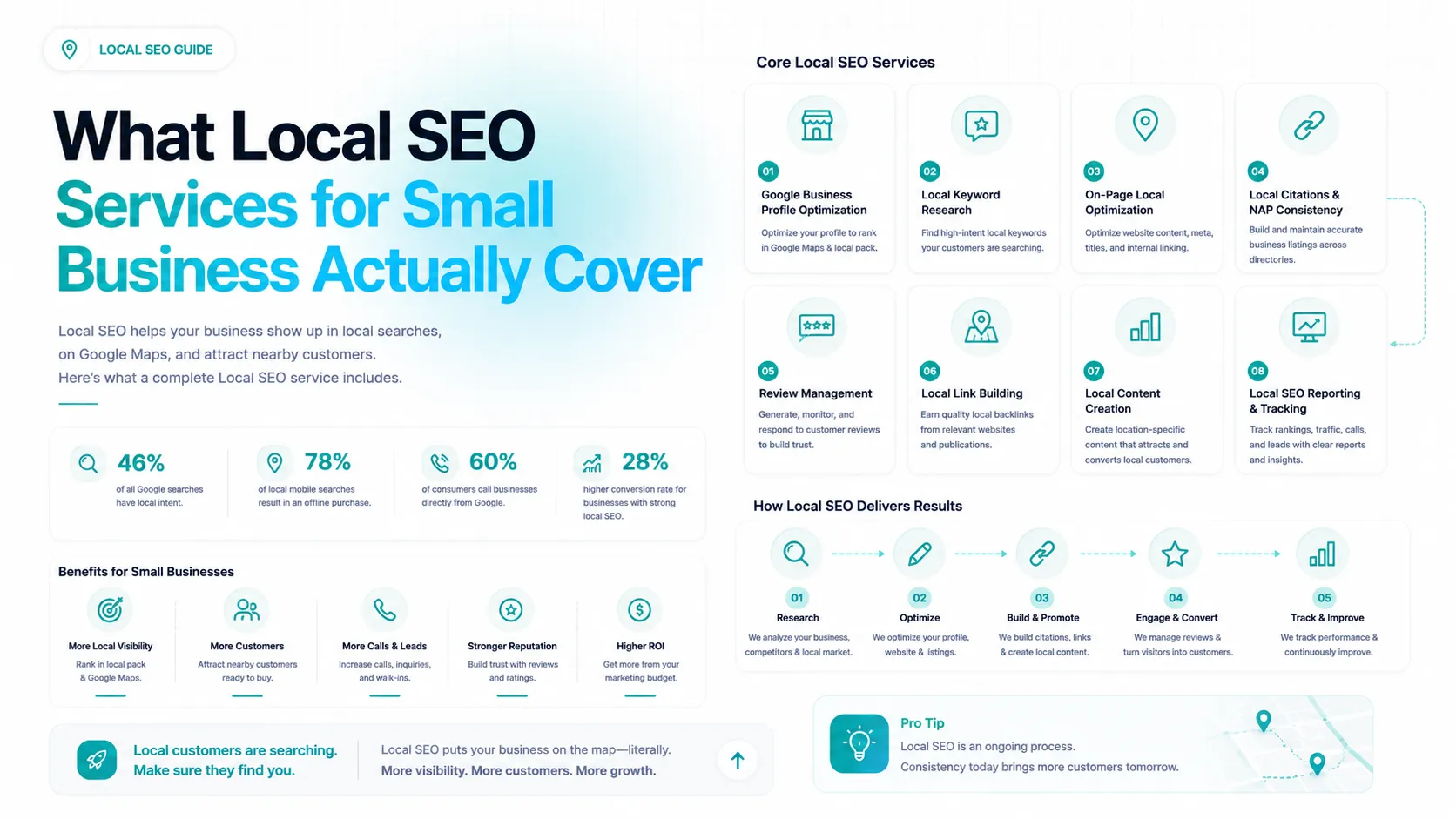
When people say local SEO, they usually mean a bundle of tasks aimed at getting your business found by people searching nearby. This includes claiming and optimizing your Google Business Profile, building consistent citations across directories, collecting and responding to reviews, and publishing content tied to your service area.
None of this is complicated on its own. What makes it hard is doing all of it consistently while running an actual business. That is usually why owners look for outside help instead of managing it piece by piece themselves.
Some owners assume this only applies to certain industries, like restaurants or home services. In practice, almost any business with a physical location or a defined service area benefits, from dentists and accountants to boutique retail shops. The tactics shift slightly by industry, but the underlying goal stays the same, which is showing up when a nearby customer is ready to choose.
Why This Matters More Than Owners Expect
Most local searches happen with strong intent. Someone typing "plumber near me" or "bakery open now" is close to making a decision, not just browsing. Google's own guidance on how local search results work confirms that relevance, distance, and prominence are the three main factors behind who shows up first.
If your business is not optimized for these signals, a rival with a thinner offering but a stronger profile can still outrank you. I have watched this happen more times than I can count, and it usually comes down to neglected basics, not anything complicated.
This is also why chasing broad national keywords rarely pays off for a small, local operation. A business with one location competing for a generic industry term is fighting a battle it was never built to win. Focusing on the local signals search engines actually reward tends to bring faster, more realistic results.
Step 1: Get Your Google Business Profile Right
This is the single most important piece. I make sure the business name, address, and phone number match exactly across the profile and the website. I pick the most accurate category, fill in every relevant attribute, and upload real photos instead of generic stock images.
A profile that is only half filled out signals low effort to both searchers and to Google itself. This one step alone often produces a visible ranking shift within a few weeks, before any other work even begins.
Step 2: Build Consistent Local Citations
A citation is any online mention of your business name, address, and phone number, whether on a directory, a chamber of commerce site, or an industry listing. Consistency across every citation matters more than the number of citations you have.
I audit existing listings first, fix any mismatched details, then add new citations gradually instead of all at once. Search engines seem to trust information that builds steadily over time more than a sudden flood of new listings appearing overnight.
Step 3: Collect and Respond to Reviews
Reviews influence both rankings and whether a customer actually calls. I ask happy customers directly, right after a good experience, since that is when people are most willing to leave one. I also respond to every review, good or bad, because that response is public and shapes how the next visitor sees the business.
A short, genuine reply does more for trust than people expect. I never use copy-pasted responses, since repeat visitors notice, and so does Google.
I also encourage owners not to fear an occasional negative review. A calm, professional response to a complaint often builds more trust with future customers than a perfect five star record ever could. What matters is how the business handles the moment, not that a bad review exists in the first place.
Local SEO Services for Small Business: DIY vs Hiring Help
Both paths can work, and the right choice depends on your time, budget, and how competitive your local market already is. The table below breaks down what each option realistically involves.
Before picking one, I ask a business owner how many hours they can realistically spend each week without pulling attention away from the actual business. Local SEO is rarely a one time task, so whichever path is chosen needs to survive busy seasons, not just quiet ones.
Approach | Time Needed | Typical Monthly Cost | Best For |
DIY (owner managed) | 3 to 6 hours per week | $0 to $50 in tools | Solo owners with time to spare |
Freelancer or part-time help | 1 to 2 hours of oversight | $300 to $800 | Growing businesses with a small budget |
Full-service agency | Minimal owner time | $800 to $2,500 | Competitive markets or multi-location businesses |
Hybrid (owner plus tools) | 2 to 4 hours per week | $100 to $300 | Owners who want control but need structure |
I do not think one path is automatically better. A single-location shop in a quiet suburb may never need an agency, while a business in a crowded city market often cannot catch up without dedicated help.
Step 4: Publish Location-Based Content
Generic pages rarely rank well for local searches. I write pages built around specific neighborhoods, service areas, or local events, since this content signals real relevance to both users and search engines. A plumbing company benefits far more from a page about emergency repairs in a specific suburb than a vague page about plumbing in general.
I keep this content useful first. Stuffing a page with city names does nothing if the actual information is thin. I answer the questions a nearby customer would actually ask, then let the location context come through naturally.
I also link these pages back to the homepage and to each other where it makes sense. A cluster of well connected, genuinely useful local pages tends to perform far better than a handful of thin pages published just to hit a keyword count.
Local Ranking Factors at a Glance
Before moving further, it helps to see the pieces side by side. This table lists the ranking factors that matter most and how much attention each one typically needs.
Ranking Factor | Impact Level | How Often to Review |
Google Business Profile completeness | High | Monthly |
Citation consistency | High | Quarterly |
Review volume and responses | High | Weekly |
Location-based content | Medium | Quarterly |
Website loading speed | Medium | Every few months |
I keep a version of this table for each client and revisit it quarterly. It is a quick way to catch a slipping profile or a stale set of citations before it turns into a real drop in visibility.
Common Gaps I See Businesses Leave Open
A lot of local SEO advice online stops at the basics and never explains what to do next. Owners set up a profile, get a few reviews, then wonder why growth stalls. The missing piece is usually consistency and depth, not a lack of effort.
I also see businesses ignore how their content reads to newer search tools. Search is no longer limited to a results page. AI powered assistants and answer engines now pull from business websites directly, and a page written only for old style keyword matching often gets skipped over entirely.
This gap rarely gets addressed in general advice online, since most guides still assume traditional search is the only audience that matters. Small businesses that plan for both today tend to hold their visibility longer than those that only optimize for classic rankings.
Tracking Progress Without Guesswork
I check a handful of numbers every month rather than trying to track everything at once. Profile views, calls generated from the listing, and position for a handful of core search terms tell me most of what I need to know about whether the work is paying off.
Vanity metrics like total website visits can be misleading on their own, since a spike in traffic from an unrelated city does nothing for a local business. I care far more about whether the right people, in the right area, are finding and contacting the business.
Why Content Structure Matters for AI Search Too
This is where I bring in LLMProGen. Local SEO services for small business increasingly need to account for how AI systems read a website, not just how Google's classic crawler does. If your site content is messy, cluttered with code, or hard to parse, it becomes harder for AI tools to summarize your business accurately when someone asks a nearby question.
LLMProGen converts a website into clean, structured, LLM-ready text, which makes it far easier for AI systems to understand what a small business actually offers. Pairing solid local SEO fundamentals with content that LLMProGen has prepared for AI readability is, in my experience, the combination that keeps a business visible as search keeps shifting toward AI-driven answers.
Frequently Asked Questions
How much do local SEO services for small businesses cost?
Costs generally range from a few hundred dollars a month for freelance help to a few thousand for a full agency, depending on competition and scope.
How long before I see results?
Most owners notice early movement within four to eight weeks, with stronger results building over three to six months. Patience matters here, since local rankings tend to shift gradually rather than overnight.
Can I do local SEO myself?
Yes, especially for a single-location business with light competition. Time and consistency matter more than technical skill for most of the work.
Do I need a website to rank locally?
A website helps significantly, since it supports content, citations, and structured information that a profile alone cannot provide.
Final Thoughts
Ranking well in your own neighborhood is not complicated once broken into clear steps. Get your Google Business Profile right, build consistent citations, collect real reviews, and publish content tied to your actual service area. From there, consistency does most of the heavy lifting.
If you want your website ready for how AI search tools read and summarize local businesses, LLMProGen can convert your site into clean, structured text built for that purpose. Try it when you are ready to make sure both search engines and AI assistants represent your business accurately.
Written by
Alex
Creative blogger sharing insights, stories, and fresh ideas.