What Is an Algorithm? A Complete Beginner's Guide


What Is an Algorithm, An algorithm is a finite, step-by-step set of instructions used to solve a problem or complete a task. In computing, it's the underlying logic that powers everything from search engines to AI models — and once you understand the basics, you'll spot algorithms everywhere.
I still remember the first time someone asked me to explain an algorithm in plain English. I froze. I mumbled something about "computer math stuff." Not my finest moment.
Here's the thing: you don't need a computer science degree to understand this word. You just need someone to break it down without the jargon.
That's exactly what I'm going to do for you today.
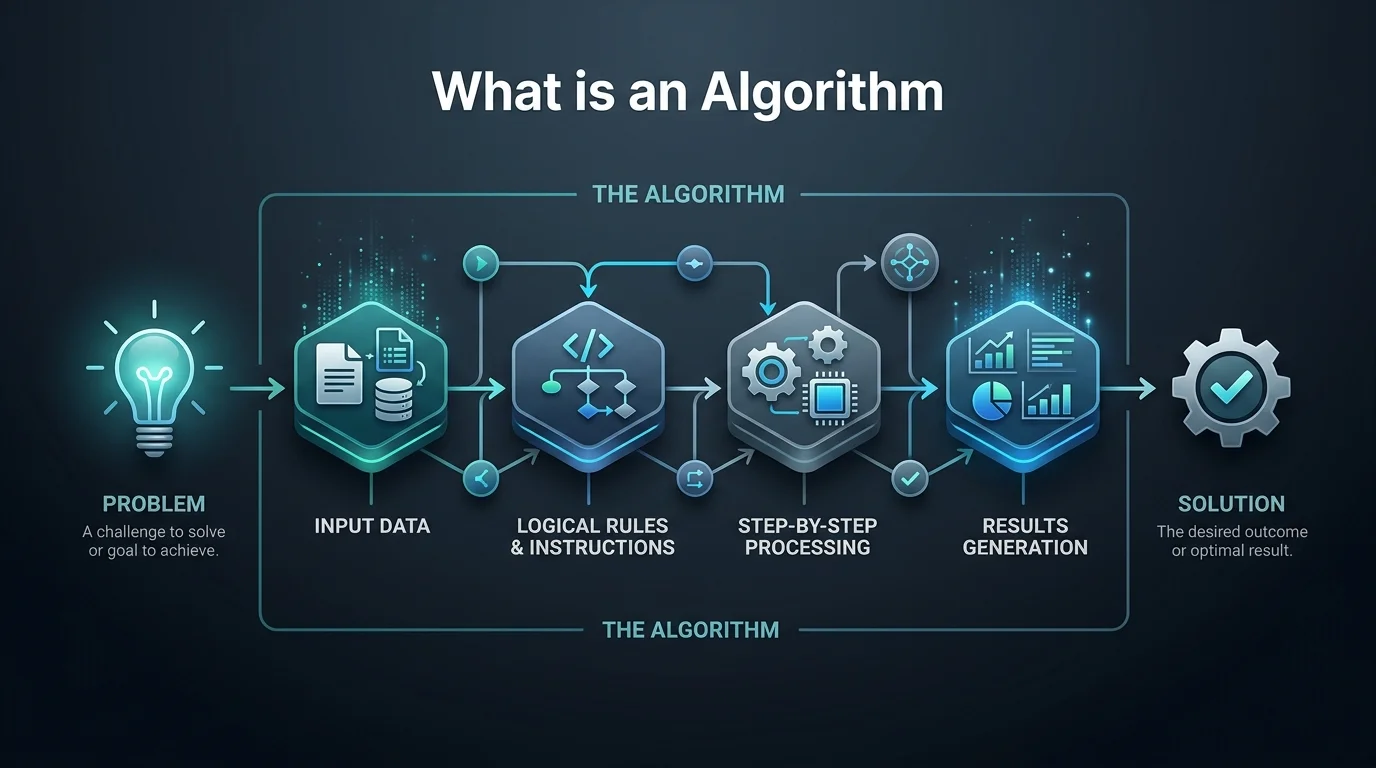
So, What Is an Algorithm, Really?
Let's start simple. An algorithm is a set of step-by-step instructions designed to solve a problem or complete a task.
That's it. That's the whole idea.
You already use algorithms every single day. Making coffee? Algorithm. Tying your shoes? Algorithm. Following a recipe? You guessed it — algorithm.
In computer science, though, an algorithm gets a little more specific. It's a finite, unambiguous sequence of instructions that a computer follows to solve a well-defined problem. No guessing. No "kind of." Just clear, precise steps from start to finish.
And honestly? Once it clicked for me, I couldn't unsee algorithms everywhere — in my Google searches, my Spotify recommendations, even my GPS rerouting me around traffic.
If you're curious how this connects to other core web building blocks, it's worth also understanding what a URL is — another simple "what is" concept that quietly powers everything online.
Why Should You Even Care About Algorithms?
I get it. This might feel like a "nice to know" topic rather than a "need to know" one.
But stick with me.
Algorithms quietly run the world you live in. Every time a search engine algorithm ranks a page, or a recommendation algorithm suggests a show you end up binge-watching, there's a set of rules working behind the scenes.
By 2026, algorithms sit even closer to your daily life than they did a few years ago — the same logic-driven structure powers modern generative AI tools, chatbots, and content ranking systems. Understanding the basics genuinely helps you make sense of that world, whether you're:
Learning to code for the first time
Trying to understand how artificial intelligence actually works
Curious about why your social media feed looks the way it does
Studying for a computer science class (been there)
Once you get the basics, a lot of confusing tech concepts suddenly make a lot more sense.
Where Does the Word "Algorithm" Even Come From?
Okay, this part is genuinely one of my favorite tech history facts.
The word traces back to a real person: Muhammad ibn Musa al-Khwarizmi, a Persian mathematician who lived from around 780 to 850 CE during the Islamic Golden Age.
Al-Khwarizmi wrote a book that was later translated into Latin as Algoritmi de numero Indorum. His Latinized name — Algoritmi — eventually morphed into the word we use today: algorithm.
Fun bonus fact: the word algebra also comes from one of his other works. Two massively important math words, one guy. Not bad for the 9th century, right?
Fast forward a thousand-plus years, and Alan Turing figured out how a machine could actually follow algorithmic instructions to solve complex problems. That breakthrough basically kicked off the entire computer age.
Wild how a medieval Persian scholar and a 20th-century codebreaker ended up shaping the exact device you're reading this on right now.
The Core Properties of a Real Algorithm
Not every set of instructions counts as a true algorithm. According to GeeksforGeeks, a legit algorithm needs to check a few boxes:
1. Clear and Unambiguous Steps
Every single step needs to be crystal clear. No vague "kind of do this" instructions allowed.
2. Well-Defined Inputs
You need to know exactly what data goes in before anything happens.
3. Well-Defined Outputs
The algorithm has to produce a specific, expected result. Otherwise, what's the point?
4. Finiteness
Here's a big one — the algorithm must terminate after a finite number of steps. It can't run forever. If it does, something's broken.
If you're building your own algorithm someday (hey, it happens), keep these four rules taped to your monitor.
How "Good" Is an Algorithm? A Quick Word on Efficiency
Here's something a lot of beginner guides skip entirely.
Not all algorithms that solve the same problem are equally good. Some are fast. Some are painfully slow once your data gets big. That's where time complexity and space complexity come in.
Developers usually measure this using something called Big O notation — a way of describing how an algorithm's runtime or memory use grows as the input grows.
You don't need to memorize the math to get the concept. Just think of it this way:
A fast algorithm stays quick even with huge amounts of data.
A slow algorithm might work fine on 10 items but crawl to a halt on 10 million.
This is exactly why algorithm efficiency matters so much in real products — like search engines that need to sort billions of pages in milliseconds.
Algorithm vs. Program: What's the Difference?
I used to mix these up constantly. Let me save you the confusion.
An algorithm is the general, step-by-step logic for solving a problem. A computer program is the specific implementation of that algorithm, written in an actual programming language like Python or JavaScript.
Here's a simple side-by-side to make it stick:
Concept | What It Is | Example |
|---|---|---|
Algorithm | The general logic or plan for solving a problem | "Sort the list from smallest to largest" |
Program | The actual code that implements the algorithm | A Python function using |
Code | The specific syntax written in a language |
|
Same core idea, three different layers. The algorithm is the recipe. The program is you actually cooking the meal in your kitchen, using your specific pots, pans, and ingredients.
How Are Algorithms Actually Expressed?
You might be wondering how someone even writes an algorithm down before it becomes code.
Good question.
According to TechTarget, algorithms can be expressed in a few different ways:
Natural language — rare, since it's often too ambiguous
Pseudocode — a simplified, code-like outline
Flowcharts — visual diagrams showing the flow of logic
Control tables — structured tables mapping conditions to actions
Programming languages — the final, executable version
Most developers start with pseudocode or a flowchart before writing actual code. It's like sketching before painting — it saves you from a lot of headaches later.
Common Types of Algorithms You'll Run Into
Two categories come up constantly, especially if you're learning to code:
Sorting algorithms — these organize data, like bubble sort, merge sort, and quick sort.
Searching algorithms — these find specific data, like binary search and jump search.
Beyond that, algorithms power everything from machine learning models to cryptography, data compression, and even bioinformatics. Seriously — there's barely a corner of modern tech that algorithms don't touch. If you're building content strategy around this shift, our breakdown of 31 AI & SEO terms you should know is a great next read — algorithms show up constantly in that world too.
A Quick Step-by-Step: How to "Think" in Algorithms
Want to start thinking algorithmically? Here's a simple process I use:
Step 1: Define the problem. Be brutally specific about what you're solving.
Step 2: Identify your inputs. What data do you actually have to work with?
Step 3: Break it into small steps. Don't skip ahead — write out every single action.
Step 4: Check for logical gaps. Would a total beginner get confused anywhere?
Step 5: Define the output. What does "done" actually look like?
Step 6: Test it mentally (or on paper). Walk through your own steps like a computer would.
Do this a few times, and algorithmic thinking starts to feel natural. Promise.
Frequently Asked Questions
What is an algorithm in simple terms?
An algorithm is just a clear set of step-by-step instructions for solving a problem — like a recipe, but for computers (or brains).
Is an algorithm the same as AI?
No. Artificial intelligence is a broader system that can learn and adapt, while an algorithm is a fixed set of instructions. AI actually relies on algorithms to function — algorithms are the building blocks, not the whole system.
What are the 4 properties of a good algorithm?
Clear and unambiguous steps, well-defined inputs, well-defined outputs, and finiteness (it must eventually stop).
What's the difference between an algorithm and a program?
An algorithm is the general logic for solving a problem. A program is the actual code that implements that logic in a specific programming language.
Why is it called an "algorithm"?
The word comes from al-Khwarizmi, a 9th-century Persian mathematician whose Latinized name, "Algoritmi," eventually evolved into "algorithm."
Quick Recap
Before you go, here's the core of everything we covered:
An algorithm is a finite, step-by-step set of instructions for solving a problem.
The word comes from al-Khwarizmi, a 9th-century Persian mathematician.
Good algorithms are unambiguous, have defined inputs/outputs, and always terminate.
Algorithms aren't the same as programs — the algorithm is the logic, the program is the implementation.
Efficiency (measured via Big O notation) determines how well an algorithm scales.
Algorithms quietly power search engines, recommendation systems, and modern AI tools.
So next time someone throws around the word "algorithm" like it's some intimidating buzzword, you'll know exactly what they mean. And honestly? You might just explain it better than they can.
Written by
Alex
Creative blogger sharing insights, stories, and fresh ideas.